Showing posts with label Fischer. Show all posts

Wednesday, February 25, 2026

The Old Tropes Again

Bobby Fischer in 1962 (credit: Wikipedia)

Edward Winter had noted, for example, in his 'once' article, many cases of unsubstantiated chess stories and rumors. A common target for these rumors is Bobby Fischer. His notorious behavior and, later in life, apparent insanity, made him a common target. 

The following web page, for example, has both suggestions that Fischer's antisemitism was due to his discovery that his presumed father, Hans-Gerhart Fischer, who divorced his mother and abandoned the family, was Jewish. (It is now known that Fischer's biological father was probably Paul Nemenyi. Nemenyi was also Jewish but he took interest in Fischer and helped his mother financially.) This is done without any evidence, apparently on general "Freudian" grounds. 

To add to this, the web page also repeats the story about Bernstein facing being rescued at the last minute from execution after playing a game of chess for his life against the officer in charge, a story that is also doubtful.

This would be understandable if the web page in question was that of a private person or a hobbyist, but the web page belongs to no less than the Museum of the Jewish People, perhaps the most important museum for Jewish history in the world.

Sunday, June 22, 2025

Fischer not Playing in Tel Aviv, 1964

 
Source Chess Life, vol. 19 no. 9, p. 214

Our frequent correspondent, Herbert Halsegger, had recently sent us a significant number of interesting information relating to chess in Israel. One is above: a detailed discussion of Fischer's famous refusal to play in the Olympiad in 1964.  

Monday, November 18, 2024

Some Popular Articles about the Jewishness (or Otherwise) of Chess Masters


Source: see below

It is sometimes not clear whether a certain player is Jewish or not. That depends on one's definition of "Jewish." Bobby Fischer was undoubtedly Jewish according to Jewish law since his mother was Jewish, but there is no need to restate here his well-known antisemitism. On the other hand, Garry Kasparov is not Jewish according to Jewish law, since only his father was Jewish, but he never denied his Jewish origins. One interesting case is that of Vasily Smyslov, who apparently has some Jewish ancestry but was is not, nor claimed to be, Jewish. 

We have noted before on this blog that Palestinian or Israeli chess writers had a tendency to "convert" any player with any Jewish ancestry to Judaism. But has the accuracy improved in the age of the internet? Is the internet used well or badly?  

As a casual beginning, we have looked at two interesting web pages. One of them is Aish (short for Aish Ha'torah, "the fire of the Torah"), the website of a well-known Jewish education and advocacy organization. It has a surprisingly well-researched general article about Jews and chess, as noted in the link given, from which the picture above is taken. In particular, it distinguishes fact from fiction: it notes that the stories about chess in the Talmud are not true, and that the story of a chess-playing Jewish pope is obviously a legend. Still, it is not fully accurate, for example claiming that Smyslov is a Jew. 

Another website is the humorous Jew or not Jew website. The site rates "how Jewish" a person is not just based on Jewish law but on how Jewish they see themselves, based on their public utterances, as well as the obviously subjective "how much we want the person to be a Jew in the first place" due to their achievement, as their "About the Jew Score" page explains. What is surprising is that this light-hearted website actually has most of the facts about Jewish or non-Jewish chess players correct. 

For example, while "blaming" Kasparov for "losing for a computer" which will lead to a future when "we're all enslaved by machines," they are quite correct about his original name and family origin. They are also openly skeptical about Smyslov's Jewishness, noting that "nobody knows for sure" whether he has Jewish ancestry (not quite true - but at least they do not simply assume he is Jewish). They also note that despite rumors about Spassky's Jewish parentage, that is not the case. 

I have deliberately chosen sites whose chess-related articles make no pretensions of being works in chess history, but are intended instead for readers primarily interested in Judaism, not in chess. It is somewhat surprising to see that just here, where one would least expect it, the actual chess history content is reasonably accurate.  

Perhaps, after all, as Edward Winter notes more specifically about Wikipedia in his most recent feature article, "general" chess information on the internet - while still full of dross - at least shows signs of improving, both in the case of specific good articles and in the removal of mistakes that are pointed out. The problem, notes Winter, is that as always, "chess history suffers when Wikipedia entries make do with references to obviously sub-standard sources." 

One example is the article about Spassky in Wikipedia. While the article has over 140 entries, almost all are from other online sources, without any indication to the reader about those sources' reliability. Compare this to what Winter justly calls a "fine article" about Hugh Myers, where the many references are almost all to the original primary sources - or to Winter's own well-regarded web Chess Notes

Saturday, August 31, 2024

Fischer in Reykjavik... in 1961


Source: Chess Life, vol. 16 no. 2 (February 20, 1961), p. 37

Mr. Herbert Halsegger notifies us that Fischer was in Iceland, winning in Reykjavik... already in 1961, in a small round-robin tournament against the Icelandic players, including the GM Fredrik Oalfsson. 11 years before his rather better known victory against GM Boris Spassky in the same location... 

Wednesday, June 12, 2024

Bobby and Friends


Source: Chess Review, December 1956, p. 375

Herbert Halsegger notifies us of the "Game of the Century" issue of Chess Review, featuring Bobby Fischer (then 13) at play, with other famous chess friends, of which one was no other than Edward Lasker. Reshevsky is also mentioned. 

It was in this issue that Fischer's famous "game of the century" against Donald Byrne was published, with the cover amazingly showing Fischer just before he played the famous 17...Be6!! that won the game. Apparently, this is not a re-enactment, as noted in the following chessbase article: The game that shook the world | ChessBase.  

Chess Booms


Source: Nu, March 2012, p. 28

Our frequent correspondent Herbert Halsegger notes an article from a Jewish magazine for politics and culture about the chess boom in Israel in 2012 when Boris Gelfand played for the world championship with Viswanathan Anand

This made us think about previous chess "booms." The recent one due to The Queen's Gambit is well known (and still ongoing) and so was the Fischer boom in the USA after Fischer won the world championship in 1972. 

Are there any other examples of such "booms" in history? Did chess, for example, become noticeably more popular after the first international chess tournament, London, 1851? 

Friday, January 19, 2024

Computer Chess

Source: www.chess.com

Chess, a timeless game that transcends borders and cultures, has found a significant place within the Jewish community. Beyond being a strategic pastime, chess has woven itself into the rich tapestry of Jewish history, culture, and intellect. In this blog post, we'll explore the enduring legacy of Jews and chess, tracing its roots, examining notable figures, and contemplating the symbolic resonance that the game holds within this community.

The history of Jews and chess is a tale of intellectual resilience and cultural prominence. Chess, often referred to as the "game of kings," found itself embraced by a community known for its commitment to education and intellectual pursuits. From the streets of medieval Jewish quarters to the salons of contemporary Jewish intellectuals, chess has been a cultural beacon, reflecting the strategic acumen and love for intellectual challenges within the Jewish tradition.

Chess is a game of tactics, strategy, and foresight. In many ways, the chessboard becomes a metaphor for the challenges and triumphs of Jewish history. Whether navigating the complexities of diaspora life, facing adversity, or contributing to the fields of science and the arts, Jews have often drawn parallels between their experiences and the moves on a chessboard. The game becomes a symbolic reflection of the intricate dance between tradition and adaptation.

Throughout history, Jews have made significant contributions to the world of chess. Akiba Rubinstein, one of the strongest chess players of the early 20th century, left an indelible mark on the game. His strategic brilliance and innovative playstyle have inspired generations of chess enthusiasts.

Another prominent figure is Grandmaster Bobby Fischer, whose Jewish heritage became a notable aspect of his identity. Fischer's prodigious talent and eventual rise to become World Chess Champion in 1972 captured the imagination of the world and further cemented the connection between Jews and chess on the global stage.

Jewish literature and art have also embraced the symbolism and narrative potential of chess. From Isaac Bashevis Singer's stories to the works of Jewish artists, the chessboard often appears as a backdrop for exploring themes of strategy, intellect, and the unfolding drama of life. It becomes a metaphorical stage where characters grapple with their destinies, much like the moves of a carefully orchestrated chess game. 

Chess education has become an integral part of many Jewish communities. Schools and organizations recognize the cognitive benefits of chess, promoting it as a tool for intellectual development. The game fosters critical thinking, patience, and discipline—all values that resonate deeply within the Jewish cultural ethos.

The relationship between Jews and chess is a compelling narrative of intellectual prowess, cultural resonance, and the enduring spirit of a community. As the chess pieces move across the board, so too does the rich history of Jewish contributions to this game. Whether seen as a metaphor, a source of inspiration, or a tool for education, the enduring legacy of Jews and chess continues to shape the narrative of both the game and the community that has embraced it throughout the ages.

(I hope you forgive my little joke. This is indeed computer chess -- that is, computer writing about chess. This is ChatGPT's reply to a request to write a blog post about Jewish Chess History.)

Wednesday, December 27, 2023

Isador Turover

Source: Sunday Star, 19 January 1936, B-11

The above photo is from a long article in the Sunday Star (the Sunday supplement of the Evening Star) brought to our attention by Herbert Halsegger. It has a good photo of Isador Samuel Turover, an American-Jewish master with particular connections to Vladimir Sournin and Frank Marshall. A chess philanthropist and organizer as well as a player, he among other things sponsored Bobby Fischer's attendance in the 1962 Stockholm interzonal.  

Saturday, May 6, 2023

Chess and the Nobel Prize for Literature

Credit: see below

There is, of course, no Nobel prize for chess. But chess appears in the work of Nobel prize winning authors. The most famous example is, of course, Stefan Zweig's The Royal Game. But a lesser-known example is Elias Canetti's Auto-da-Fe, which features the chess-playing dwarf Fischerle as a major character. By the way, there is no relationship to Robert "Bobby" Fischer -- the novel was published in 1935. 

Above is the cover page of the Hebrew edition (1979: Zmora-Bitan), which has an obvious chess motif. It is named Sanverim [The Blinding], a literal translation of the original German title, Die Blendung

P. S.

Nabokov's The Defense is perhaps better known, but Nabokov never won the Nobel prize... 


Saturday, April 23, 2022

A Caricature for a Single Move


The above cartoon, by "Meir," from Davar, 30 April 1951, p. 24, is unusual. It comes to illustrated, not chess in general, nor even a particular player or game, but a specific move - 21. c6! - by Ernst Fischer in his 2nd round victory against Oren in the 1951 Israeli championship. 

The game is: 

Fischer, Ernst - Oren, Menachem

Gruenfeld Defense [D96]

Israeli Championship, 1951, rd. 2.
 
Source: see above

1. d4 Nf6 2. c4 g6 3. Nf3 Bg7 4. Nc3 d5 5. g3 O-O 6. Qb3 dxc4 7. Qxc4 Be6 8.Qa4 c5 9. dxc5 Nbd7 10. Be3 Nd5 11. Nxd5 Bxd5 12. Rd1 Bc6 13. Qa3 Qc7 14. Bg2 Ne5 15. Bf4 Rfc8 16. Bxe5 Bxe5 17. O-O Bf6 18. Rd2 e6 19. Qe3 Bd5 20. Rc1 b6 


21. c6 Bxc6 22. Nd4 Bxd4 23. Qxd4 Qb7 24. Rxc6 Rxc6 25. Rc2 Rac8 26. Qe4 Rxc2 27. Qxb7 Rc1+ 28. Bf1 Rd8 29. Qxa7 Rdd1 30. Qxb6 Rxf1+ 31. Kg2 Rfd1 32. a4 Rd2 33. a5 Rb1 34. b4 Rdb2 35. a6 Rxb4 36. Qd8+ Kg7 37. a7 1-0

Friday, December 31, 2021

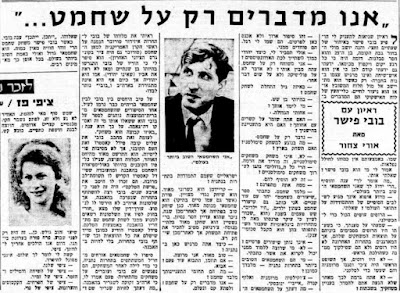
A Fischer Interview, 1968


Moshe Roytman notifies us that Al Ha'mishmar, 1.7.68, p. 2, has an interesting interview with Robert "Bobby" Fischer by Uri Tzahor [ph. spelling]. 

Some interesting notes is that Fischer claim to make his living from the royalties from his books and his chess column in Boys' Life (see the link for Edward Winter's article on the subject). Fischer notes in particular that he does not give chess lessons or play simultaneous games, which "did not help" those masters who gave them. Fischer "forgot," notes Tzahor, his tournament appearance fees or winnings. 

Fischer arrived two an a half hours late to the interview, and to the first question, "Who is Bobby Fischer?" he replied, "the world's best chess player." Given Fischer's later well-known antisemitism (or perhaps paranoia), it is noted that not only did Fischer agree to play in Netanya, but also was satisfied with the conditions and was willing to come again.

He explicitly declines to discuss anything except chess, in particular refusing to answer Tzahor's incautious question about "how a Jew like you can join the Adventists sect?" He blames the Soviets for collaborating against him out of fear. He ended the interview when Tzahor asked what he no doubt considered an intrusive question, "what are you interested in except for chess?" 

In a coda to the interview, Tzahor adds his own thoughts. He notes that Fischer likes Fidel Castro and the Cuban people in general - not for political reasons, but due to the warm reception he received there and the legal loophole which allowed him to legally play in Havana, 1965, through telex, despite the American embargo. 

Tzahor also adds one of the stories about Fischer's alleged ignorance anything except chess. He claims that "soviet players like to tell" that when Vasco da Gama was mentioned in his presence, Fischer asked "what team does he play on?" Whether this story is factual or not, I make no judgment. 

Saturday, September 11, 2021

A Porat Interview, a Najdorf Quip, and a Nimzowitsch Story

From an interview with Yosef Porat by Yosef "Tommy" Lapid, Ma'ariv, Oct. 19th, 1962, p. 11, brought to our attention by a frequent correspondent:

Botvinnik is very modest and doesn't demand special treatment... Bobby Fischer the American is the exact opposite: incomparably vain, a show-off. Success had gone to his head...

Najdorf lost to Fischer in the [1962] Olympiad. After the game, in which he blundered, I've heard him say: 'I always told myself there's only one chess player I need to fear - Najdorf.'

Nimzowitsch once played in an international tournament against an old English player and got into difficulties. He muttered [in Yiddish]: 'this alter ganef [literally, 'old thief'] tricked me after all...' the English player understood the entire sentence except for the word ganef [thief] but all present didn't want to explain it to him. So finally he asked if a ganef can be a gentleman or not.

The last anecdote was shared by Porat in good faith, but unlike the other two, he was of course not a witness. Is there any proof of the actual occurrence of this 'once' story? 

We are skeptical. First, Nimzowitsch is the subject of quite a few such 'once' stories. Second, the opponent and occasion are not specified. Third, we have read at least one other version. In it, Nimzowitsch himself, and not all present, does not want to explain what ganef means. It is added that he quickly agrees that, yes, a ganef can be a gentleman, calming the English player. 


Monday, August 2, 2021

Beginning, End, and Fischer


The same correspondent which we just mentioned in the previous post had also notified us of two newsreels made in Israel of the 1964 Tel Aviv Olympiad: one of the start and one of the end of the tournament. He also provided us with a clip of the 1968 Netanya tournament, with - naturally - concentration on Fischer's participation. 


Saturday, July 14, 2018

Czerniak about the 1951 Championship, and Prizes

 4 .Source: Al Ha'Mishmar 6/4/1951 p
In Al Ha'Mishmar, Czerniak gives an interesting view of the 1951 championship. Before this, the editor, Eliyahu Shahaf, adds that the tournament took a long time -- two months -- as opposed to the Passover, 1939 tournament where the "Lasker" club organized six tournaments in one weekend. 

He then publishes a long interview with Czerniak. The latter overviews the strengths and weakenesses of the players, noting that, overall, is a 'second level international tournament', comparing it to Venice, 1947 (won by Tartakover) or the Hastings tournaments in England.

One of the reasons the tournament took long is that the games were played in many locations. The result was a large number of special prizes. As Shahaf notes in the same column:


Oren also won the beauty prize for the second round in Haifa (against Czerniak) and for the best result in the last five rounds (4 out of 5). Kniazer won a prize for the most beautiful game for the first round in Haifa (against Glass) and Smiltiner -- the beauty prize for a game in Hadera (against Fischer), and Braun -- the beauty prize for a game in Rishon Le'Tziyon (also against Fisher). Glass also won a special prize for the shortest game (23 moves, against Braun). The overall beauty prize was won by Dobkin for his game against Mandelbaum.

This makes for five beauty prizes, a special prize for the shortest game (presumably, the shortest decisive game), a prize for best performance in the last five rounds, as well as (as Davar reports, April 6th, 1951, p. 12 of the weekly supplement) five "regular" prizes for overall placement as 1st to 5th. making it a total of eleven prizes for an 13-person tournament, or -- since (as Davar reports) the fifth prize was shared by three players, 13 prizes in a 13-person tournament. 

Monday, August 7, 2017

Chess on Stamps: Ourania(?) and Burundi(!)

Credit: micronation wiki

One side-issue of this blog is chess on stamps, as can be seen on the list of topics on the right. This time the stamps have nothing to do with Jews in particular, but they are a truly weird incident.

The "Kingdom of Ourania" issued a stamp celebrating the secret chess champion of the world, the man with the highest chess rating ever -- Stan Vaughan. This stamp is above.

Vaughan is, of course, no real chess champion. The above claims about his feats are true only according to himself; in reality, he is a crank who believes himself the "real" successor to Bobby Fischer, a claim accepted by nobody but himself, among other reasons because his actual chess level is at best that of a good amateur.

Nor is the kingdom of Ourania (which apparently claims for itself a sizable chunk of Antarctica, as per its web site) a real nation. If you haven't heard of this kingdom, it's because it's one of those fake nations created by cranks for various reasons - especially to avoid taxes, declare themselves "sovereign", make themselves kings and lords, demand diplomatic immunity, and so on (in fairness, sometimes the "declaration of nationhood" is tongue-in-cheek, as the link notes). Ourania is no more a nation than Vaughan is world champion.

Cranks giving each others fake honors, in this case a fake stamp of a fake nation honoring a fake chess master, would not merit a post about chess stamps all by itself, even if it surely is the weirdest chess stamp ever -- because it is not a genuine stamp. But the truly absurd thing here is that the Vaughan-featuring Ourania "stamp" is actually based on a real stamp.

Somehow, Stan Vaughan was chosen by Burundi to be featured as one of four 'chess masters' on a set of stamps it issued (picture from this link), together with those of the genuine chess champions Emanuel LaskerPaul Morphy, and Alexandra Kosteniuk.

Credit: 'Chess for all Ages' blog

How this had happened, I cannot imagine. There are cases of relatively weak or unknown players, such as Willi Schlage, on stamps (in his case Mali). There are also cases of players, such as Ray Keene, accepting dubious or outright fake honors. But at least in those cases the players are or were genuine masters, if not necessarily world-championship class. Vaughan's Burundi stamp is surely the only case where a fake master is given a genuine chess honor of this sort.

Saturday, March 26, 2016

A Snapshot

Who, exactly, were the masters, or international masters, or gradnmasters, etc. in Israel in the 1950s? Wonder no more: the complete list was, helpfully, given by Moshe Czerniak in first issue of 64 Mishbatzot (Feb. 1956, p. 17):
Source: see above
It is noted how these include the "old guard" who was in Palestine before the war (Porat, Czerniak, Barav, Knaizer, Mandelbaum, Macht, FischerDobkin, Beutum, and Smiltiner and Blass-- we are using Gaige's spelling), but also the new arrivals, AloniDyner, and Oren, as well as new blood, in particular, Perstiz. This did not mean other talented players did not exist; only they didn't yet have time to gain titles.

This is listed in the same page has an article by a visitor, Saul Wachs (USA), who notes how chess advanced in Israel and, in particular, its popularity in the kibbutzim and other agricultural communes, not just in the large cities.

Tuesday, July 14, 2015

Romrandom Chess

Credit: see below

Gdali Roisman brings to our attention the following suggestion 'for a new array'. It was published in Shachmat vol. 6 no. 3 (March 1967), p. 102. It was the suggestion of Meir Rom, and given the same reasons as other such suggestions, to wit, the "theory death" of chess.

Rom offers the new array tentatively, and suggests that players 'who are sick of playing by the book until the 20th move' will benefit from it. He notes the array doesn't change the rules (apart from the abolition of castling) or pieces, thus not requiring a change in middlegame or endgame strategies, or the production of new sets. The castling move is, of course, canceled in this array, but there are no other changes to the rules.

The array is interesting, being deliberately asymmetrical. presumably, to give play a more tactical, castling-on-opposite-sides character right from the start. The rooks and bishops, too, seem to start in a prima facie better, more active, position than in the orthodox game. This is unlike most suggestions for unorthodox starting positions, such as Fischer's "random chess" suggestion.

By the way, Tim Krabbe and others noted (though I cannot locate the exact place right now) that Fischer was hardly the first to suggest such a new array. Bronstein, Gulko, and others did, as well as Maarten van 't Kruijs in the 19th century, and the idea (as the article in the link notes) goes back further, to the 18th century. Van 't Kruijs was unorthodox in more ways than one: the "reverse French" (1. e3) is called the van 't Kruijs opening.

Such randomization comes readily to mind for those who wish to create a chess variant, as it requires no new rules, pieces, or boards, and is very easy to set up once the idea occurs to one. I won't be all surprised if Arabic (Shatranj) or even Indian chess was occasionally played in such a randomized fashion, for variety's sake.

Wednesday, July 1, 2015

A Fischer Letter


Credit: see below.

Above is a scan (both sides) of a letter sent by Bobby Fischer to the Israel Chess Federation, provided to us by Yoram Lubianiker. He adds that, while the date of the cancellation stamp is not clear, the stamp on the bottom right was issued in Nov. 3rd, 1970, which means that is the earliest date the letter could have been sent.

Fischer (after his participation in Netanya 1968) was invited to participate in a tournament in Israel by the ICF again, but politely declined, noting he is devoting all his energies to the conquest of the world championship. This, Lubianiker learned from person conversation from a source in the ICF which I also know, and who I know from personal experience wishes not to be named on the Internet.

Saturday, November 29, 2014

Chess Lapel Pins

Credit: Moshe Slav's collection
Above is a collection of lapel pins of the world champions from Steinitz (top left) to Kasparov (bottom right), if I am not mistaken. Tal and Capablanca are a bit hard to recognize, at least for me (though the names appear on the pins themselves). Like stamps, lapel pins are an entire world (my late grandfather, for instance, had a whole collection of them), made to signify membership in just about any organization or to commemorate just about any event. Connection to Judaism? Well, Steinitz, Lasker, Botvinnik, etc. ...

Wednesday, October 22, 2014

Chess and Stamps -- Ashdod 2006


Credit: from the collection of Moshe Slav.
Here are two segments of a envelope (limited to 1000 units) that was produced by the Israeli postal office to celebrate the 3rd International Chess Festival in Ashdod, 2006.

If one wonders about why so many strong tournaments happen to take places in Be'er Sheva (see previous post), Ashdod, and other cities in southern Israel, the explanation is interesting. Those cities, where rent and cost of living is relatively low, became the home to many Jewish emigrants from the former USSR in the 1990s, which led to a huge increase in chess quality, as Ha'aretz [link in Hebrew] explains. In fact, Be'er Sheva in 2005 had the highest concentration of chess grandmasters relative to the population in the world

True, such statistics are not particularly meaningful, since the addition or subtraction of a single GM changes the ranking, GMs being (despite their "inflation" in recent years) quite rare, and the "highest proportion" having more to do with the city's small population than the large number of grandmasters. There are many more grandmasters in total in, say, New York, to say nothing of Moscow or St. Petersburg... 

Still, it does mean something -- eight grandmasters (in 2005) in a town of about 200,000 is quite impressive, especially as it is, in this case, indicative of a high level of chess activity on all levels, as an article in chessbase web site about the Be'er Sheva Chess Club notes. The same article, incidentally, noted that currently Be'er Sheva had been passed by Reykjavik -- another small city with a well-known chess history, of course, as anybody who has heard of Fischer or Spassky knows...