Showing posts with label FIDE. Show all posts

Saturday, September 28, 2024

Graves of Non-Masters


Above is a photo I took of the grave of Vladimir Ze'ev Shteinberg, 1965-2024. He is buried in the Ganei Ester Cemetary, Rishon LeZion, Israel. He was not a chess master, but he was a good amateur player, with a FIDE rating of 2180. He also held the Israeli chess rank of senior candidate master, according to his ICF player's page (in Hebrew). 

Graves of chess masters often have a chess theme, as Edward Winter's article on the subject shows. But I am not aware of many graves of non-masters having such a theme. Does any reader know of similar chess motifs on the graves of non-masters? 

Monday, August 29, 2022

Yosef Retter, 1934-2022


The Israeli Chess Federation notifies on its web page (in Hebrew) that Yosef Retter, an international master of chess composition, had died on August 20th. The article has a very good photo of him and a very nice two-mover, a field in which he specialized. 

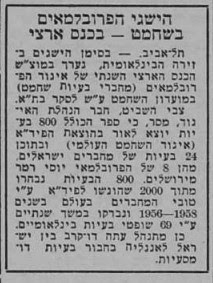
Above, we have a note from La'merchav (5 Devember 1960, p. 4) about what is probably Retter's first international appearance. It notes, under the headline "Israeli Problemists' Achievements - in a National Conference," that the 1958-1958 FIDE album, which has 800 problems of the best composers in the world, includes 24 problems by Israeli composers, include eight by Retter. We thank a frequent correspondent for notify us of this article. 

Saturday, April 27, 2019

Czerniak the Palestinian

Source: Davar's weekend supplmenet (Dvar Ha'Shavua), 27/7/1951, p. 14. 
Above, we have a clip from the chess column in Davar, noting Czerniak's victory in the 1951 Reggio Emilia tournament in Italy. We thank a frequent contributor to this blog for the information. The column notes that he was also awarded the IM title by FIDE, and that this victory is the first victory of an Israeli player in an international chess tournament. 

The column adds a letter from the Israeli consul there, Israel Eshel, who notes that the local press refer to Czerniak as a 'Palestinian', and only after he and the consulate protested that this was correct to 'Israeli' in the press. We add that, before the establishment of the state of Israel in 1948, 'Palestinian' was the usual term used in English and other languages for Jews who lived in what was then the British Mandate of Palestine.

The column also wonders how to use Czerniak's winning to get funding for the ICF, in the only practical way many organizations in Israel at the time could gain any funding, to wit, with government assistance. The key issue is who will be the next minister of education after the elections, it is noted.

Saturday, March 17, 2018

Marcuze Reporting from Holland

Source: Al Ha'Mishmar, Oct. 23rd, 1947, p. 3
Yochanan Marcuze, points out our frequent correspondent, was the representative of the Palestinian Chess Federation in the FIDE congress of 1947.

Marcuze first reports on the two tournaments which took place in Hilversum, Netherlands, with Porat representing the Palestinian federation, in the European Zone championship and then in a local tournament, commemorating the 60 years' anniversary of the Hilversum chess club, in which Porat 'took fourth place in his group'.

Marcuze then adds that he was chosen as the Paelstinian federation representative in the FIDE congress of that year (which took place in the Hague) and that he established warm relations with many representatives -- e.g., B. H. Wood asking him about arranging a radio chess match between England and Palestine.

Marcuze adds in particular the importance of the massive amounts of chess literature brought by the different delegations, and especially the 'heart-rending' books of game collections by victims of the Nazis, 'among them, needless to say, many Jews' -- and notes the old-timer Maroczy was also present. 

He ends with noting his visit to England, where many players, especially Jewish ones, showed great interest in chess in Palestine, and the Jews in particular look at Palestine 'with love and longing'.

Saturday, August 17, 2013

Oren vs. Gelfer

Source: Davar, Dec. 17th 1954, p. 14

A frequent correspondent to our blog noted that in 1954, the ex-Israeli champion, Menachem Oren, played a simultaneous game in the Emmanuel Lasker club in Tel Aviv 'last saturday' (i.e., Dec. 11th) against 24 players, 'mostly youth of level Aleph [at the time, the rough Israeli equivalent of 'candidate master' or 'expert' level in other countries -- A.P.]. The result was (from Oren's point of view) +14 -4 =6. The interesting point? One of the winners, then a nine-year old, was Israel Gelfer -- currently FIDE's vice president and for a long time the holder of numerous important posts in both Israeli chess and FIDE.

He is, by the way, an FM with a rating of about 2350, as well as an international arbiter, international organizer, and senior trainer. All of these are, incidentally, are official FIDE titles showing real achievements and the compliance with stringent standards, not honorary descriptions.

Tuesday, November 29, 2011

Antisemitism in Chess, Part II

An addition to the story of the Maghami - Shahar game in Corsica, which the Iranian GM (Maghami) forfeited rather than play an Israeli, is found in the following chessvibe analysis, which I encourage all to read. It turns out that Maghami played all other Jewish players and even openly declared he had nothing personal against Israeli players (an act of courage on his part), but that he had no choice but not to play. Often, such excuses -- "I have nothing personal against Jews, but..." -- are just antisemitism in a flimsy disguise (much like "I have nothing against blacks, but...", etc.). In Maghami's case, however, knowing the character of the Iranian regime, it is clear he really did have no choice but not to play and really has no personal animus against Jews or even Israelis. This is not an uncommon situation: as Geurt Gijssen notes (quoted in the chessvibe article), usually such restrictions on playing come from the governments involved, not from the players.

Again, there is antisemitism here, but it is (as noted in the chessvibe column) it is usually by the governments, not by the players. It is a no-win situation, both for the players and for FIDE. If FIDE keeps the pairing and forces players to forfeit, they are punished through no fault of their own. If FIDE changes the pairings, one is encouraging such behavior (by the governments, not the players) and undermines FIDE's motto of Gens Una Sumus. My own view is that FIDE should never allow such re-pairings. If a country wishes to boycott another country, it should know it is violating FIDE's motto and that there should be consequences to this action. (Then again, perhaps it actually enhances FIDE's motto, which means in Latin "we are one family". Everybody knows of families where siblings hate each other's guts and won't talk to each other...)

It is true, of course, that not all political boycotts are morally equal. It is one thing for two countries in war to refuse to play each other, as sometimes happens. It is quite another thing to boycott Israel because one refuses to recognize its existence and as part of a plan to wipe it off the face of the Earth, as Iran's government does. However, it should not be FIDE's role to be a moral arbiter and declare which country is good and which country is bad. Quite apart from the very real risk of such "moral" declarations by FIDE bureaucrats becoming just another political tool, the simple fact is that FIDE exists, as Edward Winter pointed out in C. N. 1712, 'to organize chess, not court-martials against those with objectionable opinions'. Certainly boycotting, say, Nazi Germany in 1939 was justifiable; but it would be petty and unmanly for those who did it to demand that, since their boycott is morally right, they should not suffer the forfeit of a chess game as a consequence.

Friday, July 23, 2010

"A Dream Come True"

Garry Kasparov in the fundraiser. Photo Credit: Shahr Tzafrir.

Shahar Tzafrir, an Israeli hi-tech entrepreneur, has helped launch the fundraiser for Anatoly Karpov's bid for the FIDE presidency, together with chess greats Garry Kasparov and Magnus Carlsen. The story was featured on chessbase's web site, but -- by sheer chance -- Tzafrir is a friend of a friend.

So our mutual friend, who knows my interest in chess, sent me a link to Tzafrir's flickr photostream page -- which, naturally, features many unofficial (but interesting) pictures of the event.

Tzafrir describes it as "a dream come true".

Have a look!

Friday, May 7, 2010

Euwe in Israel and Chess in the Kibbutzim


Max Euwe (right), Eliezer Pe'er, and Euwe'e wife in Israel, early 60s. Photo: Eliezer Pe'er.

GM Max Euwe, world champion and head of FIDE, was a friend of Israel and a man of principle. He insisted on holding the 1976 chess olympiad in Israel, as agreed, despite attempts by the USSR and the Arab world to "steal" the event. As Shlomo Kandelshein notes in his book Chess Olympiad Haifa: 1976, when the Soviets declared it is irresponsible for him to hold the olympiad in an "unsafe country", he replied that he felt quite safe in Israel on his visits.

But Euwe didn't visit Israel only on the occasion of the 1976 olympiad (and FIDE congress). He also visited before, in the early 60s. Above is a photo of Euwe and his wife from that time. Adds Eliyahu Fasher in the Israeli Kibbutzim's Yedion [bulletin], Vol. 13 no. 9, May 1977 (Shavuot [Pentecost] issue of the Jewish year 5733), p. 34:
Prof. Euwe and his friend Prof. Mehring from Holland toured Israel about 15 years ago and visited many kibbutzim. At the end of the tour they wrote an article in La'Merchav [an Israeli newspaper] and noted especially the high level of chess playing there. They explained [this] in the Kibbutz member's need for intellectual stimulation, one of the ways to achieve it being chess.
Euwe was a gentleman in the real sense of the word. Praise from him means quite a bit.

Friday, February 19, 2010

Dubai and Israel -- in Chess


This is by no means a political blog, but it is worth noting that Dubai being up against Israel in the international arena is nothing new. FIDE, despite FIDE's official claim that Gens Una Sumus, had allowed Dubai in 1986 to host the Olympiad, despite the exclusion of Israel.

The history of this event -- how it happened, what Israel tried to do to stop it, what repercussions it had both to FIDE and to the Israeli Chess Federation, how the debacle was used for internal political fights, etc. -- is interesting, and the ICF's archives tell the tale. For starters, see above (from Eliyahu Fasher's archives) the official letter of protest from the ICF to FIDE. It speaks for itself.

(Click on the picture for a higher-resolution version).

Monday, January 25, 2010

Mooooooooooooooo!


FIDE president Kirsan Ilyumzhinov, a leading light in the field of agricultural research. (Photo from wikipedia).

This has nothing to do with Jews, but, looking at chess history, one sees that FIDE used to be a serious body. To show the depths to which FIDE had fallen, I reproduce the following item from its official web site, verbatim.
On December 25, FIDE President, Head of Republic of Kalmykia Kirsan Ilyumzhinov took part in a solemn ceremony of prizegiving in the field of science and technology of the Government of Russian Federation. Among the prizewinners - Kirsan Ilyumzhinov. Head of Republic of Kalmykia awarded to the prize as the head of the creative team which developed and implemented sustainable production system of obtaining beef through Russian breeds of beef cattle.

Together with the Head of Kalmykia the Prize of the Government of Russian Federation awarded to other members of the creative team: Candidate of Veterinary Sciences, General Director of the open corporation "Plant Breeding of A. Chapchaeva" Ivan Erendzhenov, doctor of agricultural sciences, professor, pro-rector of the state educational institution of higher vocational education "Kalmyk State University" Anatoly Arilov, academician of Russian Academy of Agricultural Sciences, Deputy Director of the state scientific institution "All-Russia Research Institute of Animal Russia Academy of Agricultural Sciences" Nikolai Strekozov etc.
As Edward Winter said, 'How anybody, or any body, can write in such a way is beyond comprehension'.