Showing posts with label retrograde analysis. Show all posts

Saturday, June 2, 2018

First(?) Original Retrograde Analysis in the Palestinian Press

Al Ha'Mishmar, Dec. 20th, 1945, p. 3

What was the first retrograde analysis problem published in the Israeli chess Al Ha'Mishmar was, as we noted before, started as a de facto problem column. Here, for example, is a problem Yechezkel Hillel, noted above. What was Black's last move? The column add that this problem, 'the result of much work', is in memory of Baruch Rauchner, of Kibutz Mizra, one of the 'top chess pioneers in the country. Can any reader solve it?

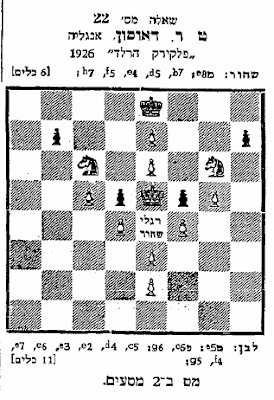
The paper previously published a retrograde-analysis problem, on Nov. 22nd the same year (p. 3), by the well-known British problemist Thomas Dawson, which is solved in detail in the Dec. 20th column, while explaining the term "retrograde". But Dawson's problem, as well as not being a Palestinian one, of course, is a mate in two, not a "pure" retrograde analysis problem. The retrograde analysis is necessary to show why the key -- 1.gxf6 e.p. -- is permissible (i.e., that Black's last move had to be Pf7-f5.) The diagram amusingly has been printed with the stopgap-text 'black pawn' on e4:


The same column (brought to our attention by a frequent correspondent) also notes an important event -- the re-opening of the Jerusalem chess club after the war, incidentally with 'Comrade Marcuze' as treasurer, with well known players (Mohilever, etc.) as members.


Friday, February 18, 2011

More Retrograde Analysis

We have already encountered the work of Yehuda Weisberg, who was killed in the Israeli war of independence in 1948. On 17.5.1957, Davar dedicated its chess column to his memory, noting he had 'made a name for himself in retrograde analysis'. Indeed he had.

Davar published a previously-unknown retrograde analysis problem by him, which is -- I believe -- seen here in English for the first time. (The usual caveats about originally being hard to prove apply.)

Source: Davar, 17.5.1957
What was Black's last move?

(It's harder -- much harder -- than it looks!)

Saturday, June 6, 2009

The UN, Retrograde Analysis, Geometrical Motifs, Purim, and Tal


Hilel Rivlin, Nahlat-Yehuda, Israel. What was Black's last move?
Source: Al Hamishmar, March 15, 1957.


As is well known, Israel is not exactly popular in the UN -- or, very often, with the USA, either. Israeli chess columns sometimes got back at the UN with their problems or comments. Here is an amusing example. The problem above was a published in Al Hamishmar during Purim (a Jewish holiday that is a combination between Halloween and April's fools' day) -- when not-so-serious problems or games are traditionally given.

The editors noted:

"The pieces in the four corners of the board in problem no. 1074 create the letters [in Hebrew, of course -- A.P.] of our crucial year, 5717 [in the Jewish calendar, starting fall 1956 -- A.P.]. We presume the special position is the result of a weird game, which was played according to the rules of the game, but against its spirit. We imagine the imaginary players of this Purim game were similar to the UN's secretary general."

In the solution (published two weeks later, on 5.4.1957) the editors added that "the solution is surprising" and "each of the pieces which make up the letters in the diagram plays a role and must stand where it is. We congratulate Rivlin for his creation."

By coincidence, the very same column has a report about a "young student", one Mikhail Tal, who has just won the USSR's championship with 14 points, ahead of Bronstein, Keres, Tolush, and others. This is one of the first -- perhaps the first -- mentions of Tal in the Israeli press.

(As usual, highlight the hidden text below for the solution).

The last few moves were: 1. Bg8-f5+ Ng6-f8.

Friday, October 24, 2008

Four Days of Sheep-Herding

Again from Eliyahu Fasher's book, Shachmet le'Hana'atcha (1980), p. 137-139, with my notes in brackets:

'During the [British] mandate, chess activity [in Palestine] was very limited and centered around the three large cities [Tel Aviv, Jerusalem, and Haifa]. Chess activity elsewhere was minimal. It should be noted that the problemists were active in the Hityashvut ha'Ovedet [the organization of the small agricultural communes, the kibbutzim] and one of the most original ones was the late Yehuda Weisberg, who fell during the [1948] war of independence in the battle of Sejera. 

Yeduda Weisberg, Fairy Chess Review, 1947. What was Black's last move?

'Above is one of his problems, which we read about in the letter he sent to his friend Yechezkel Hillel, then a shepherd in Phoria in the lower Galillee: '"I am sending you a new problem and ask you to check it and get it published. Its justification is a tough nut to crack and I doubt you'll be able to overcome it..."

'In Hillel's answer we read: "I thought about this problem for four days of sheep-herding before I solved it -- really a great idea!..."

'After this story was published in La'Merchav on May 8th, 1959, I received a letter from Levi Herzog from Ma'abarot  kibbutz with an interesting story. Levi was an active problemist in Hungary, and when he emigrated to Palestine continued with his hobby in the Emek Hefer kibbutz, where he was a shepherd. He continued to send his problems to Hungary, since there was no possible venue for publications in Palestine. Over the years he acquired ties with the editor and continued with them after the state [of Israel] was founded [in 1948]. Once the Hungarian editor asked him to add a few personal biographical details, and [Levi] added, inter alia, that he is a kibbutz member and a shepherd.

'This time the editor's answer was short: "I am very glad to hear that in your Asiatic country shepherds reached such a high level in chess". Levi received no reply to his letters any more.'

Solution (Originally published in Fasher's The Israeli Problemist, 1964. Highlight the hidden text below.)

1. a4 d5 2. Ra3 Qd6 3. Rg3 Kd7 4. c3 Kc6 5. Qc2 Kc5 6. Qf5 Nc6 7. Qxc8 Nf6 8.
Rg6 hxg6 9. Qf5 Rh4 10. Kd1 Rd4 11. Kc2 Rd8 12. Na3 a6 13. Kb1 gxf5 14. Nc2 Kc4
15. h4 Kb3 16. Nf3 Qc5 17. Ng5 Rd6 18. Ne4 Nd8 19. Rh3 Rb6 20. Re3 fxe4 21. Rd3
exd3 22. Ka1 dxc2 23. d3 Ng4 24. Bf4 Ne3 25. Be5 c6 26. Bf6 gxf6 27. fxe3 Bh6
28. exd4 Bf4 29. dxc5 Bb8 30. cxb6 Ba7 31. bxa7 Ne6. 


Tuesday, January 22, 2008

Prime Ministers and Retrograde Analysis


Who said politicians aren't interested in chess? This picture, given to me with the kind permission of Yosef "Tommy" Lapid (himself an Israeli politician), shows David Ben-Gurion, Israel's first prime minister, playing chess. Judging by his age and the spartan settings, the game was played when he was in retirement, in the Sde Boker kibbutz in the Negev desert.

Update, 17/11/2012: a much higher resolution picture is found on flickr. It turns out that the photo was not taken during his retirement, but when he was (still) PM; and not in Sde Boker, but on and Israeli gunship. It was an official photograph by the Israeli Government Press Office

From what can be seen of the position, it seems Ben Gurion's opponent is doing his best to not beat him. It isn't clear where most of White's kingside pawns have gone, or why most of his pieces are still on their starting squares. Still, at least Ben Gurion hasn't opened the game with the tyro's "standard" 1. Ph2-h4 or 1. Pa2-a4.

From the picture, we can, however, deduce what the opponent's last move was--making this post the first known connection between politics and retrograde analysis. Highlight the next paragraph for the answer.


Solution: White is about to move the c5 pawn. This pawn only has a legal move if Black's previous move was 1. ... Pd7-d5, and White intends to reply 2. Pc5xd6 en passant.