Showing posts with label Rubinstein. Show all posts

Friday, October 4, 2024

Sammy Rubinstein, a Simultaneous Display by his Father, and the Need for Sources


Boylston Chess Club shield. Source: see below.

Terje Kristiansen points out to that the Boylston Chess Club posted on its blog (see link) an interesting history of Akiba Rubinstein's family. In particular, it notes that Samuel "Sammy" Rubinstein also was a strong player, with a FIDE rating of 2380, being champion of Brussels in 1949. 

It should be added that while the blog post attempts to give sources and be accurate, some of the information or photos are unsourced and there are some mistakes. For example, Akiba Rubinstein did not visit Palestine twice, in April and May 1931, but only once - in April and May. Also, the photo included as a "simul in Palestine" is - probably - not from Palestine, despite appearing as such in Donaldson and Minev's book on Rubinstein (The Life & Games of Akiva Rubinstein, vol. 2, p. 370). 

As it happens, I was asked about this very photo by Philip Jurgens in an email from 27 September 2021. He noted the similarity of the photo to the following one, which was taken in Palestine. I wrote back that I am skeptical for reasons that may be worth repeating here. Mr Jurgens agreed, but pointed out that my skepticism is circumstantial (i.e., there is no exact location known that proves it is not from Palestine).  

Rubinstein gives a simultaneous display. Source: see above.

Here is a version of my reply to Mr. Jurgens, noting the reason for my skepticism. It had been shortened and edited for clarity.

1. While superficially similar, the photograph here is not actually in the same room. 

2. The people in the photo are dressed in conservative black - not how people would dress in Palestine back then (although the difference is somewhat subtle). Similarly, golden watches and pipes, while not unknown, were not common in Palestine. In short, the Palestine simuls were much more "working class" than this display.

3. All the sets are matching sets, of the same size/making. This would not be typical of Palestine of the time, where it was customary for players in simultaneous displays to bring their own sets. Local chess clubs simply didn't have 50 or 100 matching sets available.

4. The demonstration board in the back seems to be in German or another European language, not Hebrew. 

5. I do not recognize any of the players/personalities in your photo. 

6. In many of Rubinstein's simuls in Palestine, the players were mobbed and assisted by their neighbors/onlookers - very typical of the time in Palestine, but not in Europe (to the great chagrin of Palestine chess column editors, who tried to uproot this "uncivilized" practice...). Here the onlookers are not doing so.
The Boylston Chess Club's blog post is sloppy with sources for its photos. It mentions Donaldson and Minev's book but does not give the exact location of the photograph from it (this was given to me by Mr. Jurgens). 

Why does this matter? Because this is how mistakes are perpetuated. That Donaldson and Minev made a mistake about a photograph in their two-volume work is not the issue. No book is free from mistakes, and their two-volume biography and game collection of Rubinstein is a very serious work with a great deal of original material. But when a photo from their book is posted elsewhere, as in the blog in question, without giving the exact source, then the mistake sticks and becomes a "fact" that is hard to eradicate. 

Sunday, March 24, 2024

"Two Brilliancies (Glanzpartien) by Rubinstein"


Source: here.


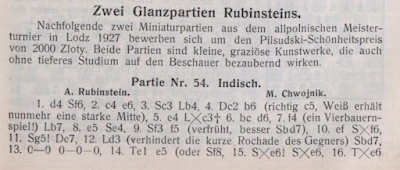
An interesting note about the game below is that it was published in the Weiner Schach-Zeitung, as Mr. Halsegger (see previous post) notes, with another Rubinstein brilliancy - against no other than M. Chwojnik - that is, Mieczysław Chwojnik, better known later as the Israeli player Menachem Oren


A Nice, if Well-Known, Combination


Source: Chessgames.com

The above games, Akiba Rubinstein vs. Moishe Hirschbein, Lodz, 1927, was brought to our attention by Herbert Halsegger. In an aesthetic final combination, play continued: 

21.Rxd7! Bxd7 22.Nf6+ Kf8 23.Nd5 Black resigned (1-0). 

Friday, January 19, 2024

Computer Chess

Source: www.chess.com

Chess, a timeless game that transcends borders and cultures, has found a significant place within the Jewish community. Beyond being a strategic pastime, chess has woven itself into the rich tapestry of Jewish history, culture, and intellect. In this blog post, we'll explore the enduring legacy of Jews and chess, tracing its roots, examining notable figures, and contemplating the symbolic resonance that the game holds within this community.

The history of Jews and chess is a tale of intellectual resilience and cultural prominence. Chess, often referred to as the "game of kings," found itself embraced by a community known for its commitment to education and intellectual pursuits. From the streets of medieval Jewish quarters to the salons of contemporary Jewish intellectuals, chess has been a cultural beacon, reflecting the strategic acumen and love for intellectual challenges within the Jewish tradition.

Chess is a game of tactics, strategy, and foresight. In many ways, the chessboard becomes a metaphor for the challenges and triumphs of Jewish history. Whether navigating the complexities of diaspora life, facing adversity, or contributing to the fields of science and the arts, Jews have often drawn parallels between their experiences and the moves on a chessboard. The game becomes a symbolic reflection of the intricate dance between tradition and adaptation.

Throughout history, Jews have made significant contributions to the world of chess. Akiba Rubinstein, one of the strongest chess players of the early 20th century, left an indelible mark on the game. His strategic brilliance and innovative playstyle have inspired generations of chess enthusiasts.

Another prominent figure is Grandmaster Bobby Fischer, whose Jewish heritage became a notable aspect of his identity. Fischer's prodigious talent and eventual rise to become World Chess Champion in 1972 captured the imagination of the world and further cemented the connection between Jews and chess on the global stage.

Jewish literature and art have also embraced the symbolism and narrative potential of chess. From Isaac Bashevis Singer's stories to the works of Jewish artists, the chessboard often appears as a backdrop for exploring themes of strategy, intellect, and the unfolding drama of life. It becomes a metaphorical stage where characters grapple with their destinies, much like the moves of a carefully orchestrated chess game. 

Chess education has become an integral part of many Jewish communities. Schools and organizations recognize the cognitive benefits of chess, promoting it as a tool for intellectual development. The game fosters critical thinking, patience, and discipline—all values that resonate deeply within the Jewish cultural ethos.

The relationship between Jews and chess is a compelling narrative of intellectual prowess, cultural resonance, and the enduring spirit of a community. As the chess pieces move across the board, so too does the rich history of Jewish contributions to this game. Whether seen as a metaphor, a source of inspiration, or a tool for education, the enduring legacy of Jews and chess continues to shape the narrative of both the game and the community that has embraced it throughout the ages.

(I hope you forgive my little joke. This is indeed computer chess -- that is, computer writing about chess. This is ChatGPT's reply to a request to write a blog post about Jewish Chess History.)

Saturday, August 12, 2023

A New Translation of a Classic Rubinstein Book


Credit: see below

The above book, Akiba Rubinstein, by Yuri Razuvaev and Valery Murakhveri, originally published in 1980, has just (2023) been translated into English and published by Verendel PublishingPhilip Jurgens, who was involved in the translation project, had generously sent me a complimentary copy. The book is a classic of chess history and it is good to finally have an English version. 

Saturday, March 25, 2023

Rubinstein - Rotlewi, 1910

The following game, brought to our attention by Tomasz Lissowski, was played between Akiba Rubinstein and Georg Rotlewi. Apart from being the same players as in Rubinstein's "immortal" game (Rotlewi - Rubinstein, 1907), it is interesting since it was published in a column in a Yiddish newspaper, Der Moment (9 December 1910, p. 5) - with annotations, in Yiddish, by Rubinstein himself, the editor of the newspaper's column. 

Especially interesting from a linguistic point of view is that the names of the pieces were in Hebrew letters but were transliteration of the German, or continental, system. E.g., the knight is ש - S - for "Springer," the bishop ל - L - for "laufer," etc. 


Rubinstein, Akiba – Rotlewi, Georg

Queen's Gambit Declined, Tarrasch [D34]

Warsaw chess club championship, 1910

Source: see above

Annotations: Akiba Rubinstein

1.d4 d5 2.Nf3 c5 3.c4 e6 4.Nc3 Nc6 5.cxd5 exd5 6.g3 Nf6 7.Bg2 Be7 8.0–0 Be6 9.Bg5 0–0 10.Rc1 c4 11.Ne5 Qb6 The queen attacks d4 and b2, changing places with the c6 knight to sufficiently protect the weak point d5. 12.Bxf6 Bxf6 13.Nxd5 Bxd5 14.Bxd5 Bxe5 If 14...Nxe5 15.dxe5 Bxe5 16.Rxc4 Bxb2 17.Qc2 with the threat of 18.Rb1. 15.dxe5 Nxe5 

16.b3! cxb3 17.Qxb3 Nc6 18.Qxb6 axb6 19.Rb1 Ra5 20.Rfd1 b5 21.Bb3 Ra7 22.Rd7 Ne5 23.Rc7 Stronger than 23. Rd5 - Rubinstein. 23...Rd8 24.Bd5 Black resigns (1-0).

Friday, December 31, 2021

Chess, Poverty, and Antisemitism

Chess is a notoriously unremunerative occupation, even on the highest levels, and many chess players were poor all their lives. Two lesser-known examples of attempts to help masters are given here, courtesy of Herbert Halsegger

In Die Stimme, 22.6.33, p. 6, It is noted that the "top player in Palestine," M. Marmorosh, is putting together a collection for Rubinstein in his difficulties. We note that this might have to do with Marmorosh trying to make amends for the Palestinian chess world's failure to pay Rubinstein his agreed fee when he visited, as previously noted in this blog.  

In the Tagesbote of 30.4.29, p. 8, notes Halsegger, it says that the Viennese master Mueller, Spielmann, and Hoenlinger [English spelling] wished to arranged a simultaneous display to help the poor and old author Franz Gutmayer. They failed because only two persons had been interested. This is interesting, adds Halsegger, since Gutmayer was a notorious anti-Semite. I add that this is seen for example in Jeremy Spinrad's research.  

Saturday, April 10, 2021

Women Solvers


The following note (Ha'aretz, 21 June 1935, p. 13) is a notification of the winners of the solving tournament by the editor of the chess column in Ha'aretz, Marmorosh. It is interesting to note that among the tope solvers we have three women: Leah BroidaHannah Zefah and Mira Vergad (ph. spelling). Broida and Zefah also won two of the three top prizes: Hans Kmoch's Rubinstein Gewinnt! and a chess clock, respectively. 

Monday, August 31, 2020

New Clubs


The above note, from Marmorosh's column in Davar (Feb. 8th, 1935, p. 5), brought to our attention by a frequent correspondent, notes among many other things about the founding of a chess club in Ra'anana, which was decided upon after 'a general meeting of all chess fans in Ra'anana'. They selected a committee to run the club and decided to buy sets, start lessons for beginners, and start a tournament for the championship of Ra'anana. This is another example of the rise in chess activity in the country in the mid-1930s, as Czerniak, Porat, and many other strong players arrived in the country, and visits by Rubinstein, Flohr, and Mieses took place. 

Sport in Palestine, 1935


The above photos are from an article from Doar Ha'yom, 'The Sport in Palestine Last Year' (April 2nd, 1935, p. 15) brought to our attention by a frequent correspondent. It mentions, among much else, Rubinstein's and Flohr's visit to Palestine, and also adds that Palestinian athletes had participated in the Western Asiatic Games, and did quite well, which makes our previous claim that the 1935 chess Olympiad was the "first" time a sports team from Palestine participated in an international event false. 

Wednesday, October 16, 2019

Rubinstein and Hebrew

Source: Davar, Dec. 11th, 1930, p. 3
In reviewing the chess life in Palestine in 1930, Davar notes that there is 'little to be done at once' with the 'limited' chess life in the country. The article - 'The Akiba Rubinstein Chess Club in Tel Aviv' notes, however, that Marmorosh founded the club with in order to revive chess in Palestine. The article notes that the club now had over 100 members, and that Rubinstein himself sent a polite letter to Wilson, the secretary of the club, agreeing to naming the club after him. It is quoted above. 

The especially interesting point is that the letter was written originally in old-style, turn-of-the-century Hebrew, the Hebrew Rubinstein learn in his youth. Rubinstein notes he got Wilson's letter from '4th of Tishrey' [The Hebrew date] and that he is willing to have the 'Ishkoki' [chess] club named after him. Rubinstein also notes he wrote previous articles for Ha'Sachmat in Hebrew but that the magazine did not survive. He politely refuses to send articles, citing lack of time, but promises to send 'interesting games' if he happens to play any, and to come visit to give simultaneous displays. Indeed, he did just that a few years later. 

Monday, July 23, 2018

A Snapshot

Source: La'Merhav Feb. 12, 1960, page 8 
A frequent correspondent notifies us of the interesting "snapshot" of the Israeli first league in 1960. We see the "old guard" in Jerusalem's Rubinstein club: Czerniak, Dobkin, Mohilever and others. We see a "mixture" in Tel Aviv's Lasker club: Aloni and Oren, but also the young Domnitz. The IDF's and the students' teams naturally feature young players: Kraidman, Guti, Stepak, and others. Tel Aviv's Reti has the "old timers" Smiltiner and Barav but also the young Persitz in the first board. 

Of particular interest is the Bat Yam club, which has Gereben in the first board, but the article (by La'Merhav's chess columnist, Fasher) notes that he already left the country -- and that Bat Yam also lost Ya'akov Mashian, the Iranian-Jewish master, 'who also left the country'.

Mashian returned to Israel in the mid-70s (at least according to Wikipedia), and -- incidentally -- played with Stepak a 193-move game in the Israeli championship semifinals (Stepak won, 1:0). This game, according to Tim Krabbe, was the longest recorded game ever played for seven years (1980-1987), and is still the longest game in time -- 24.5 hours -- 'a record it will forever hold'.

As for Gereben, he had emigrated to Israel in 1959 and played in the 1959 Israeli championship (coming in second), but left the country soon afterwards, as Fasher already notes. Ha'Tzophe of Oct. 9th, 1959, p. 4, notes our correspondent, says the 'Erno Gereben (Grünfeld)' had come to the country shortly before the championship began. Can any reader explain why 'Grünfeld'?

Edited to add: a frequent correspondent noted that the English-language Wikipedia entry for Gereben has his birth name as "Ernest [or Ernst] Grünfeld' and adds:
This name change, with other survival skills, probably helped him survive the holocaust. It was printed in the Israeli press that during one of the Olympiads, a Hungarian player, in a worse position, whispered to the Israeli player (in Yiddish) 'I am a Jew', and the game was drawn. 
It turned out to be Gereben. Based on the details given by our correspondent, an Olimpbase and Chessbase search reveals the game is probably Gereben - Kniazer, Amsterdam 1954, ending in a draw in the following position:


Tuesday, October 31, 2017

Marmorosh's Very First Column


Source: Davar, Nov. 7th 1930, p. 5 (same w/following item in this post)


Moshe Marmorosh's very first column, in Davar, Nov. 7th 1930, starts with a general introduction by the editors. As so often in Israeli (or Palestinian) press, it starts with the famous 'Song of Chess' poem, and adds a brief history of the game among the Jews.

This time the introduction, probably written by the editor and not by Marmorosh himself, is rather good, with a detailed note both of important chess-related items written by Jews, both famous (like 'Song of chess') and rather obscure ones, like the article 'The Toys', article by Yehoshua Reichensahn (ph. translation -- the original Yiddish, see the next post, is רייצענזאהן), in "SF"R's [Saul Pinchas Rabbinowicz - link in German, last name also spelled Rabinowitz] Knesst Israel", a Zionist yearbook edited by Rabbinowicz in 1885-1888 in Warsaw. The unsigned introduction was probably (see also the next post in the blog) not written by Marmorosh himself, as it refers to him in the third person.

We have already mentioned in this blog the first game published in it -- the famous 1907 Rubinstein win vs. Rotlewi. Here is the first problem, by L. Holzer:


'Chess' is spelled שחמת -- this was before the common spelling today, שחמט, became the standard ca. 1940. It is also interesting to note that, as usual for Hebrew chess works at the time, the pieces were given Hebrew names and initials (e.g. King = מלך [Melech] = מ, the initial letter, Hebrew being written from right to left), but the board's files used Latin letters.

Saturday, July 16, 2016

'Meet our Masters': Moshe Blass, by H. Reed

Our frequent correspondent Moshe Roytman had sent us, a while ago, quite a few nice "finds" from the chess literature of the early state of Israel. A particularly interesting one is that Al Ha'Mishmar's chess column had run a 'meet our masters' series of pen portraits of Israeli masters. Here is their portrait of Moshe Blass -- From Al Ha'Mishmar, Aug. 12th, 1949, p. 8, by H. Reed [ph. spelling]. Below is our translation, and our comments in square brackets.

Meet Our Masters

We are beginning this week a series of articles about Israeli chess players. We wish to introduce the reader a series of players that are not known to the public and, especially, to the youth. This week we overview Moshe Blass.

Moshe Blass

Among the chess masters in the country there are players of international caliber, which have succeeded in many tournaments and matches.

One of them is Moshe Blass. Before arriving in the country, 17 years ago, he was one of the strongest players in Poland, often mentioned together with Rubinstein, Tartakover, Frydman, Makaryczyk, Dr. Kohn, and the late Przepiorka. In 1927, when Najodrf and Czerniak were young beginners [in Warsaw], he already won the Warsaw championship, after a brilliancy against P[aulino] Frydman. He played in the Olympiad twice for the strong Polish team: in 1928 in the Hague and in 1938 [sic - 1930 is correct] in Hamburg.

From 1933 he is part of the chess life in our country and for many years he had no equal, until younger forces like Foerder [Porat], Czerniak, and Aloni dethroned him.

His greatest victory was in 1935, in the international tournament arranged with the Maccabiah, when he came first before Foerder, Enoch, and the Viennese Glass, who recently returned to the country after many troubles [a hint that Glass ran away from Vienna to Shanghai in 1938, thus surviving the war].

Blass' style is superb, pure and classical, without entering opening complications. He shows his talent in the middle game, and his desire for beauty and perfection is evident in all his games.

As a man, Blass is modest, which made him popular with chess players.

Despite his age removing him from the tournament hall, it is a pleasure to see him next to his regular table in one of the coffee houses, beating strong opponents in offhand games.

The game added is Blass - Dobkin, Tel Aviv Championship, 1945 (Slav defense). According to the computer (Fritz 6), the game was more or less equal until Dobkin blundered, allowing mate in two, but it is still an interesting example. The analysis is by the editor of the chess column or Fritz 6, as indicated.

1. Nf3 Nf6 2. c4 c6 3. d4 d5 4. e3 e6 5. Nc3 Nbd7 6. Bd3 dxc4 7. Bxc4 b5 8. Bd3 dxc4 9. a4 b4 10. Ne4 Bb7 11. b3 c5 12. Nxf6+ gxf6 13. Bb2 cxd4 14. Nxd4 Nc5 15. Bc4 Rg8 16. Rg1 Rxg2 17. Rxg2 Bxg2 18. Qh5 Bd5 19. Rd1 Bxc4 20. bxc4 Qa5 21. Qf3 Rc8 22. Nc6 Qxa4 23. Bxf6 b3 23... Rxc6? 24. Qxc6! Qxc6 25. Rd8# - editor. 24. Na7


24... Qxc4? Fritz 6 recommends 24... Rb8 or 24... Qb4+. 25. Qc6+ and Black resigned (1-0) due to 25... Rxc6 26. Rd8#.

Edited to add: we thank our correspondents for supplying the spelling of the names!

Saturday, April 30, 2016

From Harvard University

Image Credit: See Below
Edward Winter, in Chess Notes 9850 (link here, scroll down for the relevant C. N. Item) that Harvard Library has a collection of chess photos from Palestine / Israel, and gives a link to the relevant Harvard web site. The above is the simultaneous display of Rubinstein vs. Marmorosh, which we often mentioned in this blog. The Harvard web site has a much higher resolution picture.

To the best of my knowledge this is the only surviving picture of the display in question. The note (in Hebrew script) at the bottom right says Plastica / Tel Aviv. "Plastica" was, presumably, the name of the shop which developed the prints.

In addition, notes Winter, it has a link to numerous photographs of the 1964 Olympiad taken by the photographer Ya'akov Agor, (יעקב אגור -- his name, the Hebrew, or original, version of 'Jacob', is also sometimes spelled Yakov, Ya'acov, etc.). He was a photographer for various Israeli newspapers, especially of cultural figures, as this link for example notes. One good example is an informal photograph of Aloni (obviously in a private home, not in the tournament hall):

Details: see above.
Or, obviously from the same roll of film, those who wish to know how Haifa looked at the time, on a "regular" street, not in or near the tournament hall:

Details: see above.
But these are two of literally hundreds of such photos, arrange on Harvard's site in a few groups of ca. 150 photographs each. It has numerous photographs of chess personalities, better and lesser known.

Sunday, February 7, 2016

Emanuel Luftglas-Emanueli


Credits & Notes: See below.
The top note (Davar, May 6th 1931, p. 1), deals with Rubinstein's live chess display against Marmorosh, which took place on 9/5/1931, and notes that the clothes worn by 32 actors were 'based on designs by the painter Emanueli'.

Moshe Roytman, our frequent correspondent, wonders if this is Emanuel Luftglas-Emanueli , 1896-1958 (link in Hebrew), who is mentioned, inter alia, as a stage designer for the TEI (Teatron Eretz-Israeli, 'Palestinian Theatre') in the second cutting above, Davar, Aug. 5th, 1926, p. 1.

It seems very likely that it is him. It turns out that Emanuel Luftglas, as he is usually known, was the first formally-trained stage designer in Palestine, who worked in many theatres after emigrating to Palestine in 1922.

Roytman also provides a link to a long article about the man and his work (Davar, May 8th, 1964, p. 20) and a tribute page by his grandson (both links in Hebrew). It seems that 'Emanueli' was never his official last name, but a "professional" one, based on his first name. Perhaps he followed the common Zionist custom of using a Hebrew name instead of one's foreign-sounding birth name.

Emanuel Luftglas-Emanueli, from Davar, May 8th, 1964, p. 20.


Saturday, January 23, 2016

"Busy People's Got Time"

Source: Davar, 20/7/1964
The above is a cutting from an article in Davar, by Gershon Alimor (ph. spelling), brought to our attention by Moshe Roytman. The title is "Busy People's Got Time". The article (not related to the paper's chess column) deals with Rubinstein's visit to Palestine and especially the fact the Biyalik was a chess fan; but why would a great poet waste time playing chess? Alimor notes the answer given by the Jewish philosopher Jakob Klatzkin:
I was playing chess with him in the Hotel Gdansk. Suddenly he was approached by a writer (I don't remember who) who addressed him as follows: 'Prof. Kltazkin, I am surprised: you are writing an important book now, you're deeply busy with spiritual things; how can you waste hours playing a game?'. Klatzkin replied: 'listen, whomever tells you he's too busy to play chess, is a lazybones who does nothing. Whomever really works, his thought is ordered, and he finds time for everything, especially something as glorious as chess'. 
Indeed so!

Monday, December 28, 2015

Chess and Antisemitism in Russia

Illustration of the famous "lost son who became Pope" medieval legend. Source: Jewish Fairy Tales and Legends (1919), by Gertrude Landa ('Aunt Naomi'). Available online here

Tomasz Lissowski notifies us that, in his research for his book on Winawer, he discovered that in April 1914, an 'All-Russian Chess Society' was founded in St. Petersburg by P. P. Sosnitsky, who was elected president and '1st honorary member'. The other two honorary members were the Jewish players Winawer and Rubinstein, quite a surprising fact considering the well-known antisemitism in Russia at the time.

Of course, antisemitism being common in Russia at the time did not mean every Russian was antisemitic. We already noted Chigorin had openly and warmly praised Winawer, which he considered his 'master and guide', in an official reception in the St. Petersburg's chess club. 

The members of the newly-founded chess society apparently had nothing against Jewish players. Alas, adds Mr. Lissowski, the first world war, which broke out a few months later, put an end to all those plans. 

Wednesday, December 23, 2015

A "Life Chase" Match

Credit: The National Library of Israel "Time Travel" web site
A contributor to this blog had reminded me that Israel's national library, apart from a large physical collection of chess materials in rare magazines, etc., also has them on their web site. Entering 'שחמט' (Sachmat, chess) or 'chess' (in English) does indeed find quite a few items -- although, for this particular item, one needs to look for 'chase', not 'chess', for obvious reasons. Here, we have an advertisement for the live chess game between Marmorosh and Rubinstein.

One wonders whether more people came to 'Hapoel graund' to watch the chess game or the 'foot-ball' (i.e., soccer) game. One may also wonder about the number of typos and factual mistakes (Rubinstein was not, of course, the 'world chase [chess] champion'). This is especially surprising since, according to the item's description, it was printed in Ha'aretz press -- that of the most important newspaper at the time in Mandatory Palestine -- and is also of exceptional quality in terms of color and technical printing quality for the time.

Thursday, April 23, 2015

Renewal

Source: Davar, Sept. 24th, 1937, p. 4
In the following note, a propos of the Palestinian championship, Marmorosh adds that on Sept 18th, the representatives of 'a few chess organization in the country' had convened to 'renew the national chess organization and to put it on a solid base'. These included the Jerusalem Lasker club; the Tel Aviv club; the clubs in the Sharon area; the 'new chess club in Haifa'; and the 'chess association of the clerks' club in Jerusalem'. The 'founding meeting' was scheduled for 25/9/1937 in the Menorah club.

While this federation's activity, like chess activity in Mandatory Palestine in general, became (almost) moribund due to the war, it shows us a good 'snapshot' of the growth in interest in chess all over the country since the early 30s, as interest was raised for various reasons, such as visits by RubinsteinFlohr, and Mieses, the sending of a team to the Olympiad in Warsaw in 1935, etc., as we have seen previously on this blog.