Showing posts with label olympiad. Show all posts

Saturday, September 19, 2026

Chess and Stamps - Part VIII

 
Credit: ebay.

Our long-time acquaintance and chess player, Itzhak Bar-Ziv, was already featured in this blog concerning both the chess olympiad and stamps (searching for "Bar Ziv" or similar terms will find the posts). We note now that he had told us he expanded his interest in chess stamps and is making a serious collection of it. We "made a date" to see it, hopefully some will be posted on this blog soon...

Monday, August 31, 2026

"The Game of Queens"


A frequent correspondent notes that in 1977, the Israeli film service produced a short (29 min.) film about the 1976 Israeli women's team to the Haifa Olympiad. The team (Alla Kushnir, Ljuba Kristol, Olga Podrazhanskaya, and Lea Nudelman) won first place. The above still from the movie shows the four of them (from left to right, Nudelman, Kushnir, Podrazhanskaya and Kristol) with their trainer, Eliyahu Levant

The title is a pun on "the game of kings" (mishak ha'mlachim), a poetic Hebrew name for chess. The movie has many candid shots of the players, including during the award ceremony, and is well worth watching even if one doesn't speak Hebrew, to see the people behind the game. 


Wednesday, April 8, 2026

Postcard from Oren to Barav

 
Credit: Prof. Ami Barav

Prof. Barav presented us with the following postcard, to his father (Israel Rabinovich-Barav) from Menachem Oren, with the signatures of the Soviet team in the Amsterdam Olympiad. 

The signatures, as identified by Mr. Kosimov, are:

1. Botvinnik

2. Smyslov

3. Bronstein

4. Kotov

5. Keres

One of the signatures in black, just below Smyslov's, is that of Igor Bondarevsky. The other member of the Soviet team not represented here is Geller. 

Tuesday, April 7, 2026

A Good Photo of the Soviet Team, Amsterdam 1954

 
Credit: see below

Prof. Ami Barav notifies us of the following good photograph of the soviet team, Amsterdam, 1954. From right to left: Bronovski (administrator, holding the cup), Botvinnik, Keres, Bronstein, Smyslov, Geller, Kotov

Monday, April 6, 2026

Chess Poem


Source: see below

The same book mentioned in the previous post, Eliahu Shahaf's Israel Chess Championship 1961/62, also has a chess poem by H. Ben Shlomo on p. 104. The readers of this blog have done nothing to deserve a translation of this poem, although, to judge by the scenes described, it is not a poem about this tournament, but about the Amsterdam Olympiad, 1954. 

The poem mentions in particular the game Botvinnik - Porat and the international scene, and the claim that the whole Olympiad was really an "internal Jewish battle," despite the various flags, due to the large number of Jews on the leading teams. The poem ends with the claim that the prize "stayed in the family": that is, with the USSR team, three of whose players (Botvinnik, Bronstein and Geller) were Jews. Perhaps the author believed that Smyslov was also Jewish.

Sunday, April 5, 2026

Photos

Itzchak Aloni

Yosef Porat

Menachem Oren

Eliahu A. Mandelbaum

Israel Yosef Keniazer

Yosef Dobkin

Moshe Czerniak

Shlomo Smiltiner
Source: see below

Sometimes, it is good to remember that chess players are also people, and to find photos of how they looked - or at least, how they looked to the public. Above are photos of the Israeli players of the 1952, 1954, and 1956 Olympiads as given in Mandelbaum and Perstiz's Israel Be'olympiadot Ha'shachmat [Israel in the Chess Olympiads] (Tel Aviv: Mofet, May 1958). They all seem - to judge by the sets and clocks - from the olympiads in which they participated, but this is tentative. 

Photos are, respectively, from the following pages:

Aloni - 90; Porat - 93; Oren - 89; Mandelbaum - 92; Keniazer - 95; Dobkin - 91; Czerniak - 94; Smiltiner - 92. 

Why this order? The photos are from a section of endings they played, and are arranged by the Hebrew alphabetical order, with Oren first and Keniazer last.


Sunday, June 22, 2025

Fischer not Playing in Tel Aviv, 1964

 
Source Chess Life, vol. 19 no. 9, p. 214

Our frequent correspondent, Herbert Halsegger, had recently sent us a significant number of interesting information relating to chess in Israel. One is above: a detailed discussion of Fischer's famous refusal to play in the Olympiad in 1964.  

Friday, February 28, 2025

Boris Spassky, 1937-2025


Gligoric (l.) vs. Spassky, 1965. Source: see below.

Boris Spassky was the 10th chess world champion. He was also, simply put, a gentleman. He was always generous and gallant. In particular, his willingness to continue the match with Fischer in 1972 after Fischer lost the first game and forfeited the second was one reason the match was not aborted. Edward Winter had updated his web page about Spassky with a link to an "exceptionally fine" obituary by Leonard Barden, from which this photo is taken. Needless to say, Winter's web page is intended merely as a sampler of the great amount of material in Chess Notes about the 10th world champion. 

Almost all the obituaries note that Spassky was, even more than a chess player, a gentleman: generous to other players, including his opponents. To give only examples from Winter's page noted above, Spassky was very generous towards Fischer, pointed out Keres as a "particularly kind and gentlemanly colleague," and his evaluation of Petrosian was higher than that of some other masters, notably Botvinnik, to say nothing of the chess public which often belittled Petrosian (see also Winter's page about Petrosian for more details.) 

It is a bit odd to speak in this way of a world champion, but it seems that in the popular perception among the rank-and-file players, Tal and Fischer - due to their aggressive and perhaps more accessible style - are seen as superior to the "loser" (to Fischer) Spassky and "weak" Petrosian. As if Spassky's 1972 match was the whole of his career, or Petrosian is to be faulted, as Winter notes, for not playing in Tal's style. But in the case of one of the truly great players, like Spassky, I am certain history will remember him more kindly than the often-jingoistic press and potboilers falsely portrayed him.

Interestingly, it was claimed that Spassky is Jewish - but as the Jewish News Syndicate reports, Spassky himself denied this and was "mystified" how this rumor was circulated. It should be noted that, as the same source notes, Spassky rather foolishly signed an infamous 2005 antisemitic petition, but he distanced himself from it almost immediately.

Spassky was in Israel for the 1964 Olympiad. He was occasionally mentioned in this blog (check "Spassky" in the subject list for details). The chess world lost not just a legendary player, but a gentleman. 

Tuesday, December 31, 2024

More Caricatures By Ross


Source: see below

Herbert Halsegger notifies us that G. Ross (the initial is taken from the source mentioned below, p. 49) had made many more illustrations of the players in the 1964 Olympiad. The above sketches are taken from the report, "1964 Olympiad - Selected Games" by Hans Kmoch, on pp. 49-53 of Chess Review, February 1965. Many more are found there. See also about Ross in this post.

Saturday, November 30, 2024

Israel in the Finals


Source: see below

The same volume of Shachmat mentioned in the previous post had, following the article about Israeli chess history, also a short article reprinted from the Jerusalem Post about Israeli in the 1964 Olympiad's finals (pp. 29-28, again in reverse order). 

It is a rather interesting article - as typical of the period, having little to do with chess itself, and much more with the relation of chess to education, Jews in general, a cure for the "dismal performance" of Israeli athletes in physical sports, and so on. Again, as in the previous post, the name of the player - Zadok Domnitz - was printed in Hebrew. 

Tuesday, July 23, 2024

Chess Olympiad Package

Source: Chess Review, Sept. 1964, p. 258.

Mr. Herbert Halsegger notifies us that Chess Review had a full-page advertisement for a round-trip visit to Israel for the chess olympiad of 1964. Are there any other examples of such "package deals"? 

Wednesday, July 3, 2024

Uzi Geller, 1931-2024

Credit: Almog Burstein.

The late Uzi Geller, Israeli champion (1971) and member of the Israeli chess olympiad team (1972), had passed away at the age of 93, as I was notified by the Israeli Chess Advancement Center, managed by Almog Burstein. Burstein's email added a link to a long obituary (in Hebrew) in a blog by those who knew him well.

Geller is typical of his time: he lived in a kibbutz all his life, and got his start in chess in the "glory days" of the communal settlements' chess "boom" of the 1950s and (especially) 1960s.

Sunday, June 30, 2024

Aloni Making an Impression


Source: Chess Review, December 1954, p. 360

The game between Aloni and Kotov in the 1954 olympiad made quite an impression, since Aloni won, leading the Israeli team to a 2:2 draw with the all-powerful USSR. One example, given to us by Herbert Halsegger, is crowning the game as "game of the month" by Chess Review in December 1954, with annotation by no other than Dr. Max Euwe

Saturday, June 29, 2024

Samuel Schweber

Source: Chess Review, July 1955, p. 198

The above note was brought to our attention by Herbert Halsegger. It should be noted that Samuel Schweber had also played in the 1964 Olympiad in Tel Aviv, and in a first-day postcard signed his name in Hebrew, as noted previously in this blog. He also signed his name in Hebrew in Eliezer Pe'er's notebook in the 1960 Olympiad. Mr. Halsegger also notifies us of a game between Petrosian and Schweber with notes by Najdorf, found (in Spanish) on this web page, with nice photographs of both.


Wednesday, June 12, 2024

Israel vs. Mongolia, Moscow Olympiad, 1956


Source: see below

The same issue Mr. Halsegger pointed out to us in the previous post also has, in other news, a report from the Moscow, 1956, Olympiad - with a photo of Zhgder (left) of Mongolia playing Czerniak in the Olympiad. It is on p. 356 of the issue. 

Wednesday, May 15, 2024

On Edward Lasker, by Mona Karff


Source: Chess Life and Review, January 1976, p. 7

Biographical articles about chess players by other players are, of course, very common, but Herbert Halsegger notes an interesting example. Not only are both the subject and author Jewish - which is hardly surprising in chess! - but the author of the article about Edward Lasker is a female master, namely the Jewish Mona Karff. We should note that as we mentioned elsewhere, Edward Lasker had, in the same year, visited the chess olympiad in Haifa, 1976. 

Wednesday, October 25, 2023

ICF Partiorism

Credit: see below

The Israel Chess Federation had posted a series of photos of Israeli players and teams, mostly in international events such as the 2022 Olympiad. The photos are by Dr. Mark Liebschitz [ph. spelling]. Of particular interest is the above image - what seems to be a (small) double blindfold simul (3 boards each) in the Israeli Knesset, or parliament. 

P. S.

For some reason the above paragraph's outline will not follow the usual one used in this blog, sorry!| 

Wednesday, September 27, 2023

Porat - Larsen, anti-Turton

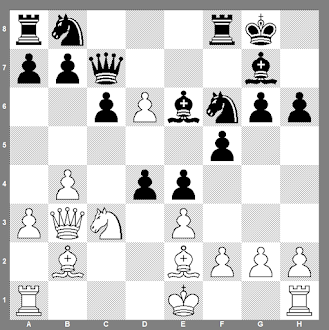
Edward Winter notes that Yosef Porat was the victim of an anti-Turton move (or combination) by Bent Larsen in the 1956 Olympiad. What is an anti-Turton? As Heidenfeld notes (see Winter's article for details):

It consists in forcing the attacker who wishes to double two pieces on the same gait in such a way as to have the stronger piece in front and the weaker behind (called the Turton in the jargon of problemists) into playing the weaker piece across the so-called “critical square”... and thus into reversing the planned line-up.

The game is: 

Porat, Yosef - Larsen, Bent

12th Chess Olympiad, Moscow, 1956, 6th round (preliminaries) 

Source: Olimpbase

1.Nf3 f5 2.c4 Nf6 3.Nc3 g6 4.b3 Bg7 5.Bb2 d6 6.d4 c6 7.e3 Qa5 8.a3 O-O 9.Be2 e5 10.b4 Qc7 11.d5 h6 12.c5 e4 13.Nd4 dxc5 14.Qb3 cxd4 15.d6+ Be6

Anti-Turton. 15...Qf7 (the other possible move) allows 16.Bc4, to be followed by 16...dxc3 17.Bxf7+ Rxf7 18.Bxc3, when Black has three pieces for the queen. 


16.Qxe6+

The point behind 15...Be6: the white queen was forced to move beyond the critical square (c4), so Bc4 will no longer pin the black queen to the king after Black plays Qf7.

16...Qf7 17 Qxf7+ Rxf7 18 exd4 Rd7 19 d5 Nxd5 20 Bc4 Kh7 21 Bxd5 Bxc3+ 22 Bxc3 cxd5 23 g4 Rxd6 24 gxf5 gxf5 25 Rd1 Nc6 26 b5 Nd8 27 f3 Ne6 28 fxe4 fxe4 29 Rf1 Ng5 30 Rf5 d4 31 h4 Nf3+ 32 Ke2 Rc8 33 Bb4 Rg6 White resigns (0-1).

Saturday, July 22, 2023

Meetings in Buenos Aires, 1939


Albert Becker (left) vs. Paul Keres, 1936. Credit: Wikipedia.

We have noted in this blog before how the Palestinian (Jewish) team in 1939 naturally refused to play with the German team, and that this cause a serious problem until Grau "saved the day." Porat's eyewitness account was reported here.

Porat said that the Palestine team was "not invited to the negotiations" and that "the organizers notified us that the German team objected with the claim that Palestine, as a Mandate, is not in a state of war with Germany, so they see no reason to cancel the match!" 

The master's thesis noted in the previous post (see there for credits) sheds more light on the matter. It refers to a letter from the captain of the German team, Becker, to Max Bluemich, originally posted online by Chessbase in 2008. In it, Becker does indeed inform Blumlich that the German team claimed Palestine "is not a British colony, but a League of Nations mandate" and therefore formally not in war with Germany. 

It is clear from Becker's letter that the real reason for his objection is that a 2:2 draw without play with Palestine would benefit other teams (esp. Argentina) which could expect a better result by playing the relatively weak Palestinian team. What is also clear, and more surprising, is that Becker notes "The Jews [i.e., Palestinian team] came with the Argentinians to our apartment to appeal to our sense of sportsmanship" to convince Becker to agree to the 2:2 draw! 

Porat does not mention any such meeting in his recollections. It may be that he was not part of it, or that he wished to hide any such informal connection with the German team. It is clear, from Becker's letter, that the Palestinian team would not have played the German team under any circumstances. 

Another interesting point, also mentioned in the letter and pointed out in the master's thesis, is that Becker complained that Alekhine, the French team's captain (and of course world champion) was very much against the German team, and forbade "his people" from any contact with them - with the absurd result that the Palestinian Jews came to talk with Becker while Alekhine and the French did not. 

Does this prove Alekhine was not an antisemite? It depends on his motives. He could have been opportunistically trying to harm Germany for the benefit of France's chess team. He could have been angry at Germany's aggression and boycotted the Germans out of principle. Or he could have done so out of protest at the German treatment of the Jews. 

The latter two motives, given Alekhine's later behavior, seem unlikely. But this behavior does support the claim that Alekhine, while an opportunist, was not actually devoted to Nazism - or for any other ideology for that matter - but rather would do whatever he thought would benefit him at the time. 

But how could the Jewish team come to meet a man who ended his letter with "Heil Hitler"? It seems that Becker was no fanatical Nazi. Like all of the rest of the German team, he remained in Argentina during the war. Nothing in his biography suggests particular Nazi sympathies. But he was writing in 1939 to a man who was an ideological Nazi, and the "Heil Hitler" signature was more or less compulsory in such situations. 


Saturday, October 29, 2022

A Triple Party


The previous post does not, however, mean that the "Reti" club ignored the young players. Here is one example: a frequent correspondent notes that Ha'tzophe reports (June 19, 1959, p. 6) on "a triple party" in the "Reti" club, whose secretary at the time was Eliezer Pe'er

These were the sending of the Israeli Students Organization's team to a Budapest tournament (the 6th World Student Team Chess championship); the prize ceremony of the 1959 Tel Aviv championship (won by Persitz), and presenting the "Reti cup" to the winner of the "Reti" club championship, Meir Rauch

But while "Reti" knew well to honor young players and their achievement in the Reti club, the actual players in the "Reti" club tended to be old-timers, like Rauch. This was not, of course, 100% so: some young players played for the club at the time, in particular Raafi Persitz, as can be seen, e.g., in Ma'ariv's report of league play on 10 June 1960, p. 12. (This too was pointed out to us by a frequent correspondent.)

In that report, it is noted that "Reti" and "Lasker" are fighting for the league championship, which was often the case in those years. "Lasker," in the early years of the state, was by far the strongest club in the country, even as chess activity began to flourish again. So when some of its top players left to form "Reti" in the mid-1950s, for the next period these two clubs were at the top.