Showing posts with label Pe'er. Show all posts

Saturday, June 29, 2024

Samuel Schweber

Source: Chess Review, July 1955, p. 198

The above note was brought to our attention by Herbert Halsegger. It should be noted that Samuel Schweber had also played in the 1964 Olympiad in Tel Aviv, and in a first-day postcard signed his name in Hebrew, as noted previously in this blog. He also signed his name in Hebrew in Eliezer Pe'er's notebook in the 1960 Olympiad. Mr. Halsegger also notifies us of a game between Petrosian and Schweber with notes by Najdorf, found (in Spanish) on this web page, with nice photographs of both.


Saturday, October 29, 2022

A Triple Party


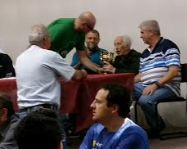
The previous post does not, however, mean that the "Reti" club ignored the young players. Here is one example: a frequent correspondent notes that Ha'tzophe reports (June 19, 1959, p. 6) on "a triple party" in the "Reti" club, whose secretary at the time was Eliezer Pe'er. 

These were the sending of the Israeli Students Organization's team to a Budapest tournament (the 6th World Student Team Chess championship); the prize ceremony of the 1959 Tel Aviv championship (won by Persitz), and presenting the "Reti cup" to the winner of the "Reti" club championship, Meir Rauch. 

But while "Reti" knew well to honor young players and their achievement in the Reti club, the actual players in the "Reti" club tended to be old-timers, like Rauch. This was not, of course, 100% so: some young players played for the club at the time, in particular Raafi Persitz, as can be seen, e.g., in Ma'ariv's report of league play on 10 June 1960, p. 12. (This too was pointed out to us by a frequent correspondent.)

In that report, it is noted that "Reti" and "Lasker" are fighting for the league championship, which was often the case in those years. "Lasker," in the early years of the state, was by far the strongest club in the country, even as chess activity began to flourish again. So when some of its top players left to form "Reti" in the mid-1950s, for the next period these two clubs were at the top. 


Saturday, June 23, 2018

Tunisia, Lebanon and Israel in the 1960 Olympiad

Source: Eliezer Pe'er's collection
The late Eliezer Pe'er had been with the Israeli team in the 1960 Olympiad. He had, inter alia, collected (as we have noted) signatures from all the players (with the exception of... the Israeli team!) 

This included the signatures of the Tunisian (left) and Lebanese players. What is more, not only have they signed the autograph book willingly, but Tunisian even played Israel in the event two years later, i.e., in the 1962 Olympiad, being the first time to our knowledge Israel played an Arab team in any sporting event. 

Sunday, June 4, 2017

Eliezer Pe'er, 1915-2017

Credit: Moshe Roytman
Israel's oldest player, Eliezer Pe'er, had just passed away at the age of 101. In the above picture, taken during an event held in his honor this passover, was sent to us by Moshe Roytman, we see him (seated in black) receiving a lifetime award. In the ceremony, adds Roytman, Pe'er officially declared his retirement from competitive chess (at the age of 101 and 7 months), ending at least eighty years of official chess activity. 

Depending on what "chess activity" means -- we start counting here (see the link) from his first public chess activity, a solver of a problem in Davar in 1937 -- at a relatively late age of 22. Assuming he had played in tournaments before that, perhaps as a child, this would add at least 5-10 years, making a record of ca. 85-90 years of competitive chess, surely close to a world record. 

Moshe Cna'an, a well-known chess enthusiast, noted that in one of his last two tournaments, Pe'er player a 9-year-old (age difference: 91 years). Nissan Levi organized the event. We note that Pe'er had very kindly given us much material for this blog -- such as the following item.

Wednesday, March 6, 2013

75 years of Documented Chess Activity -- a World Record? [Edited: Probably not, but...]

Credit: Pixar
What is the longest time a Jewish, or Israeli, or Palestinian chess personality was active? We already saw the case of A. L. Mohilever, who published a letter in a chess magazine as late as 1994 -- 73 years after his first chess publication, in 1921.

A reader notes two more cases.

Shmuel Friedmann, known as "Dugo", who started his activity in the Rishon Letziyon chess club in 1940, and was still active upon his death last year -- 72 years of activity, including 50 [1947-97] as the club's president.

Beating both, however, is Eliezer Pe'er [nee Perelberger], who appears as a solver in Davar on Dec. 10th, 1937 [link in Hebrew] and is still active today, 2013, in the Reti chess club in Tel Aviv. This would make it 75 -- going on 76 -- years of chess activity.

Is this a world record?

Edited to add: various web sites, such as this one, claim the record is held by Walter Ivans, who "started to play chess at age 10" and "died at 98" having "played for 85 years" [i.e., to age 95].

However:

1. It is not clear what the source of this record is. Does any reader have information about Ivans?

2. Pe'er, too, is to be 98 this year [b. 1915], and probably "started to play" chess as a child [most players do]. If we accept that he learned chess before his 13th birthday -- which would be unusually late -- then he already beat Ivans' record.

3. It is not clear of what Ivans' chess activity had been [can some reader enlighten me?], while Pe'er constant activity in Palestinian / Israeli chess is well known. He was, for example, the captain of the Israeli team to the 1962 Olympiad; he was active in the Reti club since its founding in 1952, the reader noted above informs me; etc.

Many people learn the game as children and play occasionally all their lives; any centenarian who plays an occasional game could thus claim 90+ years of "chess activity", beating both Pe'er and Ivans.This is why I attempt to find documented evidence of "chess activity": actually joining a chess club, publishing or solving a problem, etc. Hence I am not claiming that Pe'er has nearly 90 years of "chess activity", nor make similar claims about "Dugo" or Mohilever.

4. Finally, "learning the game at age X" is too vague. For one thing it would add -- as we saw -- quite a few years to the records of Mohilever, Pe'er and "Dugo" as well. For another, it's usually impossible to verify -- how can one tell, nearly a century later, if a player learned to play at age 6, 10, or 14?

More editing: The same reader noted that, for example, Andor Lilienthal and Aron Schvarzman probably had longer documented careers. True, true -- but it is still surely an Israeli record, at least...