
Source: Museum of the History of Polish Jews.
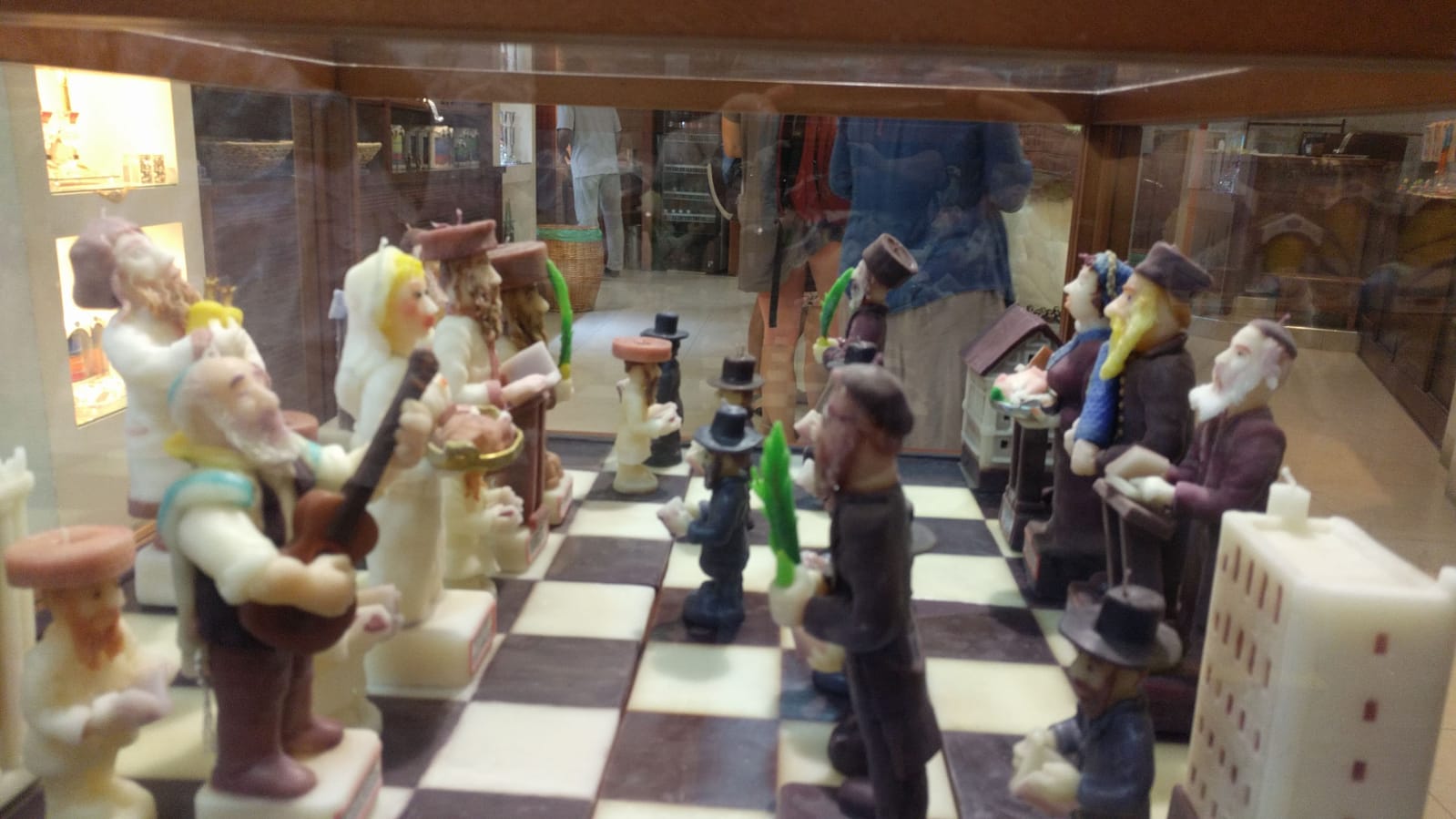
Mr. Herbert Halsegger notifies us of a new exhibit in the Museum of the History of Polish Jews: a chess set made in hiding by Pola Najder during the war. The details are in the link above.
Source: Museum of the History of Polish Jews.


Here are two pictures that maybe show the difference between the king and the queen better. The piece to the left is the king... There are many other variants of the style, and they were made in many countries in Europe and for a very long time...But Régence pieces became much less common when Staunton pieces became the international standard in 1924.The style was also used in other parts of the world for a long time, especially in French influenced areas. Kings with a cross is primarily connected to Staunton sets. Also other styles could have a king with a cross, but most other European and English styles normally featured kings without a cross.
We thank Dronen for the additional information and the correction.


The above chess set, a gift to captain William H. Barker, was presented in 1947 to him by those whom he took care of in a DP camp after the second world war. It is found on the Facebook site of the Jewish Museum in Vienna, as Mr. Herbert Halsegger notifies us.
.png)
.png)
In London and Oxford, we visited the British and Ashmolean museums. Below are photos of the famous Lewis chess set (ca. 1200) and another chess set from ca. 1500; note the shape of the rooks.


 |
| Source: Ha'Boker, Feb/ 16th, 1945, p 6 |
 |
| Credit: Personal Collection |
 |
| Photo credit: A. P. |
 |
| Photo credit: A.P. |
 |
| Photo Credit: see below |

 |
| Both Pictures: credit Moshe Slav and Slav Inc. |
 |
| An enlarged section of the second picture above. |


 |
| Gefilte Fish. Credit (public domain photo): www.wikipedia.org. |
After the first bombing of Warsaw in 1939... Simcha, his sister, and his mother had managed to smuggle themselves to the USSR by crossing the Bug river, and lived in a while in Brest-Litovsk. The refused a Soviet citizenship and were therefore expelled at the end of 1940 -- on rafts -- to Komi, USSR, not far from the capital, Syktyvkar.
That city was a place where Stalin and Trotsky exiled political prisoners since 1927 [sic -- a reader notes this is slightly inaccurate. Trostsky lost power by then, and the town was probably used as an exile place already in Tzarist times.] So apart from "anti-socials" there was in the city also an intellectual elite... most of the labor camp's workers did work on the Syktyvkar river, cutting trees and sailing them down the river. Where there's a river, there are fish! ... he and his sister remembered their mother making gefilte fish and would barter it for needed items. It is possible they got the set from one of her customers then -- sometime between 1941 and 1943.
His father got ill with tuberculosis and his mother with kidney disease. As incredible as this sounds, they both got released from the work camp [in 1943] for medical reasons [! - A. P.] and moved to Voronezh, where they both worked for the railway administration, as it was an important railway center.
The city is on both sides of the Voronezh river, and, when she was not hospitalized or in treatment, his mother would get fish and make gefilte fish. People didn't have money to pay, as there was a terrible shortage of everything, so they bartered. One client taught him to play the violin. It is possible another taught him chess and left his set with them as payment. ... at any rate the set is in our family's possession at the very latest from the beginning of 1944.The set is still in their possession. From its looks it is from pre-revolutionary Russia, and probably a treasured possession of the chess teacher or worker who traded it for gefilte fish. I will post a photo of it as soon as I can.
 |
| Photo: A. P. |
 |
| Photo: A.P. |
 |
| Photo: A.P. |
 Image credit: www.flickr.com.
OK, I'll stop here, or else this blog will have nothing but such images.
Image credit: www.flickr.com.
OK, I'll stop here, or else this blog will have nothing but such images.

