Showing posts with label Labounsky. Show all posts

Saturday, May 18, 2024

Palestine Tournaments in Chess Review, 1947


Source: Chess Review, March 1947, p. 9

In Chess Review, 1947, there is a short - but detailed - report on three tournaments in Palestine. One was the Tel Aviv championship (held, we add, in the "Lasker" chess club), mentioning in particular - with slightly variant spellings - A. Labounsky, Mandelbaum, Keniazer and Porat [Foerder]. It also mentions the "Jewish settlements" tournament - presumably the one of the communal settlements - and the upcoming 1947 championship, which eventually did not take place (the next championship, of the new state of Israel, took place in 1951) but mentions Hon, Aloni, and Rabinovich-Barav, as well. 

Sunday, June 25, 2023

Avraham Labounsky and Yosef Hermann


Credit: see below

In the above photo, given to us by Ami Barav (Israel Rabinovich-Barav's son) we see Avraham Labounsky (left) playing with Yosef Hermann, probably in a cafe in Tel Aviv in the 1940s. Hermann came to Palestine in 1937 and played in Tel Aviv's Lasker and Reti clubs. Barav, in turn, received the photo from Hermann's daughter, Aliza Distnik (ph. spelling). 

Saturday, June 3, 2023

Avraham Labounsky


Credit: Prof. Ami Barav

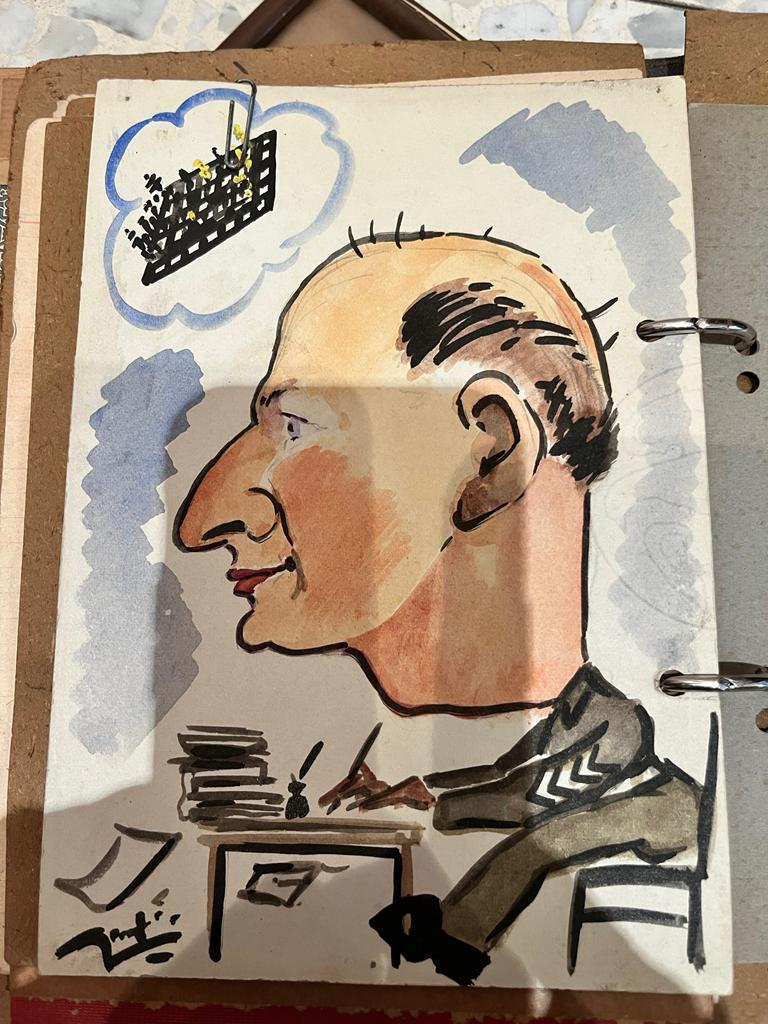
Prof. Ami Barav (Israel Rabinovich-Barav's son) sends us the following high-quality photo of Avraham Labounsky (left) playing against an unnamed opponent in 1938.  Also, found in Avraham Labounsky's apartment after his death, was the following caricature, passed to me by Prof. Barav:


Saturday, December 5, 2020

Tel Aviv - Jerusalem Match, 1923


An earlier item this time: a frequent correspondent notes this report from Doar Ha'Yom (October 10th, 1923, p. 4) of the Tel-Aviv - Jerusalem championship in the "E. L." (Emmanuel Lasker) club in Jerusalem. (It was brought to my attention by a frequent correspondent.) The Jerusalem paper's chess columnist - Mohilever - notes that Tel Aviv won 21.5 - 14.5, and explains that the Jerusalem players didn't prepare well, and some were simply too weak for such a tournament. The author notes in particular Labounsky from Tel Aviv as a promising young player. 

Saturday, May 23, 2020

Domnitz - A. Labounsky, 1954

One of the relatively lesser-known chess columns was that of Zmanim ("The Times"), a smaller newspaper in Israel than the major papers like Davar, Al Ha'mishmar, and others. The editor of the chess column was A. A. Mandelbaum. This column was brought to our attention from a frequent correspondent. From Zmanim we offer the followin game of the young Zadok Domnitz, when he played in the IDF's team in the Isreali premier league against the older Avraham Labounsky. 

Domnitz, Zadok - Labounsky, Avraham
Pirc Defense (B07)
Israeli Premier (Aleph) League, 1954
Source: Zmanim, 13.8.54, p 8S
Annotator: A. A. Mandelbaum

1. e4 d6 2. d4 Nf6 3. Nc3 g6 4. Be2 Sharper and more promising is 4. f4. 4... Bg7 5. Be3 O-O? 


Routine. Since White didn't apply the usual h3, Nf3, etc. attack and left himself more flexibility in pursuing the attack, Black should have used delaying tactics and defer the castling to a more  appropriate time. 6. h4 e5 Needed is 6... c5 7. dxc5 Qa5 8. cxd6 Nxe4 9. dxe7 Re8 10. Bd2 Nxc3 with compensation for the pawn 7. d5 b5! 8. Bxb5 (8. Nxb5 Nxe4) 8... Nxe4 9. Nxe4 Qa5+ 10. Nc3 Bxc3+ 11. bxc3  xb5 and with the threat of Ba6 Black has nothing to fear. 7. d5 c6 8. g4 Qa5? Correct was 8... cxd5 9. exd5 Qa5. 9. Bd2 Qb6? 9... Qc7 immediately is better. 10. g5 Ne8 11. h5 f5? 


Weakens the g8-a2 diagonal, and loses immediately. More consistent with the position is 11... Nc7.  12. dxc6 Be6 Bc4+ must be stopped at all costs.13. Be3 Qxc6 13... Qxb2 is forbidden due to 14. Na4 Qa3 (14... Qb4+ 15. c3 and wins) 15. cxb7 and wins. 14. Bb5 Qc7 Better is 14... Qc8. 15. hxg6 hxg6 16. exf5 gxf5 17. Qh5 Nc6 18. Qg6 Qc8 19. Rh6 f4? 


Up to now all of Black's moves were forced, but now 19... Nd4 would allow longer resistance. For example 20. Bd3 Bc4, Or 20. O-O-O Nxb5 21. Nxb5 f4 22. Nxd6 Bf5! 23. Nxc8 Bxg6 24. Ne7+ Kf7, etc. 20. Bd3! Threatens Rh8+ followed by Qh7#. 20... Rf5 21. Qxe6+ Enough to win, as we shall see. 21... Qxe6 22. Rxe6 Rxg5 The fight to regain the piece is hopeless. 23. Nf3 Rh5 24. Bd2 Rh1+ 25. Bf1 Rd8 26. O-O-O The Re6 is not in danger. 26... Nc7 27. Rxd6 Rh6


The Re6 rook was protected indirectly: 27... Rxd6 28. Bc4+ And wins the Rh1. 28. Rxd8+ Nxd8 29. Bxf4 A double attack on the Nd8 and Rh6. 29... exf4 30. Rxd8+ Bf8 31. Bc4+ Kh7 32. Rd7+ Black resigns (0-1).

Monday, October 21, 2019

Jerusalem vs. Tel Aviv, 1924

Source: Doar Ha'Yom, March 30th, 1924, p. 3
One of the first matches - probably the first match - between two chess clubs in Palestine took place in 1924, when the newly-establishes clubs in Jerusalem and Tel Aviv played a match. Here, with local patritoism, Jerusalem's Doar Ha'Yom notes the 'total victory' of Jerusalem's Gordon, Pappo, Mohilever and Korn over Tel Aviv's Labounsky, Polano (ph. spelling), Weisel and Steinberg.  One wonders whether Tel Aviv's "Polano" is actually Polani, a member of the Jerusalem club in 1923, as players moved about quite a bit at the time. 

Monday, September 2, 2019

The 1939 'Lasker' Club Passover Tournaments

Source: Davar, 21/4/1939, p. 8
Marmorosh had promised, in the April 14th column, to give a detailed report of the tournament the next week. This he did. Below the photo -- showing, right to left (seated) Mrs. Schwarzman, Zelmenitzka, Nachmani (both ph. spelling), Dr. Labounsky, Porat, Marmorosh, Zerodinzki (ph. spelling; club manager), Winz, Blass, Kniazer, Mrs. Binfeld (ph. spelling) and Ya'akov. 

Highlights from Marmorosh's report are that Rabinovich-Barav (then in Haifa) and Porat (then in a Kibbutz in the north) were elected 'honorary members' of the Lasker Tel Aviv Club. Other highlights note there are now 130 members in the club, that there were more than 1000 visitors during the tournament, and that 'interest in the women's tournament did not flag, despite the amazons' flagging game'. 

Like many of his generation, Marmorosh just counldn't take women's chess seriously, Graf and Menchik's achievement notwithstanding. 

Tuesday, February 5, 2019

The Labounsky Brothers, Palestine, 1920s


Credits: See Below
The following two pictures show us the Labounsky brothers. In the top photo, Nahum Labounsky is standing and his brother Avraham is sitting on the right. In the bottom picture, Nahum is sitting on the left Avraham is standing. 

The pictures, from Ami Barav's collection, were in his view photographed in the 1920s in Tel Aviv. Can anybody identify who they are playing with? 


More on Flohr's Picture

Credit: Ami Barav's collection
Following the previous postcard of Flohr , we add the back of the postcard (see link for credits). It is addressed by a chess player who visited Palestine in 1934 to "my dear chess friend" Nahum Labounslky for his help during the player's stay. Can anybody decipher the signature?

Saturday, June 2, 2018

Persitz, the "New Face" in the Tel Aviv Championship

Source: Davar, Jan. 24, 1950, p. 30

Here, we see a note of the 1950 Tel Aviv championship, in Davar's chess column, reporting the drawing of the lots. The editor notes that while Avraham Labounsky (the current champion) as well as Kniazer and Mendelbaum could not play, we see some "new faces" such as the fifteen and a half years old Persitz. Persitz indeed will become one of Israel's greatest chess talents inthe 60s and 70s. We thank a frequent correspondent for adding pointing this our to us. 

Saturday, March 17, 2018

Tel Aviv Championship, 1946 -- and the First all-Hebrew Chess Magazine

Source: Al Ha'Mishmar, April 18th, 1946, p. 3
An interesting report is found in Al Ha'Mishmar in 1946 by our frequent correspondent: it reports that despite 'a few unfinished battles', which 'cannot affect the final result', Kniazer won the Tel Aviv Championship for 1946. Yet the complete table -- given, e.g., on p. 90 of Ptichot Be'Sachmat ['Chess Openings'] by Hon,(3rd edition, Sept. 1964, as pointed out on p. 2 of the 4th edition, 1968) -- shows that A. Labounsky won the championship (Kniazer was joint 2nd/3rd).

The 1946 report also adds severe criticism of the tournament -- no less than four players had withdrawn, but 'unfortunately there is no official supreme organization (a Palestinian federation) to investigate the matter'. Technically false, as such a federation existed since 1936 as we have seen, but it was indeed de facto defunct due to the war, the battle for independence, and many other more important events. As Hon himself notes, (Ptichot Be'Sachmat, 4th ed., p. 27, for example) it was only after the end of the war that chess life in Palestine was renewed.

He adds (ibid) that the time was also ripe for 'a renewed appearance of a chess magazine' and that he took it upon himself to publish it -- but that it only 'lasted four issues', but was the first time a chess magazine was written (entirely) 'in Hebrew transcription' -- in earlier cases, as numerous examples in this blog show, the squares were usually given in Latin letters.

Indeed, in the very same column where the report of the 1946 tournament was given, a quick review of the first issue of Hon's magazine was given as well -- with the chess editor of Al Ha'Mishmar adding that an important point is that it is entirely in Hebrew, precisely what Hon wrote later in Ptichot Be'Sachmat. 

Sunday, December 31, 2017

Chess Posters

Source: The NLI
In Israel, it was common until the 1970s (at least) to advertise chess tournaments on posters which were posted on official notice boards in cities. Here is one for the 1969 (15th) Tel Aviv Championship, officially, the Abraham Labounsky memorial tournament. It includes both the "old guard" -- Czerniak, Aloni, Blass, Smiltiner -- and the "new blood", such as Bobis, Stepak, and 'ten talented youths'.

Friday, June 12, 2015

Barav - Vidor, 1944: A 12-move Combination

Barav was called by Shaul Hon (in Taharum Amanim Be'Sachmat [Master Chess Tournament], Tel Aviv: "Tel Aviv: "Omanuth", 1952, pp. 92-93) 'one of the greatest tacticians in our country' and a 'exemplary blitz player'.

He was also an organizer: he was one of those who established the Palestine Chess Federation, organized the sending of the Israeli teams to the Olympiads in the 1950s, headed the Israel Chess Federation for a while in the 50s, and so on.

His son, Ami Barav, apart from supplying me with the above information, also kindly gave me press clippings and score sheets of such games. One of them is between Barav and Vidor, the scoresheet given to me by his son:

Source: Ami Barav's collection.

The game was published, not only in Mendelbaum's and Persitz's ook (pp. 92-93), but, as part of Barav's obituary, in Shachmat vol. 11 no. 8 (Aug. 1979), p. 176. The obituary was written, and the game analyzed, by Avshalom Yosha. His is the analysis below, unless otherwise indicated. 

Barav, Israel - Vidor

Dutch Defense, Staunton Gambit (A82)

Lakser Club "Yovel" championship, 05.02.1944

1.d4 f5 2.e4 fxe4 3.Nc3 Nf6 4.Bg5 e6 5.Bxf6 Qxf6 6.Nxe4 Qg6 (Better is 6...Qh6) 7.Ng3 Be7 8.Bd3 Qf7 9.Nf3 Nc6 10.c3 b6 11.Qe2 Bb7 12.0–0 0–0–0 13.a4! Bf6? (13...g5  required) 14.b4 h5 15.a5 h4? (better is 15...g5) 16.Ne4 h3 17.g3 Qh5 18.axb6 axb6? (The file should not have been opened, but even after  18...cxb6 19.Ba6 white is Much better.) 19.Ba6 Nb8 20.Bxb7+ Kxb7 21.Qc4! 


'The beginning of a majestic combination' (Yosha). 'It too me 45 minutes, then I calculated a 12-move combination. Persitz would come to me to show me another variation every time, but I showed him I calculated it all.' (Israel Barav, from his son's recollection). 

21...Qd5 (21...Qxf3 22.Ra7+! Kxa7 23.Qxc7+ Ka6 24.Ra1+ Kb5 25.Nd6#) 22.Ra7+ Kxa7 23.Qxc7+ Qb7 (23...Ka6 24.Ra1+ Kb5 25.c4+  etc.) 24.Ra1+ Na6 25.Rxa6+ Kxa6 26.Nc5+ Kb5 (26...bxc5 27.Qa5#) 27.Nxb7 Ra8 28.Nd6+ Ka4 29.Qc4 Ka3 30.Nd2 Kb2 31.Qb3+ and Black resigned (1-0), due to 31...Kc1 32.N2c4 Bg5 33.Kf1 with unavoidable mate:  


'One of the most brilliant combinations even made in the country' -- Mohilever (quoted in Yosha's article). Mohilever also remind the reader in Yosha's piece that that Barav was one of the founders of the Palestine Chess Association, with Mohilever himself, Nachum Lebounsky, Haim Reid, and others. 

A search of secondary sources (books in Hebrew from the 1950s, chessbase's database, chessgames.com , etc.) find no games by Barav online, and only this specific game appeared once or twice in Hebrew-language sources. Ami Barav had done a significant service in saving some of his fathers games, which I plan to publish here periodically. Let us say now only that they justify Hon's statement about Barav's talent. 

Edited to add: Barav notes that the correct spelling is 'Labounsky', not 'Levonsky'.

Saturday, April 5, 2014

More About Avraham Labounsky, the First Secretary of the Palestine Chess Federation

Avraham Labounsky. Credit: see below.

We have noted before that Avraham Labounsky was the first secretary of the Palestine Chess Federation (his brother, Nachum Labounsky, was elected the first treasurer in the same meeting).

Moshe Roytman now informs us that a capsule biography of him (from which the above photo is taken, in British Uniform; link in Hebrew) was published in Davar on Feb. 21st, 1947, p. 23, on the occasion of him winning the [1946] Tel Aviv championship -- ahead of Mendelbaum, Kniazer, etc. The full crosstable is found, e.g., in Shaul Hon's Ptichot Be'Sachmat [Chess Openings], Shach Pulishers: 1964 [1957], p. 90.

Of particular interest is the claim that he started 'getting interested in chess at age 16', which is relatively late; his winning Rome's city championship in 1933 when he studied there; and playing a match against 'Bizzio [ph. spelling -- ביזיאו], the 'Roman champion', winning 6:2. It is also mentioned that when he was in active servive in the British Army (1943-1946), he 'organized simultaneous displays in the Jewish companies'. Surpisingly, his role in the Palestine Chess Federation is not mentioned.

These companies -- which served in branches as varied as the Auxiliary Military Pioneer Corps to transportation and camouflage companies -- were the forerunners of the more famous Jewish Brigade, est. late 1944. More information (in Hebrew) about these units can be found here.

Note: Ami Barav adds that correct spelling of the name is not, as said before, 'Levonsky', but 'Labounsky'

Saturday, December 7, 2013

The Early Days of the Palestine Chess Federation

Source: Davar, Nov. 14th, 1934, p. 5. 
A frequent correspondent of ours notes that on Nov. 14th, 1934, the Palestinian Chess Federation officially started its activities by opening a chess club in the "City" cafe in Tel Aviv (three times a week) and calls for all chess players to join by writing to the secretary, Nachum Labounsky, in his Tel Aviv address. What's more it notes that its first general meeting in the same cafe had about 70 (!) players. It is interesting that one of the items on the agenda was 'hearing a report about the activities of the previous [chess] committee'.

As there was no previous chess Palestinian Chess Federation prior to this date, indeed the article itself notes that it had just started its actions, this can mean either the leading Tel Aviv players or organizers, perhaps that of the Rubinstein's club committee, or else that a committee of chess enthusiasts had worked as an unofficial Palestinian Chess Federation before the official annoucement. Mystery solved -- see next post, above.

Lebounsky himself writes on Nov. 30th in Davar (p. 10) that the Federation's two main goals are, apart from promoting chess in general (buying new sets, arranging tournaments, etc.) to stop the 'chaos' in Palestinian chess by having one federation, and to get Palestine into FIDE for the Olympiads -- in both of which it succeeded.

Edited to add: Ami Barav notes that the corrct spelling is 'Labounsky', not 'Levonsky'.