Saturday, October 3, 2009

In Memorium: Shaul Hon, 1921-2009


The Israel chess world has lost one of its oldest and most active members -- Shaul Hon. As the obituary in the Israeli Chess Association's bulletin (Aug. 2009, p. 38) notes, he was a true polymath -- earning a degrees from the Hebrew University in nine (!) different fields, including inter alia biblical studies, art history, linguistics, and law. The obituary adds that he was Ma'ariv's (Israel's largest, or second-largest, newspaper) resident reporter for chess, law, and archeology -- surely a unique combination.

Hon's author's page on an Israeli used-book internet 'clearing house' lists fifteen different books (not counting "doubles") of which eleven are chess books. This is without taking into account his hundreds of articles, columns, investigative reports, etc. on various subjects, from literature and law to art history and chess.

Hon was the only (so far as I know) Israeli reporter that covered live the 1972 Fischer - Spassky world championship match. As he related in his book, Ha'Krav al ha'Keter [The Fight for the Crown] (Tel Aviv: Ma'ariv Library Press, 1972), he was the first reporter in the world to officially break the story that Fischer is going to forfeit the second game on time -- half an hour before all other reporters. As Hon explains, after Fischer was 30 minutes late, he realized Fischer might like to be late 5 or 10 minutes, but certainly not half an hour, and that therefore he will not show up.

Hon was a bit of a fanatic for correct Hebrew -- unsurprising, considering he was inter alia a student of Naftali Hertz Tur-Sinai (nee Turtschiner), the head from the 1930s to 50s of the Academy of the Hebrew language, an institute whose raison d'etre is to find Hebrew words to replace foreign ones. (Tur-Sinai, by the way, was satirized by the humorist Efraim Kishon in the 1950s in the character of 'Elihav bar-Ahisemech, the living soul of the Hebrew language'.)

Tur-Sinai, Hon related in a 1964 article, sent him to 'purify our chess terms from foreign expressions that unfortunately still appear in our midst.' (Hon, Shaul. Minuach Ivri be’Shachmat [Hebrew Terminology in Chess]. Shachmat, 2nd year, no. 8 (March 1964), pp. 3-4.) Hon suggests, e.g., that since a pawn in Hebrew is a hayal (lit. 'soldier'), one should not talk of kelim kalim and kelim kvedim ('light pieces' and 'heavy pieces', from the English) but rather of ktzinim zutarim and ktzinim bechirim (junior and senior officers). The international term 'Zugzwang' should be replaced with the Hebrew kfai ('to be forced to act', from the verb kefot, 'to force someone to act'.) Naturally, kfai must not be confused with kfat -- 'to be completely tied up' -- Hon's translation of the German (and Hebrew chess jargon) Patt, or stalemate.

It is not surprising these suggestions did not succeed, since players are not likely to change common terms just to preserve perfect logical consistency in their jargon. However, some suggestions were accepted: for example, to replace gilgul (lit. 'reincarnation') with hachtara (lit. 'coronation') as the Hebrew term for 'promotion'. Most players seem to intuitively think of the promoted pawn itself (or, as in Through the Looking Glass, herself) as rising in rank, usually to royalty, not as "dying" and being "reincarnated" as a piece -- despite the fact that the pawn is in fact removed form the board and another piece (usually the queen) put in its place.

May he rest in peace.

(Photo above: cover of Ha'Krav al ha'Keter, Hon's 1972 book about the Fischer-Spassky match.)

Saturday, September 19, 2009

Mistakes

From Eliyahu Fasher's personal archives, a quote in a letter to him. The letter, from 1967, is a note by chess problemist A complaining to Fasher about chess columnist B:
About Mr. B's "pseudo-apology" in his latest column, claiming that 'to make no mistakes is the same as to not do anything', one can reply, 'make lots of mistakes -- that means you did a lot'.
This excuse is still commonly used, and the reply is still apt.

Saturday, September 12, 2009

God Knows what the Mailman Made of it


A postcard from a fellow-problemist to Eliyahu Fasher, 1967. Image credit: Yad Tabenkin institute, Eliyahu Fasher's archives.

Chess jargon -- and problemist's jargon in particular -- is notoriously odd-looking for the non-initiated. Hans Ree notes in his article 'Sic' (The Human Comedy of Chess: A Grandmaster's Chronicles, 1999, pp. 284-285 [Milford: Russell Enterprises]):
"Do you people really talk about 'problem composers'?" my interlocutor asked with amazement. "Certainly, that is the usual term," I said. She was silent for a moment, and then she smiled and said: "That is the term I have always been looking for, for my husband."
Here we have another example. 'You asked without [picture of black knight], so without [picture of red rook] f6'. What are those weird pictures? And what is f6 -- in Hebrew, written like 'and 6' ? 'And 6' what? No doubt some code. What's more, the letter says that in the previous form there were 'four threats', but now the writer is only giving 'two threats'.

A threatening letter in code. Who sends something like that in a postcard, anyway, which anybody can read? Should I, the mailman, report it to the police?

P.S.

I apologize for the wonky formatting in the last two posts -- blogger's formatting is acting up again.

A Good Reason for Speeding


Photo Credit: Yad Tabenkin institution, Eliyahu Fascher's archives.

A 'happy new year' note from the Friedman family to Eliyahu Fasher:

Printed, top two rows: '
Where? Where are you hurrying?'
Added in Friedman's handwriting: 'Even in time pressure?'

Saturday, September 5, 2009

Andrew McMillan's Investigation of the Alekhine "Checka" Arrest Affair


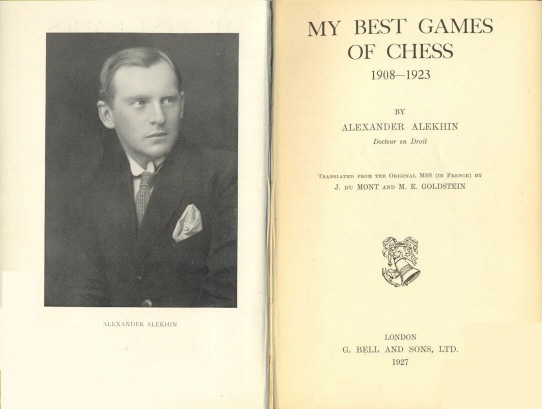
Alexander Alekhine. My Best Games of Chess 1908-1923 (London: G. Bell & Sons, 1927). Photo credit: Edward Winter's Chess Notes #4310.

One of the well-known stories about Alekhine is that he was nearly shot by Odessa's secret police in 1919, only to be saved by Yakov Vilner's intervention with the Ukrainian chief commisar, Kristian Rakovsky, due to recognition of his chess genius. Vilner worked in the Odessa military tribunal at the time, and told Fedor Bohatrichuk this story in great detail, which Bohatrichuk quotes in his writing (in pages 51-52 of his book Moi' zhiznennyi' put' k Vlasovu i Prazhskomu manifestu [My Life's Path to Vlasov and the Prague Manifesto], Globus Publishing House, San-Francisco, 1978.) Andrew McMillan generously sent me both Bohatirchuk's original Russian writing and a translation into English.

Different versions of the story exist, apart from the one above. Andrew McMillan also informed me (my additions in brackets for clarification):
In his [Russian-language] well-researched book on Alekhine, [Alexander Alekhine, 1992, Moscow] Shaburov states that the story of Alekhine being arrested by the Odessa Cheka in April 1919 and rescued due to his chess reputation first appeared in CHESS magazine in its Dec. 1937 issue. In that story Trotsky himself is involved. Shaburov established from a number of sources that Trotsky was not in Odessa during this period. Shaburov then mentions the version of this story in Müller and Pawelczak's book about Alekhine . Shaburov also briefly gives Bohatirchuk' version that Vilner told him that he saved Alekhine by getting Rakovsky to intervene. Shaburov acknowledges a different version...
that Agriculture Commissar Dmitry Manuilsky was the one who intervened.
A summary of both Bohatrichuk's 'Rakovsky' version and of the 'Manuilsky' version can be found online, e.g., at this link. McMillan notes that Shaburov's research is thorough and his email is merely a brief summary, and also that -- unsurprisingly -- Shaburov found little original documentary evidence. Shaburov (says McMillan) further notes in his book that a similar story was told about Ossip Bernstein in Edward Lasker's obituary of him in the April 1963 Chess Review, pp. 104-105 (which McMillan also scanned and sent to me) and elsewhere. Shaburov, notes McMillan, speculates that since Bernstein and Alekhine were both in Odessa at the time, somehow what happened to Bernstein was told of Alekhine.

However, it seems to me the opposite is more likely. Bohatirchuk's recollection of his conversation with Vilner is full of specific details (in his original writing, if not in the summary posted here and in the link above) -- names, dates, etc. -- while Lasker's claim about Bernstein's has very few verifiable details, and tries to "make up" for lack of verifiable evidence with a dramatic story.


Lasker does not mention who saved Alekhine's life, but only that it was 'a superior officer' who overruled the execution order of 'one of those sadistic minor officials'. It has the chess master prove his identity by playing a game (literally for his life) with the officer, 'winning in short order'. In Lakser's version, the master was not only under sentence of death, but already lined up against the wall in front of a firing squad (!), together with many others, when the 'superior officer' discovered his identity -- and those others' lives were also saved by the master when his identity was confirmed by winning the chess game with the officer. Finally, Bohatirchuk unquestionably was in revolutionary Russia (or the Ukraine) at the time of this alleged incident, while Lasker, of course, was not.

Is it not more likely, on literary grounds at least, that if anybody was in fact arrested and threatened with execution, it was Alekhine, and that story 'grew with the telling' and was transferred to Bernstein?

Above all, there is Alekhine's own cryptic handwritten note, forwarded to me by McMillan, confirming that he was in fact imprisoned -- and released -- by the Checka (or Tsche-Ka). As McMillan notes:
So far all I can send you from these is the unpublished handwritten note Alekhine included in the original manuscript of his book Das Schachleben in Sowjet-Rußland Berlin 1921. It confirms that he was imprisoned by the Odessa Cheka but does not provide information about the reason of his imprisonment or release. Buschke reproduced the note in the Sunday, August 5th, 1951 issue of Chess Life, page 3.
The note -- in German, translated by Buschke into English -- is reproduced below:


Saturday, August 22, 2009

Never Take the Easy Way Out


David Bronstein, ca. 1964. Image: Wikipedia, "David Bronstein" entry.

From Moshe Czerniak's 1963 chess history book (see exact details in the post previous to this), p. 90:
Bronstein doesn't like to achieve his goals the easy way. I once blamed him for deliberately chosing the most difficult way during a game, in order to engage his creativity. The same quality is typical of him in life. When he learned to read English, he immediately started reading Shakespeare's work. 'It is harder, but also more interesting', he explained.
Can't say I'm surprised!

Mieses in Palestine


In Moshe Czerniak's Ha'sachamat (first volume, first issue, dated merely '1936'), we find it reported (p. 2) that 'one of the relics of the great players of the 19th century, Ya'akov [the Hebrew name translated as "Jacques" in French] Mieses, was in our country.' Not only that, but Mieses contributed an article about Jewish chess history to the same issue of the magazine (pp. 8-10).

According to Czerniak's later recollections, in Encyclopedia Tevel u'Meloah: Toldot Ha'Sachmat me'Reshito ve'Ad Yameynu [The Whole World Encyclopedia [Series]: the History of Chess from Its Beginning to the Present] (Tel Aviv: Mofet Press, 1963), pp. 50-51, he says, however, that the visit was in 1937. Czerniak adds there:
In 1937, when over 70, he arrived in our country. As a Jew, he wanted to know the Holy Land. Despite this being during the Arab revolt, he did not avoid going to the Wailing Wall and visiting the old city in Jerusalem. He gave a few simultaneous displays in the country. In one of them he played blindfolded against eight amateurs in Jerusalem. In another exhibition he stopped two of his game for a while so that his observant opponents could pray ma'ariv [the evening prayer].
Does anybody have information about the exact date of the visit -- was Czerniak's memory in 1963 faulty, or was his 1936 magazine misdated? Does anybody have more details about the visit?

Edited to add -- the visit was certainly in 1936. The particulars can be found in more posts about 'Mieses' in this blog. There are slight discrepancies between the totals of players in Mieses', Marmorosh's, and Czerniak's recollections. With all probablity Marmorosh's contemporary and detailed accounts are the most accurate. 

Tuesday, August 11, 2009

Abdullah of Jordan and Chess


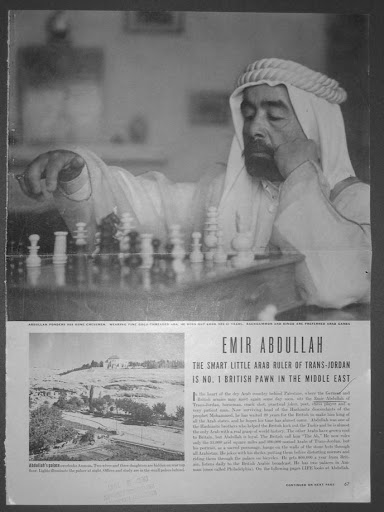
As previously noted on this blog, king Abdullah I of Jordan (1882-1951) was a keen chess player, having invited Moshe "Mendel" Marmorosh to play with him in Amman in the 1930s (see also Edward Winter's chess notes #4211.)

Above is another photo of him from 1941 -- at the time, he was the emir (governor) under the British mandate. This photo appears on "Mr. Chess"'s very interesting picasa album. (Hat tip: Andrew McMillan).

Sunday, August 9, 2009

Without Comment


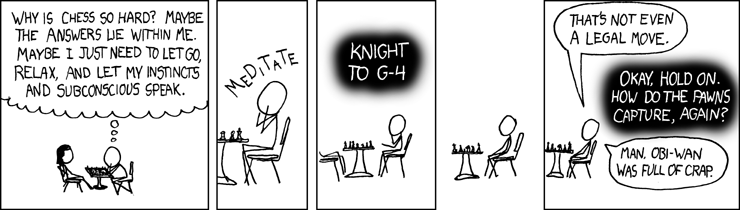
From www.xkcd.com , the web-based comic strip.

Well worth visiting for other reasons than chess.