Friday, November 23, 2012

Chess on the Radio

Credit: Occam's Razor blog

A frequent contributor had returned from the evening in honor of Shimon Kagan, the first native-born winner of Israel's national championship (in 1967) among other achievements, had noted that those who arrived had reminiscences of the "good old days" -- and, in particular, noted the importance of radio in Israeli chess. They recalled how they used to listen to chess programs on the radio, and when Zadok Domnitz had drawn with world champion Tigran Petrosian in the 1964 Olympiad held in Israel, this item opened the radio's regular news program.

A few more details: there were already regular chess radio columns in the 1940s before the declaration of the state of Israel in Kol Yerushalayim ["Voice of Jerusalem"], the British-mandate run radio channel. After the founding of Israel and of the national Kol Israel ["Voice of Israel"] channel, Shaul Hon ran the chess column for a few years, followed by Moshe Czerniak. Czerniak's programs were quite advanced: in 1951 he ran an entire series of broadcasts about chess endings, including "Queen vs. Pawn" (14.2.1951) and "Bishop vs. Pawns" (11.4.1951), to name two.

Edited to add: a (different) frequent contributor notes that Aviad Yafe [link in Hebrew], an Israeli politician who was inter alia the head of the Israeli Chess Federation, had given an interview in the 1970s where he remembered how, in 1936 or 1937, as a 13-year-old, he served as an assistant to Czerniak in producing his radio column. This makes it likely that Hon took over when Czerniak, who left for the Argentine Olympiad in 1939 and only returned in the early 50s to Israel, was not in the country. Hon, apparently, gave the column "back" to Czerniak by the 1950s. The same reader also notes Davar mentions as recently as 1964 regular chess columns in the radio and provided us with the link (below).

Also, from Yochanan Afek
During  Haifa olympiad 1976 there was a special national radio studio there run by  professional presenters like Amos Goren and Khaiuta Dvir with a daily program broadcasted at 23.00. Moshe Czerniak was the chess expert summerizing the daily round and  interviewing  celebrities of whom I can remember the good old Edward Lasker. My own role in that studio was to announce every night the results of the day to the entire nation.

Sources (In Hebrew): "A Listener's Comments" [B. Ron], Davar, 21.1.1949; "A Radio Chess Department" [Shaul Hon], 29.10.1948; also the weekly "radio guide" published in Davar (Friday supplement) for details concerning Czerniak's programs. "The New Kol Israel Schedule", Davar, 27.3.1964 (chess is mentioned in the last line [link in Hebrew]); personal email from Afek and a contributor.

Friday, November 16, 2012

Quick One this Time -- Political Leaders and Chess

Shimon Peres (l.) vs. GM Alik Gershon (r.). Credit: The Happy Hermit

In 2010, Alik Gershon established a new simultaneous record (playing 523, drawing 58 and losing only 11). At about the same time, a reader's correction: the above photo is actually from 1996, before the elections, when Peres was not President, but Prime Minister. To judge by the board, Peres -- like Ben Gurion -- considers developing pieces optional. What is it with Israeli political leaders and bad play?

Politics and Chess - Again

Time cover of edition with Abdullah I's interview (copyright Time magazine)
Considering the situation right now in the middle east, it is only fitting to look at chess history to see what effect, if any, chess had on war and politics in the middle east. First, we have often commented on, for example, chess in the IDF, or on political leaders and chess (see blog's tags).

Second, we have found something interesting. As is well known, in the war of independence the Jordanian king, Abdullah I, seemed rather reluctant to invade Israel (although Jordan did indeed participate in the war and even captured some territory, notably the old city in Jerusalem). In an interview in Time, titled "Chess Player and Friend", a few months before that (Feb. 16th, 1948), Abdullah is described as follows:

Last week, fingering a set of exquisitely carved chess pieces in his winter palace at Shouneh, a few miles east of the River Jordan, he told a TIME correspondent: "Politics is like chess: you cannot rush your pawns across enemy territory, but must seek favorable openings".
Of course, we are not suggesting Abdullah didn't invaded with full force in 1948 because he though this would not fit with chess strategy. But it is interesting that he uses chess metaphors to describe his famous caution. What's more his metaphor shows a greater understanding of chess than the usual ones political leaders use. 

It's amusing to compare his chess with the way David Ben Gurion played -- very much "rushing his pawns across enemy territory" without any concern for a favorite opening. Perhaps there is a deeper lesson here? Perhaps it is not so much lack of chess skill, but the aggressive vs. cautious character which both leaders were famous for that determined, partially, their chess-playing way? 

Wednesday, November 7, 2012

Gamesmanship, Legitimate Play, or a Tall Tale? Or, why it is Harder to Write History than one Might Think.

I am writing a relatively long post to show the way chess historians must be careful not to buy anything they are told -- but also not to dismiss everything they are told, either. While many laymen believe everything people recall about the past due to exaggerated respect to eyewitness testimony, amateur historians tend to fall into the opposite extreme: to dismiss all accounts that have minor variations in them as "inventions", and rely only on "published documents", forgetting that psychological factors make recall fuzzy as time goes on, which hardly means the eyewitness is lying, and that documents can be just as wrong as eyewitness statements.

The worst cases of this are seen in holocaust denial, where amateur historians (David Irving most famously) ignore the context and the times, relying only on published documents, and thus take at face value the Nazi's talk of "evacuations" and "fighting partisans", and claim minor discrepancies in eyewitness testimony as "proof" they are all lying. The reality, as historian Michael Shermer notes, this is getting it backwards: the Nazis deliberately used obfuscations in their official documents, while it would be extremely surprising if all eyewitnesses, each with their own point of view, would have told exactly the same story.

Something similar, if on a much more benign level, happened to me, when trying to establish the truth about an historical incident. I was told yesterday by a veteran Israeli player, IM A, that another Israeli player, IM B, had used the following trick:

In a lost position, with both players in desperate time pressure, IM B had deliberately hanged his queen! He slammed down his undefended queen on d4, forking the opponent's queen on a7 and the king on g7. His opponent, famous American GM C, was shocked, and started thinking furiously. He might indeed have lost on time, as IM B intended, if it weren't for IM B's unfortunate mistake: he slammed the clock so strongly his own flag fell! After the game, GM C and his colleagues told me, angrily: "this is just not done!"

The problem? I checked the database and no game between IM B and IM C which fits the description took place. What's more, IM B apparently never reached such a position in any formal game. Incidentally, the position itself occurred quite rarely, even with the queen defended: only about 200 times in nearly 3 million games in my database.

It is easy to now dismiss the story as an invention, a tall tale. But this would be hasty. There was indeed a game between IM B and GM C in the said time and place which IM A had noted. What's more, the game ends, two moves before the time control, in the following position:


In this position, after Black's move (... h5) the database says Black won (0-1). Indeed he is about to mate White. But, if here White played Qd4!? in an effort to make Black think a few seconds and lose on time, it would fit well with IM A's story. It is not surprising that if this is so, this last "tactical shot" was not noted in the database.

But this is not the end of the story. Does this mean IM B actually tried to "pull a fast one"? Possibly: objectively, Qh1, Qe2 or even Qxg4 are better (although they still lead to a dead-lost position) but would not have such a psychological effect on the opponent. So an attempt at a "swindle" seems possible. On the other hand, he might have been so short on time he might have blundered in earnest: after all, even great players sometimes commit oversights.

If I knew how hard it would be to get to the truth in chess history, I might never have taken up this hobby...

Tuesday, October 30, 2012

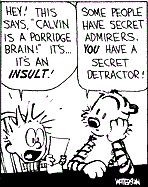
I have a Secret Admirer...

Credit: Calvin & Hobbes, 7 Nov. 1992

The memorial event for Yaakov "Yashek" Bleiman passed with great success, if I say so myself. Two "surprise guests" were videos by his daughter (and his grandchildren), as well as an interview with various VIPs (top engineers in Rafael, high-ranking officers who knew him, etc.), both live and on video. We are considering how. and whether, to put the event online.

The next day I received a delivery of flowers. I would have liked to thank the sender, of course, but there was no return address for the sender... so in case you are reading this, thank you! 

Wednesday, October 24, 2012

Chess and Politics, Continued

Eliezer Zurabin (l.) playing with Yitzhak Modai. Photo credit: A.P.

The above photo was taken 23/3/1979 on Menachem Begin's plane, as he was travelling in 1979. The two were close associates: Zurabin was the head of Begin's 1977 election campaign, and Modai one of the ministers (minister of energy and also minister of communications) in Begin's government.

It is interesting to note that the two, despite being VIPs, are playing with a cheap plastic (the pieces) and paper (the board) set, the kind of beginners' set Israeli children used to buy for pocket money. As for the game itself, White seems to have just queened, but Black is still a rook and knight for a couple of pawns ahead. The two seem to be taking this rather absurd position quite seriously.

The photograph is hanging in El Al's building in the Ben Gurion airport, together with many other candid photographs of Israeli PMs on El Al's flight. Begin and Ben Gurion themselves, as we have seen, occassionaly played chess, although neither were particularly good at the game (nor claimed to be).

Monday, October 15, 2012

Bleiman's Event -- 25 10 2012 (Hebrew)

For Hebrew reading folks: attached is the invitation's to Bleiman's event.


Thursday, October 4, 2012

Announcement

Image credit: St. Paul's Anglican Church

The Israeli Chess Federation is preparing a memorial event for Ya'akov Bleiman (1947-2004), a chess player, chess child prodigy, engineer, and winner of many awards for his contribution to Israel's security managing projects in Rafael. The event will take place on Oct. 25th, ca. 5 PM, in Beit Ha'Sachmat in Tagore St., Ramat Aviv. More details will be given soon.

Bleiman was nicknamed the "Vilna Gaon", for good reason, as can be seen from my previous post about him. He lived a fascinating life, and played superb games. The public is invited -- more details will be given later.

Answer to Quiz: Chess and Zionism

A Zionist postcard, with Herzel in the center, ca. 1900. from  The Jerusalem Connection.

The notation is reversed. Doar Hayom uses a notation where the files are signified from left to right -- the h-file is the Aleph (א, first letter of the Hebrew alphabet) file, the g-file the Beyt file (ב, the second letter), and so on. In particular it means the kings are on the d (ד, Daleth, the fourth letter) file and the queens on the e (ה,  Hey, the fifth letter) file. Thus the game notation is "mirror imaged" from the usual current Hebrew notation, where the a-file is signified with an א, the b-file with a ב, etc.

The game given in the previous post actually started 1. e4 e5 2. Nf3 Nc6 3. e4 (the Scotch gambit), etc. By the way, the term used for the queen -- the Hebrew letter ג, for גבירה (Gvira, Dame, as in the French) was later replace by מה, for מלכה (Malca, Queen, as in English).

Why the weird notation? The reason is Zionism. The Lasker chess club members which ran the Doar Ha'Yom chess column were ardent Zionists, and they wanted to revive Hebrew in all fields -- including chess. This meant, inter alia, translating all chess notation. Since the "gentile" chess notation in the European languages goes from left to right, this was ruled out. Instead, a "Jewish" chess notation -- from right to left, as in Hebrew -- was instituted.

This notation did not last long, as it made comparing or translating games from foreign sources unnecessarily difficult and even more prone to error than  chess notation usually is. In every move the translator had to remember to "translate" the first English letter into the eight Hebrew letter, the second into the seventh, etc., and vise-versa. By the 1930s at the latest the notation reversed back to what it is to this day, namely, the a-file is the Aleph file, the b-file the Beyt file, etc.