Saturday, August 17, 2013

Oren vs. Gelfer

Source: Davar, Dec. 17th 1954, p. 14

A frequent correspondent to our blog noted that in 1954, the ex-Israeli champion, Menachem Oren, played a simultaneous game in the Emmanuel Lasker club in Tel Aviv 'last saturday' (i.e., Dec. 11th) against 24 players, 'mostly youth of level Aleph [at the time, the rough Israeli equivalent of 'candidate master' or 'expert' level in other countries -- A.P.]. The result was (from Oren's point of view) +14 -4 =6. The interesting point? One of the winners, then a nine-year old, was Israel Gelfer -- currently FIDE's vice president and for a long time the holder of numerous important posts in both Israeli chess and FIDE.

He is, by the way, an FM with a rating of about 2350, as well as an international arbiter, international organizer, and senior trainer. All of these are, incidentally, are official FIDE titles showing real achievements and the compliance with stringent standards, not honorary descriptions.

Tuesday, July 23, 2013

A Nice Marmorosh Simul Win

In this position, Marmorosh (white, to move) has a nice attack. But how does he win? The game is from a simultaneous display given in Tel Aviv in 1927, published in La'Merchav's chess column on 20/7/1956 (editor: Eliyahu Fasher, with his annotations below).


1. Qh7+ Kf7 2. g5 Rh8 3. g6+ Kf6 4. Rde1! (threatening 5. Rxe6#) Bd5 5. Bc1! (threatening mate in two on g5) Nf5 6. Bf4 Rxh7 7. Rxf5+ exf5 8. Bxc7 Kxg6 9. Rh5 Be4 19. Rxe4 and wins (remains with two bishops for the rook).

Saturday, July 20, 2013

Who was Rev. Cohn of Chicago?

Lost to Rabbi Cohn? Credit: wikipedia.

In The Occident, on Nov. 15th, 1860, (p. 6), the Jewish-American newspaper, appears a note that "Rev. Mr. Cohn" was chosen as a Rabbi for the Chicago congregation. This is relevant to Jewish chess since the article continues to note that he is a celebrated chess player who "vanquished the celebrated Paulsen."

The problem is that I can find no game which Paulsen lost to Cohn, nor a tournament (using Jeremy Gaige's Chess Tournament Crosstables) finds any player named "Cohn" who played in America in that time period in strong tournaments.

Is this mere puffing by the newspaper -- e.g., perhaps Cohn once won a game in a simultaneous display or the like -- or was there really a strong player named Cohn from 1860s Chicago? I shall re-check using Gaige's Chess Personalia, but I doubt I will find anything. Does any reader know more?

Edited to add: I checked, and, as expected, found no Cohn or Cohen who could fit the bill in Chess Personalia.

Chess History and the Hebrew Language

Credit: wikipedia


It is now well known, and accepted by almost all authorities, that chess originated in India ca. 600 AD. This was not the case in the 19th century, when the invention of chess was attributed to numerous other ancients, legendary or real, such as Achilles, King Solomon, etc.

One of the first mentions of chess in a Jewish newspaper was in The Occident, the American Jewish newspaper, on Oct. 18th, 1860, pp. 4-5, reprinting an article from the Chess Player's Chronicle, by the Jewish player, Aaron Alexandre, who was a strong player (winning a match against Staunton in 1838) and chess historian. The letter claims that chess was invented, perhaps, by Moses, and that 2 Samuel ii. 14 is, based on the original Hebrew, was really the settlement of a political dispute by a game of chess, much like the old Indian legend about chess being invented as a replacement for actual war.

Alexandre's interpretation is ingenious, linguistically speaking, but quite forced, and in any case not accepted by most people. But it is probably the first time in the modern era a Jewish player tried to argue for a specific origin of the game -- naturally attributing it to the Jews.

P.S.

For some reason I cannot link to the article itself, it's possible however to search the newspaper in the link with the details provided.

Saturday, July 13, 2013

Quick Addition about the 1929 "Mystery Tournament" & Other Inter-City Tournaments in the 1920s.

Note: all links here are in Hebrew, except the first.

We have seen before that there was an unofficial Championship of Palestine in 1929. Tarbut Encyclopedia (Masada Press, 1964), in "Jews in Chess", adds that the the winner was Victor Winz, one of the strongest players in Palestine at the time.

This was not, it should be noted, the first tournament where players from various cities had joined. Already in 1922 there was a Tel Aviv - Jerusalem match; here is a report on the second (1923) tournament, which mentions in particular Pappo, the Tel Aviv player, as being successful (in Hebrew).

What's more, Marmorosh, in the mid-1920s, was promoting chess all over Palestine. While from Tel Aviv, he played for a while also in Jerusalem clubs, and even won the Jerusalem championship in 1928, while Pappo, playing for Tel Aviv in 1923, played in the Jerusalem championship in 1924.

As people did not "move about" too much at the time, it is likely that the clubs simply didn't care where a strong player lived -- as long as he joined and played. So the whole matter of which tournament was the first "general" or "nation-wide" tournament in Palestine depends more on definitions than on the facts. Was it in 1922, 1924, 1928 or 1929?

Sunday, June 30, 2013

Congratulations, GM Gelfand

Credit: Chess Base's report

GM Boris Gelfand had made the best result of his career, winning the Tal Memorial, with 6/9 with no losses, ahead of Carlsen, Anand, Kramnik, Nakamura and others, for a 2900 Elo performance.

It was an excellent tournament with many fine games, and such a score is a great achievement by any standard. Congratulations, Boris, for an excellent performance.

Apart from Gelfand's another particularly noteworthy score is Nakamura's: only one draw, four wins and four losses.

"Ha'Sachmat" Gets Noticed Abroad


Our correspondent Moshe Roytman notes that Ha'Sachmat, the magazine often mentioned in this blog which was published in the early 1920s by the Lasker chess club had been noticed abroad. For example he notes that on Dec. 5th, 1923, a short article [above] about it appeared in Der Moment, a European Yiddish-language newspaper.

I suppose this is partially what Mohilever meant when said in Doar Hayom [29.6.23] at the time that "the eyes of the Jewish chess world are raised to us" as the Lasker club is "holding up proudly the flag of Jewish chess"...

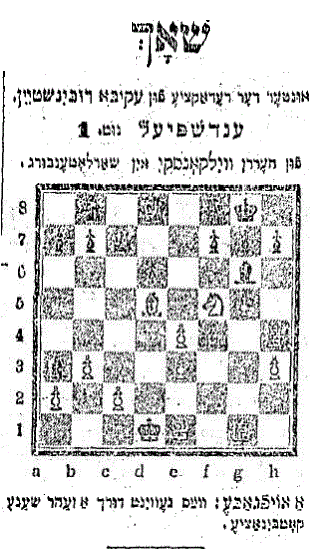
Rubinstein Chess Column


"Der Moment" published from 1910 a chess column in Yiddish edited by Rubinstein. Here are the first  (Nov. 18th 1910) and the second column as an example. Above are the beginnings of both [long] columns; the complete columns are in the links.

The first column includes, inter alia, Rotlewi - Bogljyobow 1:0 (Rubinstein calls the opening "Queen's pawn game" and explains that Black "uses the old reply to the queen's gambit"'; today it is known as the old Indian defense), the second a report on the Lasker-Janowsky match with a game from it (a Lasker victory). 

Advertisements


Our frequent correspondent, Moshe Roytman, informs us of he following ad [top]  from "Der Moment", a Yiddish-language newspaper, on Oct. 13 1913, declares the publishing of the "first Yiddish chess magazine" edited by Salwe and Kreichek (my phonetic spelling and promising contributions from Emmanuel Lasker, Akiba Rubinstein, and others. Another ad for the same magazine - below - from Nov. 19 1913 notes that the latest issue has an article about King Solomon [sic!] and the Wonder of Chess". Mr. Roytman informs me that a total of three issues were published in Oct.-Nov. 1913.