Saturday, August 30, 2014

Down for Repairs -- and Background Change...

Credit: www.ace949.com 
Sorry about the blog's disappearing pictures -- I seem to have a problem with the syncing between the Picasa Album and the blog. Hope it will be fixed soon...

Update: (Aug. 30th, 2014): the problem appear solved; I also -- finally -- found the way to change the background to a more chess-like image.  

Friday, August 15, 2014

Success Books and Chess

Credit: www.richasaking.com

Credit: www.amazon.com
Chess had often been associated with logic, intelligence, and so on -- in the popular mind; reliable scientific proof strong chess players are more intelligent than non-players is hard to come by, though there is (for instance) some evidence they have, when it comes to chess positions, very good memories.

Such memories certainly helps those who play many blindfold games, for example (how exactly simultaneous blindfold players "see" the boards is an area researched quite a bit by psychologists today).  But, as Edward Winter in particular did much to point out, this hardly that the sans voir feats of, for instance, Pillsbury, were due to some general, magical super-intelligence (linked, in the popular mind, to madness).

Winter correctly insists that all such feats be shown to actually have occurred in contemporary sources and not invented or embellished by "once"-type historians. This is done not to diminish Pillsbury's or other players' reputation, but to enhance it: he believes, correctly, their reputation should be based on their actual chess achievements, not on such public displays which may, or may not, have occurred.

But -- intelligence in general aside -- does playing chess well give one skills to succeed in life, from memory to persistence? Some chess players have written books about success: two Jewish ones are Kasparov (if he is considered Jewish, since his father was), and Susan Polgar, whose book is supposed to come out soon. Do such books do any good?

I am conflicted about this. Usually, books about success are, in the words of Andrew Oldenquist, 'books for losers, for mice who would be supermen' (in his book The Non-Suicidal Society), who think there is a gimmick that will make others give them money, sex, or prestige -- without having the character, ability, or hard work that makes them deserving of it. Or, as G. K. Chesterton put it in The Fallacy of Success,  books about success tend to be written by those who cannot even succeed in writing books.

(Certainly this is true of a well-known chess writer, who wrote one of those 'how to succeed in life using chess' books -- without being strong enough a player to have a single game by him found in the Chessbase 9 database).

And yet, in these two particular cases, one thing is certain: both Kasparov and Polgar are huge chess successes. If anyone has a justification to write 'success and chess'  books,  they do.

Kasparov's book indeed is far better than the usual run of dire 'success' books. He doesn't give quick-and-easy gimmicks, but points out certain character traits and habits which he developed that made him succeed in chess.  He argues, reasonably, that they can be developed, by practice (as he did), and that they are traits that can help to succeed in life in general.

The book is not a masterpiece, nor claims to be; it is not clear to what degree its advice can be carried out in practice; but it is not worthless. It is interesting and useful -- if only due to what it shows us about Kasparov's life and views.

Polgar's book is not out yet. Naturally, I cannot say anything about its content. Presumably she, too, knows about success enough to not give us trite advice -- but to show us, from her experience and life, how she succeeded and what she deemed important for success. Let us hope the book will be useful and interesting as well.

(31/8/2014: post slightly edited per commentor's note).

Mona Karff Carticature

Credits: see below.


Mona Karff had been mentioned in this blog often before. In Chess Notes no. 8756, Edward Winter adds a caricature of her, and of various other players of the Stockholm Olympiad, which were given to Chess Review by Karff herself (the full details are in Winter's post). Above is her caricature -- a small selection of the complete set of caricatures.

Thursday, July 31, 2014

Kibitzers

Source: 64 Mishbatzot, no. 4., p. 69 (May 1956)
Who says strong players don't enjoy being kibitzers? Here are Keres (middle) and Alekhine looking with great interest at a game in the 1939 Olympiad. The picture is from an article about Israel (actually, then, the British Mandate of Palestine) in the Chess Olmypiads. Later made into a book, it was originally a series of articles by Czerniak in his magazine.

Meran 1924 and 1926

Credit: see below.

Miriam Morris, the daugher of the artist David Friedmann, notifies us that Luce D'Ambrosio's book about Meran 1924 and 1926 uses (with her permission, of course) some of her father's art. The book was praised by Edward Winter in C.N. 8657 as 'deeply researched and luxuriously produced', which -- coming from Winter -- is high praise indeed.

In particular, Morris notifies us that the back cover has her father's portrait of Gruenfeld (top) and Colle, the latter found by D'Ambrosio, she not having been aware of its existence before.

Note 13/9/2014: Thanks to commentators who informed my the picture at the top is, of course, Gruenfeld and not Bogolyjubov. 

Monday, July 14, 2014

Chess Caricatures

Credit: See Below
In Chess Notes no. 8721 (scroll down required) the unlikely claim that this caricature of Fischer was in fact "by himself" was discussed by Edward Winter. Unsurprisingly, as Winter notes in Chess Notes no.8724 (scroll down required), it turns out that it was not by Fischer, but by the late Berislav Petric, as his daughter, Marina Petric, notes in her very interesting web site. Like father, like daughter: he clearly passed on his artistic talent to her.

Following the link Winter gives, I add that except this particular image, there are many other wonderful caricatures there. I add many of them are well known to chess "old timers" from various publications, but rarely given credit when originally published in them, at least to my admittedly vague recollection. Her web site is well worth a visit, including the non-chess content.

P. S.

In order not to violate copyright, I am only giving here the same image Mr. Winter used, which is one of many found on her web page. I believe this is "fair use" in this context.

Sunday, July 13, 2014

Computer Problems / Birthday Announcements

Picture credit here.

Due to computer crash that temporarily doesn't allow me to access my files (I have backup but the computer itself is on the fritz) - oh, and this "war in the promised land" (again) thingy going on - I will only be posting quick notes in the next week or two. One such quick note is from Moshe Roytman, who reminds us that Luba Kristol is 70. She was one of Israel's top female players when she was active, winning two world correspondence championships (for women). Happy birthday!

Tuesday, June 17, 2014

Untimely Death Notices

Photo Credit: Quotespedia

Edward Winter notes in his article Chess and Untimely Death Notices that 'a surprising number of publications had misguidedly shovelled into the grave various chess figures who were, to a greater or lesser degree, still alive.' The (currently) last item on that list (also found in C. N. 8682) concerns Sammy Greenberg, whom Marmorosh had mistakenly killed off, as we had noticed while reviewing Marmorosh's chess columns from the 1930s. Full details found at the links provided. 

Saturday, June 14, 2014

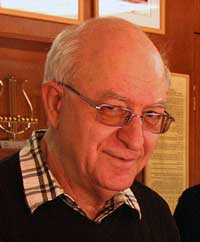
Uri Avner, 1941-2014

Uri Avner. Credit: wfcc.

We are sad to report that the Israeli player and composer, Uri Avner, had passed away this Thursday. A brief biography of his problemistic achievements is found here. The same site also has a notice of his passing.

He was a strong OTB player (e.g., IDF champion 1961, member of the Israeli Students' Olympiad team a few times, etc.), with a FIDE rating of about 2250. But he was best known for his problemistic achievements, having left competitive chess for problem composing ca. 1970.

There, he made Israel a powerhouse in the field (organizing three PCCC congresses in Israel for example), and reached the very top of the organization -- the head of the FIDE Permanent Commission for Chess Compositions. He was also a GM for chess composition.

There is a lengthy, and very good, obituary in Hebrew here  by Ram Soffer, from which the above summary is taken. It is at the Israeli Chess Federation's web site. 

There is also one of his last -- and very entertaining -- lectures online, at this link, and one can see a few of his games here.

On a personal note, Avner, a psychologist by training, had a very acid and funny sense of humor. Three examples from my personal experience:

(After he got off the phone with a certain chess organizer who was, and still is, very good as an organizer, but only a mediocre player): "Ever since he broke 1750 in the rating list, he demands the honor such an achievement entails."

(Discussing with me whom to invite to an ICF meeting): "The only two people I know who would draw a crowd are myself and Adrian Schwartz ... [a chess playing serial rapist who just got paroled - A. P.]"

(About his composing style): "I compose anti-Merediths. That's the number of pieces left off the board when I'm done."