Saturday, December 26, 2015

"Powerful Piece Play"


This is the headline given to Barav’s victory against the 2nd place finisher in the Verbandsmeisterschaft in Berlin, Waechter (to use the English transliteration). Barav himself was then Rabinovitch, or 'Rabinowitsch' in the German spelling above -- 'Barav' is a Hebrew translation of the name, which means 'the Rabbi's son'. 

We see, as the annotator notes, Barav's favorite weapon -- a kingside sacrificial attack -- at work once more. The tournament crosstable, and the newspaper cutting, were sent to me by his son, A. Barav

Barav, Israel - Waechter

(Souce & Annotations: Vossische Zeitung, 26/5/1929, p. 12)
Queen’s Pawn Game (D00)

"Powerful Piece-Play" [V.Z.]

1.d4 Nf6 2.e3 d5 3.Bd3 c5 4.c3 e6 5.Nd2 Nc6 6.f4 cxd4


Now Black has an inferior center. 7.exd4 Bd6 8.Nh3 Qc7 9.0–0 a6 10.Qe2 0–0 11.Nf3 b5 12.Ne5 Bb7 13.Bd2 Rfe8
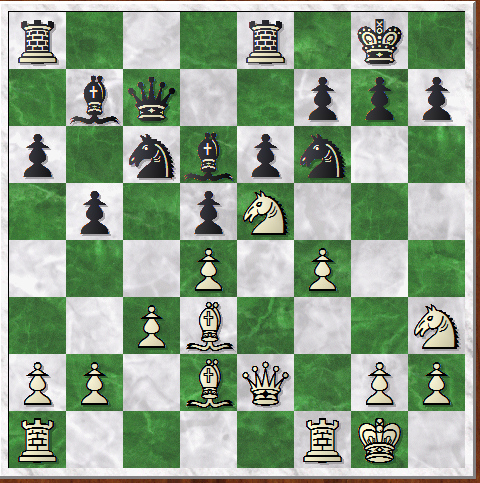

Black should not have given up the defense of f7 with the rook. Now both White knights join the attack on it. 13...Ne4 Is no good: 14.Bxe4 dxe4 15.Ng5 (not 15.Qxe4? Nxe5); but 13...g6 should have been considered, with the idea of Kg7 and Rh8, parrying Ng5 with h6.

14.Ng5! Nd8 One should not that the Bb7 and Ra8 should have been freed. 15.Ng4 The Nf6 defender must be eliminated. 15...Nxg4


If  15...h6 16.Nxf6+ gxf6 17.Nh7 Be7 18.Qg4+ Kh8 19.Qh5 and wins. 16.Bxh7+ Kf8 17.Qxg4 g6 18.Qh4


Threatens 19. Bxg6 fxg6 20. Qh8+. 18...Kg7 18...Ke7 19.Ne4+ Kf8 20.Nf6 19.Rf3 Rh8 20.Rh3 Bc6 21.f5! exf5 22.Ne4 Kf8  22...dxe4 23.Bh6+ Kxh7 24.Bf8+ (Or  24.Bg5+ ) 24...Kg8 25.Qxh8# 23.Bh6+

Black Resigns 1–0

Thursday, December 24, 2015

Another Nice Barav Victory

As promised, I am occasionally publishing on this blog games by Israel Barav (orig. Rabinovich), who was especially known for his tactical brilliance. Here is one such nice game, against one of Palestine's stronger players, Shlomo Smiltiner, who had passed away recently at the age of 100:

Lasker Club, Tel Aviv
June 7th, 1945
Israel Barav – Shlomo Smiltiner
Source: A. Barav’s collection.
[Annotations adapted from Deep Fritz 8's]
Caro-Kann (B10)

1. e4 c6 2. Nf3 d5 3. Nc3 dxe4 4. Nxe4 Nf6 5. Ng3 Bg4 6. Bc4 e6 7. O-O Nbd7 8. d4 Bd6  (8...h5 9. h3 Bxf3 10. Qxf3 =) 9. h3 Bxf3 10. Qxf3 Qc7 11. c3 Nb6 12. Bb3 h6  13. a4 Rd8 (13... Nbd7 14. Bc2 is better) 14. Re1± Kf8 15. Ne4 Nxe4 16. Rxe4 Kg8 17. Bd2 Nd5 18. Rae1 Qe7 19. c4 Nf6 20. R4e2 Bb8 (20... Bb4?! 21. Bc3 Bxc3 22. bxc3 Qc7±) 21. Bc3 h5? (21... Qd6 22. g3 Bc7 +-)


22. d5! (Clearance to allow c3-e5) cxd5 (22... exd5 23. Rxe7) 23. cxd5 Nxd5? (better is 23... e5 24. Bxe5 Bxe5 25. Rxe5 Qd6, but Black is still lost) 24. Bxd5 Qd6 25. Re5 (Fritz prefers 25. Rxe6!? due to 25… Qxd5 26. Qxd5 Rxd5 27. Re8+ Kh7 28. Rxh8+ Kxh8 29. Re8+ Kh7 30. Rxb8 Rd7 +-) 25... exd5 26. Re8+ Kh7 27. Qxh5+ Qh6 28. Rxh8+ Rxh8 29. Qxf7 Qg5 (if 29... d4 30. Bxd4 Rd8 +-)


30. Bxg7! Rg8 (if 30... Qxg7 31. Qh5+ with mate) 31.Bf6+ Rg7 and Black resigned without waiting for the opponent’s reply (1-0)

Wednesday, December 23, 2015

A "Life Chase" Match

Credit: The National Library of Israel "Time Travel" web site
A contributor to this blog had reminded me that Israel's national library, apart from a large physical collection of chess materials in rare magazines, etc., also has them on their web site. Entering 'שחמט' (Sachmat, chess) or 'chess' (in English) does indeed find quite a few items -- although, for this particular item, one needs to look for 'chase', not 'chess', for obvious reasons. Here, we have an advertisement for the live chess game between Marmorosh and Rubinstein.

One wonders whether more people came to 'Hapoel graund' to watch the chess game or the 'foot-ball' (i.e., soccer) game. One may also wonder about the number of typos and factual mistakes (Rubinstein was not, of course, the 'world chase [chess] champion'). This is especially surprising since, according to the item's description, it was printed in Ha'aretz press -- that of the most important newspaper at the time in Mandatory Palestine -- and is also of exceptional quality in terms of color and technical printing quality for the time.

Monday, November 30, 2015

Nimzowitsch Obituary

Aron Nimzowitsch. Credit: Wikipedia
Moshe Roytman informs us that a large, full-page-headline (though on p. 6) obituary of Aron Nomzowitsch in the Yiddish-language Unser Express [אונזאר אקספרעס], 'After the Death of a Great Chess Genius', on April 9th, 1935.

Ouch!

Credit: Chesscraft blog
A reader of this blog noted that, contrary to what I was writing for years, the English transliteration of the Israeli journal שחמט is actually Shahmat, not Shachmat. Thank you, anonymous poster -- and it goes to show that, once more, errare humanum est. Now I only have a few thousands of typos to correct...

Vera Menchik Jewish?!

Source: See Below

Moshe Roytman, a frequent correspondent, sent me the following headline, from Unser Express (in Yiddish), Sept. 20th, 1929, p. 15, about 'The Jewish Maiden Vera Menchik, which had Defeated the Greatest Chess-Players in the World'. 

What evidence is there that Menchik was Jewish? Technically it is possible that her father was since Menchik is indeed sometimes a Jewish name: a diminution of "Mann", i.e., "little man", as Jewish Family Names and Their Origins (Guggenheimer & Guggenheimer, Ktav Press 1992, p. 507) notes. But that hardly means all those with that name are Jewish -- any more than all those named, say, Rosenberg are Jewish (Alfred Rosenberg, to name one, was one of the major Nazi war criminals tried in Nuremberg, for example). 

Also, it is possible (technically) that her mother, Olga Illingworth was Jewish -- Illingworth is certainly a British name, from her father, but her personal name is Russian, so it is possible her mother was Jewish despite her father's name. But this seems unlikely as her (Olga's mother) first name was Mary Illingworth.

The most likely explanation seems to be that Unser Express was, simply, misled by Menchik's last name into assuming that she is Jewish, but is it possible that she was in fact Jewish, or "half Jewish" (i.e., on her father's side, which would not make her Jewish by Jewish law)? 

Chess in the Newspapers

The following photo -- given to me by Mr. Gdali Roysman (my spelling trasliteraiton from the Hebrew, I hope I am not misspelling it...) -- shows Davar Le'Yeladim ["Davar for Children"] of Dec. 8th, 1954. It shows yet another early attempt to make chess popular among the young in the mainstream press in Israel:


Sunday, November 1, 2015

An interesting Marmorosh Game

Source: Shachmat No. 5 / 29 (Dec. 1964), p. 15
In the following simultaneous game by Marmorosh, an interesting event happened. This game, says the (unsigned) article in Shachmat, was from a simultaneous display in Holon (Israel), 1956. Annotations by Shachmat:

1. Qb3!! Q:f7 2. d:c6!

'An extremely interesting position! Both queens are undefended and threaten each other. The black queen cannot move, due to immediate mate.'

2... Rgf8 3. c:b7+ Q:b7 4. Qe6+ Qd7 5. Qa6+ Qb7 6. Ne6+ 'and wins'.

More on the "Mystery" Tournament...

Source: Shachmat, June-July 1964, Vol. 2 no. 11-12 (23-24), back cover
Having procured, with Alon Gruenfeld's generous help, the 1964 issues of Shachmat, all I can say is -- so much for the "mystery". As I already noted, the games were published in Shachmat in 1964. Above is the back-cover report in Shachmat, and all the games of the international section appeared in full in that and the next three (August - October) issues of Shachmat. There was also a complete crosstable, and that of the Israeli masters' "B Tournament").

I should have known better; I fell into the trap of believing Chessbase and similar online / computer sources are reliable. They are indeed, when it comes to recent (ca. 1990-) tournaments and international events, but not at all when it comes to smaller, historical events that were mostly reported in non-European (or American) sources. This is why Jeremy Gaige's and other archivists' work, such as the multi-volume Chess Tournaments Crosstable (which, alas, I do not have access to) and Chess Personalia are indispensable.