Friday, June 21, 2019

Some Things Never Change

Source: Al Ha'Mishmar, 5/2/1948, p. 3
Square brackers are our additions.

Reply to Correspondence:[To] Israel Schaechter [ph. spelling], Cyprus:
There is no limit on the number of pieces that may be promoted, and it is therefore legal to have two queens, three knights, etc.; by the way, the colloquial Hebrew term [for 'pawn'] is hayal [soldier] or ragli [foot soldier], and not ikar [farmer, i.e., the German term Bauer]. 

We note that the fact that a Jew with such a name was writing from Cyprus means he probably was a refugee caught by the British when trying to enter the mandate of Palestine illegally, or else perhaps one of the representatives from the Yishuv or other organizations that were allowed to join them to help take care of their needs. 

Memorials

Source: Al Ha'Mishmar, 22/1/1948, p/ 3 

In the above column, then edited by Eliyahu FeiginAl Ha'Mishmar's chess columns noted the death of Avraham Feldklein in battle near Gan Yavneh in the Israeli War of Independence (1948). We have already commented on this note, but here we add the two problems in his memory: by Yosef Goldschmidt (using Gaige's spelling Yosef rather than Feigin's German-based Josef) and B. Hendel


The solutions were published on Feb. 12th (p. 3) of the same paper. No. 201: to avoid the "cook" 1.Nh6 the authors adds a black pawn on h7. Key: 1.Rxh7. No: 202: 1.Qf6 Nf7 2.Qd6+ Nxd6 3.Rc8+ Nxc8 4.Rh7! with four varieties of mate. 

Obituaries and Congratulations

Source: Sachmat, Vol. 17 no. 2 (#183)
A frequent correspondent of ours notes the obituary of  Ya'akov Gavish, the late Haderah (Is.) chess player and organizer, not only in his city but in the Ha'Poel sports organization and correspondence chess. The writer of the editorial, Zalman Gurevich, was the treasurer of the ICF in the 50s and 60s, after Dr. Menachem Oren resigned. 

The curious historical part of the obituary is that Gavish was the manager of the local Ha'Poalim bank in Hadera, and that without his contributions and those of others in financial circles, the ICF could never afford to send teams to the Olympiads in the 50s and 60s. The entire ICF's budget at the time, notes Gurevich, was based on voluntary contributions from well-wishers. 

In addition, the page has a congratulatory message for Roman Dzindzichashvili for his victory in the 1977/1978 international tournament in Hastings (ahead of ex-world champion Petrosian and many other top players). Understandably, the same issue has him on the cover, stating 'Roman Dzindzichaschvili -- I came, I saw, I conquered', the latter statement also in the original Latin.


Tuesday, May 21, 2019

Chess on TV

Source: La'Merchav, 3/7/1970 p. 9.
We have previously noted chess on television in this blog, but a frequent correspondent pointed out another contemporary source. The paper notes the exact schedule on Israeli education television: 14 20-minute broadcasts, twice weekly. The newspaper adds the series was created by Moshe Czerniak and would also be partially presented by him.

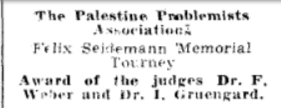
The first Palestine Problemists' Association Tournament

Source: Palestine Post, Jan. 16th, 1948, p. 6.
The results of the first Problemists' international tournament, the Felix Seidemann Memorial Tourney, were reported in the Palestine Post on Jan. 16th, 1948. The organizers noted the numerous problems, and added an apology by Eliyahu Feigin, on behalf of the PPA, for delays in the publication of the results. Feigin also added more details on the large number of problems, etc., in his Al Ha'Mishmar column we have just quoted in the previous post. Note the judges include also Drs. F. Weber and I. Gruengard, Gruengard, in particular, having been a major influence on Israeli chess in general and problemists in particular for many years. 

War Losses

Source: Al Ha'Mishmar, 22/1/1948, p. 3
In the above chess column in Al Ha'Mishmar, edited by Eliyahu Feigin, the editor note the death in combat (in the War of Independence, or rather in the disturbances before it started) of Avraham Feldklein, 'one of Rishon Le'Tziyon's best chess players'. 

He was killed at the age of 18, came in 3rd in the last city (moshava, lit. 'settlement') the previous year, and also was the city's blitz champion and won a match with the city's champion, M. Stoltz (ph. spelling), 3:2.

Added: a frequent contributor adds, based on contemporary sources (link in Hebrew) that the correct spelling is probably Stoltzaft (שטולזפט). He was apparetly quite an active played at the time. 

Also: another correspondent notes the name is Sztulzaft Meir, later changed to Shatil.

It is added that the two problems published in the paper that day are dedicated to his memory. 

Saturday, April 27, 2019

Czerniak the Palestinian

Source: Davar's weekend supplmenet (Dvar Ha'Shavua), 27/7/1951, p. 14. 
Above, we have a clip from the chess column in Davar, noting Czerniak's victory in the 1951 Reggio Emilia tournament in Italy. We thank a frequent contributor to this blog for the information. The column notes that he was also awarded the IM title by FIDE, and that this victory is the first victory of an Israeli player in an international chess tournament. 

The column adds a letter from the Israeli consul there, Israel Eshel, who notes that the local press refer to Czerniak as a 'Palestinian', and only after he and the consulate protested that this was correct to 'Israeli' in the press. We add that, before the establishment of the state of Israel in 1948, 'Palestinian' was the usual term used in English and other languages for Jews who lived in what was then the British Mandate of Palestine.

The column also wonders how to use Czerniak's winning to get funding for the ICF, in the only practical way many organizations in Israel at the time could gain any funding, to wit, with government assistance. The key issue is who will be the next minister of education after the elections, it is noted.

The Education of a Chess Player

Source: see below
Note: updated 21/6/2019.

Above, we see a page from Israel Rabinovich-Barav's notebook of annotated games, which he kept as a young man. The notebook was loaned to me by his son, Ami Barav. The games are mostly famous ones from the 19th and early 20th century, of which the first, Schiffers vs. Chigorin, St. Petersburg, 1897, is a typical specimen. The game above is Blackburne vs. Marco, Monte Carlo, 1901.  

There are also some games where one of both of the opponents are unnamed, and one curiosity: a game allegedly by J. J. Rousseau (vs. an unnamed opponent, given in other sources as prince Conti). Barav understandably didn't know that this game, widely circulated in various sources from the mid-19th century onward, was proven by the chess historian H. J. M. Murray to have been a forgery as early as 1908, as shown by Edward Winter in a definitive article about Rousseau's chess career. 

Why did Barav copy out famous games when he could just read them in a book? The reason is obvious. Barav uses the tried-and-true method that (almost) all strong players used to get better: learning from game collections of other players, and trying to understand what both players were doing, each side's plan, where the crucial mistake was made, why it was a mistake, etc.

For this purpose, Barav annotates on his own many of the games, sometimes in great depth. His annotations are sometimes made at great length; e.g., a Tarrasch - N.N. brilliancy is annotated in five whole pages (10 columns), almost own his own.

In the Blackburne-Marco game sample page above, he notes, for example, that 5...Bxe3 is bad since it 'opens the f-file for the [white] rook', and similarly that 10,,,Nxb3 is weak since 'Black wants to gain the upper hand on the queen's side, but by this weakens the king's side'.

Saturday, April 13, 2019

Candid Photos from the Tel-Aviv / Haifa 1958 International Tournament


Details: see below
Ami Barav, Israel Rabinovich-Barav's son, kindly provided us with the following photos he took, as a young boy, of the players in the international tournament that took place in Tel Aviv and Haifa in 1958. They are from the 13th round. The photos show, from top to bottom, White mentioned first:

Arie Rosenberg thinking in his game against Sylvain Burstein (who later changed his name, as noted by a correpondent below, to Inbar). 
Israel Dyner playing Itzchak Aloni
Laslo Szabo playing Samuel Reshevsky
Carel Van den Berg playing Yosef Porat.