Monday, October 21, 2019

A Live Chess Game in Haifa, 1927

Source: Doar Ha'yom, Aug. 30th, 1927, p. 4
We noted before in this blog that there were, in the 1920s and 30s, examples of live chess -- often with a Zionist theme. Here is another one: a game which took place 'last Saturday [i.e. Aug. 27th] at 5:30 PM on the "Maccabi the Hero" playing field' in Haifa. The exhibition had 'drawn a small crowd of about 1000'. We add that the game was advertised (one line) in Davar, Friday, Aug. 26th, 1927, p. 1.

The report adds the costumes - Jews vs. Romans - were very good, and the 'game manager' (i.e., player), Ben Hanoch, playing the Jewish side, had (unsurprisingly for such displays) defeated Harrari, playing the Roman side. The report adds, however, that for most of the spectators the game 'remained unclear, unfortunately'.


A Kniazer Simul

Source: Ha'Tazphon, March 26, 1926, p. 7

How strong -- or weak -- the players in the Jerusalem "Lasker" club were in the 1920s can be seen by the fact that when Kniazer from Haifa gave a simultaneous display in 1926, he defeated most of the club's top players such as Mohilever, Vogel, and Polani and only Pappo managed to draw. This note was brought to our attention by a frequent correspondent. 

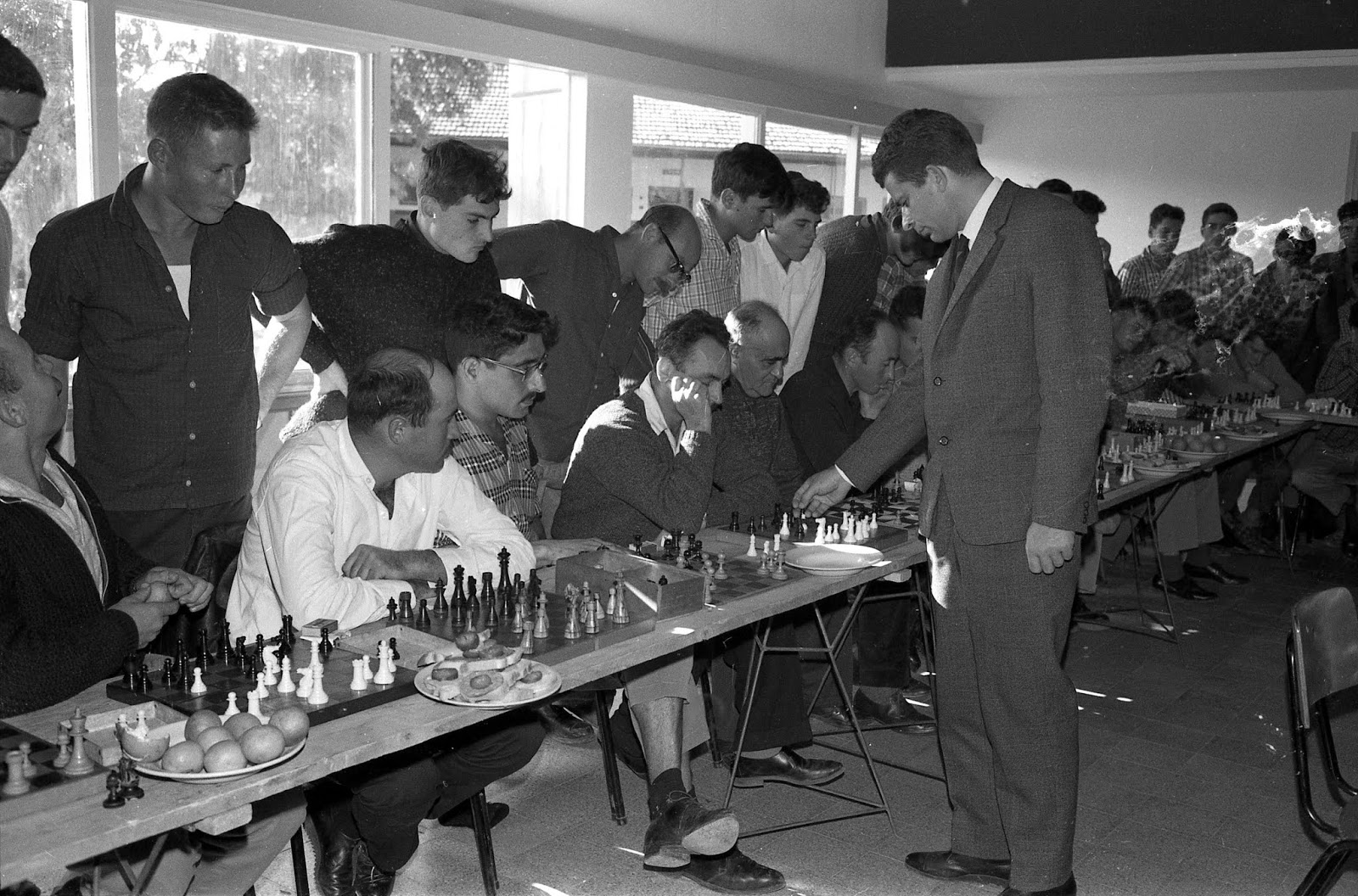
A Spassky Simul

Spassky playing in Ein Harod. Source: see below

We have sent information to Edward Winter about a Boris Spassky simultaneous display in Israel, 1964, and he had graciously published it in his well-known Chess Notes (#11513). All details about the photographs and credits for finding them is to be found in the link. 

We add that the Spassky simultaneous display was in Ein Harod on Saturday, Nov. 28th, 1964, according to an article in Kol Ha'am (Nov. 23rd, 1964, p. 3), which lists all of the simultaneous displays the USSR team was planning to give while in Israel. 

Wednesday, October 16, 2019

La'Merchav Readers vs. Euwe, Telegraph Match, 1961-1962

Source: La'Merchav, June 7th, 1962, p. 8

The game, a Sicilian defense, was: 1.e4 c5 2.Nf3 Nc6 3.d4 c:d4 4.N:d4 e6 5.Nc3 Qc7 6.g3 a6 7.Bg2 Nf6 8.0-0 N:d4 9.Q:d4 Bc5 10.Bf4 B:d4 11.B:c7 B:c3 12.b:c3 d5 13.e:d5 N:d5 14.Be5 f6 15/Bd4 Kf7 16.c4 Ne7 17.Rab1 Rd8 18.Bc5 Rd7 19.Bb6 Rc7 20.Bd6 R:c4 21.B:b7 Ra7 22.Rfb1 Nf5 23.Bb8 R:b7 24.R:b7+ B:b7 25.R:b7+ Kg6 Draw (0.5-0.5).

The game given above was played La'Merchav readers (White) and Euwe (Black). It was played by  telegraph at the rate of a move a week, between Nov. 10th, 1961 and June 7th, 1962. It was published in La'Merchav's chess column. La'Merchav's readers chose White's move by vote, with the editor (van Amerongen and Z. Shomron) allowing himself to intervene in case the readers recommended a obvious blunder, but there was no such case. 

The game was brought to our attention by a frequent correspondent, who notes that he himself played as a reader of a youth's magazine in a similar game ageist Tal

An Euwe Game Quiz

Source: TBA later
In this position, Euwe (playing Black) offered a draw, which was accepted by White. What was the occasion and what's the relationship to Israeli chess? 

Rubinstein and Hebrew

Source: Davar, Dec. 11th, 1930, p. 3
In reviewing the chess life in Palestine in 1930, Davar notes that there is 'little to be done at once' with the 'limited' chess life in the country. The article - 'The Akiba Rubinstein Chess Club in Tel Aviv' notes, however, that Marmorosh founded the club with in order to revive chess in Palestine. The article notes that the club now had over 100 members, and that Rubinstein himself sent a polite letter to Wilson, the secretary of the club, agreeing to naming the club after him. It is quoted above. 

The especially interesting point is that the letter was written originally in old-style, turn-of-the-century Hebrew, the Hebrew Rubinstein learn in his youth. Rubinstein notes he got Wilson's letter from '4th of Tishrey' [The Hebrew date] and that he is willing to have the 'Ishkoki' [chess] club named after him. Rubinstein also notes he wrote previous articles for Ha'Sachmat in Hebrew but that the magazine did not survive. He politely refuses to send articles, citing lack of time, but promises to send 'interesting games' if he happens to play any, and to come visit to give simultaneous displays. Indeed, he did just that a few years later. 

Chess on Israeli TV -- with Gil Hovav


Gil Hovav, an Israeli presenter and chef, gave a short feature about chess in Israeli TV, on his show 'Game Theory' [Torat Ha'Mishakim, תורת המשחקים] in 2017. The video (mostly in Hebrew) includes an interiew with Kramnik, Gelfand, and also mentions chess boxing and has Hovav losing with a fool's mate (presumably deliberately) to a chess player in Union Square.

"Another 100,000 Israeli Pounds"

Source: La'Merchav,  Oct. 8th, 1964, p. 3
The same frequent correspondent notes that Eliyahu Fasher reports in a long article in La'Merchav on the government's agreement, due to the great success of the Olympiad's preparation, to donate another 100,000 Israeli pounds to the proejct. Fasher notes that chess is Israel's 'top sports export'. The article also has a good quality photo of  Zadok Domnitz

Chess on the Radio

Source: Ha'Boker, May 8th, 1965 p. 8
A frequent correspondent notes that Yosef Porat was on Israeli radio in 1964 -- 'with his return as a winner from an international chess tournament that took place in Mongolia'.