Thursday, September 15, 2022

The Menace of Sexism in Chess


This post has nothing to do with Jews in particular, but I hope it's still interesting. 

Perhaps the oddest publication I know of about chess is this odd pamphlet, published by Alexander Baron (certainly not the well-known writer of the same name). The booklet is obviously intended tongue-in-cheek, but whether it is intended fully as a joke is not clear to me. It considers three possibilities (pp. 3-4):


He supports the third explanation, after mentioning, inter alia, that he came to that conclusion after the following stint in prison (p. 1):


William Hartston comes in for special abuse throughout the pamphlet, as in the following "proof" of the conspiracy:


Whether the author is serious or is spoofing those are overly sensitive to "sexist" slights where there are none, is not clear to me. Presumably this is an instance of Poe's law, according to which it is always impossible to tell parody from serious claims, at least on the internet. 

Reb Alter Ego


A frequent correspondent pointed out that Doar Ha'yom's infrequent chess column was in the back pages, next to the "small talk" column. Here is one example, from May 24th, 1929, p. 5. It is a study by H.(erman) Mattison ("White goes and makes a remis", with Black's forces on the bottom). The odd thing is that the "small talk" column is by "Reb Alter Ego" ... 

Monday, August 29, 2022

Pilgrimage


I was notified by a colleague that GM Evgeny Postny added to his social a media a photo he took of Emanuel Lasker's grave. It is reproduce above. 

It should be noted that the graves of many chess masters are found in the somewhat morbid but fascinating web site, "Find a Grave." These include among many others the graves of Steinitz,  Lasker, Capablanca, Alekhine, Botvinnik, Tal, and many others. 

Yosef Retter, 1934-2022


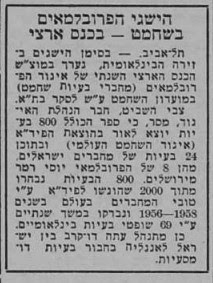
The Israeli Chess Federation notifies on its web page (in Hebrew) that Yosef Retter, an international master of chess composition, had died on August 20th. The article has a very good photo of him and a very nice two-mover, a field in which he specialized. 

Above, we have a note from La'merchav (5 Devember 1960, p. 4) about what is probably Retter's first international appearance. It notes, under the headline "Israeli Problemists' Achievements - in a National Conference," that the 1958-1958 FIDE album, which has 800 problems of the best composers in the world, includes 24 problems by Israeli composers, include eight by Retter. We thank a frequent correspondent for notify us of this article. 

Friday, July 29, 2022

Ben Gurion and Chess


A frequent correspondent notified us of a funny exchange between David Ben-Gurion and Shaul Hon found in Ben Gurion's archives. In 1955, Hon (letter above) asked Ben Gurion to write an introduction to his book, Chess Openings, describing it (technically inaccurately) as "the first chess book in Hebrew." Naturally Hon emphasizes the importance of chess as the "Jewish game," the importance of the book to Zionism under the "for the first time in 2000 years" principle, and flatters Ben Gurion by saying he (Ben Gurion) is known as a chess player. 

Ben Gurion politely refused, noting that while he supports the publication of the book as a worthy goal and would be glad to read it, he is "unjustly suspected" by Hon of having any chess abilities or achievements.

Incidentally, Ben Gurion repeats the same refusal to write an introduction later, in 1966, this this time to a request by Eliahu Shahaf. Again, he supports the publication of the book and even adds that Gat, one of the best Israeli players and a member of his kibbutz, told him about it, but that he doesn't have the chess skills to write an introduction for a chess book. 

The letter is of interest since Ben Gurion gives some details of chess career (or rather lack thereof), noting that he played as a youth (in Russia) but "was never good at the game." Once in Palestine, he hardly played at all, except for a short time in Sejera, against "Meir Rodberg who was a good player."


Thursday, July 28, 2022

Chess and Class War


A frequent correspondent points out to us that in Ha'mashkif had criticism of chess on the second page on the second page of its 13 June 1945 issue. The revisionist newspaper -- its title means "The Observer" -- was that of those in favor of a maximalist Jewish state, as the map on their masthead shows (top image). As such, it was a minority to the general moderate socialist Zionist leadership of the Jews in Palestine at the time. 

The criticism, under the title "Chess and... Class War" (lower image), is not so much of chess itself but of its coverage in the socialist Al Ha'mishmar (then still just Mishmar). The article notes that the reporting in Al Ha'mishmar keeps inserting socialism into the chess column, by, for example, noting that the winner of the Palestinian championship was the "modest worker" Itzhak Aloni, which implies the existence of immodest workers of the despised upper classes. Or, complains Ha'mashkif, Al Ha'mishmar's reports about another tournament (a 32-player elimination tournament in "Lasker"; see e.g. Davar, 11 February 1945, p. 3), said they are glad "comrade Aharon Susna," a plumber by profession, won, thus proving the rise of the working class. 

What really got Ha'mashkif's goat was the short story reported by Al Ha'mishmar about Susna. In his youth, a revisionist Zionist came to Susna's town in Poland and wanted to make Jews there join the revisionists. Susna, a good socialist, played chess with him and won - which was reported by Al Ha'mishmar as a victory, not in a chess game, but of the forces of progress.

It seems Ha'maskhif is over-egging the pudding. Calling someone "comrade" (haver) instead of "Mr." was indeed common in socialist papers at the time, but was just a polite figure of speech. Similarly, Aloni being described as a "modest" worker merely indicates he held a junior, as opposed to a senior, position at work. Finally, it is hard to believe Al Ha'mishmar seriously implied the game Susna won against a revisionist in Poland is truly a case of class war. It seems more of a humorous way to frame the story, or rooting for the home team. 

More Chess Art - Book Covers


In the following book, a Hebrew translation of Jose Saramago's The History of the Siege of Lisbon is illustrated by cubist painting by Jacques Villon. It is hardly surprising Villon, the older brother of Marcel Duchamp, was interested in both chess and art. 

Saturday, June 18, 2022

Tel Aviv Founded - by Chess


A frequent correspondent notifies us that it was over a game of chess that Tel Aviv was founded. In Ha'olam, April 19th, 1929, p. 8, a witness, Kadish Yehuda Silman, describes the scene which occurred 30 years previously, ca. 1900. 

In Meir Dizengoff's house, in a gloomy, rainy day, the house of "almost the only intellectual [in Palestine] in those days," a small group of were sitting and complaining about the bad situation of the Jews in Palestine when playing chess. They were wondering what to do to improve the Jews' situation - and in particular, how Jews can own their own homes instead of renting from Arabs -  as "one was moving the knight, the other the rook, and a third keeps saying 'check!'." 

Suddenly, they all decided, as sprits rose, "what ears once heard in the time of Nehamaih: let us rise up and build!". And thus, the decision to fund Tel Aviv was made. 

Sunday, June 12, 2022

Czerniak's Notebook


Mr. Tomer Kaufman had brought to our attention Moshe Czerniak's notebook from the 1930s, which he owns. With his permission, we present here an example: Czerniak's summary of the 1935 Olympiad. The games and commentary are in Polish, and he has in the notebook games from a variety of events in the 1930s, mostly Palestinian events but also, as noted, the Olympiad.