Saturday, June 3, 2023
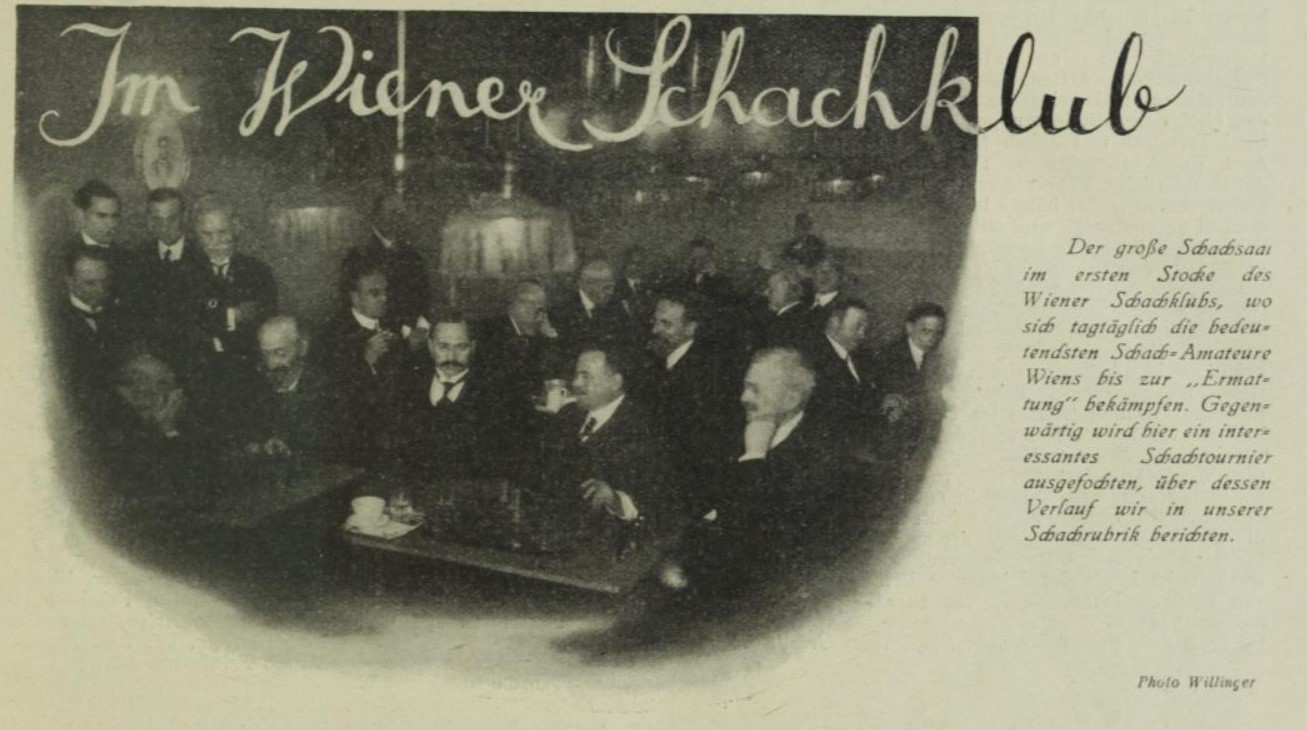
The Vienna Chess Club in "Die Buhne"
Dr. Eduard Stiassny
Our correspondent Herbert Halsseger draws our attention to an article in KARL magazine (January 2023, pp. 33-39) about Vienna, 1921. The article mentions the Jewish sponsor of the tournament, Dr. Eduard Stiassny, a noted chemist and industrialist. Stiassny tragically committed suicide in 1938. Mr. Halsseger also notes his grave, and points us to a simultaneous game he played in October 1900, to Emanuel Lasker (Lasker playing Black and blindfolded).
Credit: here.
Stiassny, Eduard - Lasker, Emanuel
King's Knight Opening [C40]
Blindfold Simul, Vienna chess club, October 1900
Source: Wiener Schachzeitung, October 1900, pp. 212-3.
1.e4 e5 2.Nf3 d5 3.exd5 e4 4.Ng1 Nf6 5.d3 Qxd5 6.Nc3 Bb4 7.Bd2 Qe6 8.Qe2 Nc6 9.Nxe4 0–0 10.c3 Nd5 11.0–0–0 Re8 12.Ng5 Qd7 13.Qh5 h6 14.cxb4 hxg5 15.Qxg5 Nd4 16.Bc3 Qc6 17.Kb1 Nxc3+ 18.bxc3 Nb5 19.c4 Nc3+ 20.Kc1 Qa4 21.Qd2 Nxd1 22.Qxd1 Qa3+ 23.Kc2 Bd7 24.b5 a6 25.Qb1 axb5 26.Nf3 bxc4 27.Nd4 Ba4+ 28.Kd2 c3#
Beer Chess
Credit: A. P.
Saturday, May 20, 2023
Walter Tevis
The same publication, The Nation, sometimes writes about chess - although usually in a metaphor for politics. On the other hand, one example of actually writing about chess is in its investigation of the Walter Tevis revival due to the Netflix adaptation of The Queen's Gambit. The article argues that "the problems with Tevis' books is the problems with addiction." One is reminded of Edward Winter's review of the book, which noted it "traces the elevation of Beth Harmon, a prodigy in chess, drink and drugs, to the loftiest heights of the first-named vice."
Canetti - A Tribute
We have just mentioned in this blog Elias Canetti's chess-related work. By sheer chance, The Nation had just published an appreciation of him, "Elias Canetti: The Last Cosmopolitan." While chess is not mentioned in the article (unsurprisingly), it is well worth reading.
Saturday, May 6, 2023
Chess and the Rosenbergs' Trial
Chess and the Nobel Prize for Literature
There is, of course, no Nobel prize for chess. But chess appears in the work of Nobel prize winning authors. The most famous example is, of course, Stefan Zweig's The Royal Game. But a lesser-known example is Elias Canetti's Auto-da-Fe, which features the chess-playing dwarf Fischerle as a major character. By the way, there is no relationship to Robert "Bobby" Fischer -- the novel was published in 1935.
Above is the cover page of the Hebrew edition (1979: Zmora-Bitan), which has an obvious chess motif. It is named Sanverim [The Blinding], a literal translation of the original German title, Die Blendung.
P. S.
Nabokov's The Defense is perhaps better known, but Nabokov never won the Nobel prize...
Sunday, April 30, 2023
Snapshot, 1955
A frequent correspondent points out that in Ha'aretz, 25 March 1955 (p. 5) it is noted that a new chess club will is to be opened 91 Hayarkon St., Tel Aviv. There will be an 8-game match between two of the IDF's champions - the previous, Bernstein, and the current one, Shiyovich. It also notes that for the upcoming Independence Day, there will a tournament dedicated to all those who lost their lives in the IDF. Finally, there is going to be a blitz championship on 2 April "open to all soldiers." Does anyone have more information about this club?
Saturday, March 25, 2023
Rubinstein - Rotlewi, 1910
The following game, brought to our attention by Tomasz Lissowski, was played between Akiba Rubinstein and Georg Rotlewi. Apart from being the same players as in Rubinstein's "immortal" game (Rotlewi - Rubinstein, 1907), it is interesting since it was published in a column in a Yiddish newspaper, Der Moment (9 December 1910, p. 5) - with annotations, in Yiddish, by Rubinstein himself, the editor of the newspaper's column.
Especially interesting from a linguistic point of view is that the names of the pieces were in Hebrew letters but were transliteration of the German, or continental, system. E.g., the knight is ש - S - for "Springer," the bishop ל - L - for "laufer," etc.
Rubinstein, Akiba – Rotlewi, Georg
Queen's Gambit Declined, Tarrasch [D34]
Warsaw chess club championship, 1910
Source: see above
Annotations: Akiba Rubinstein
1.d4 d5 2.Nf3 c5 3.c4 e6 4.Nc3 Nc6 5.cxd5 exd5 6.g3 Nf6 7.Bg2 Be7 8.0–0 Be6 9.Bg5 0–0 10.Rc1 c4 11.Ne5 Qb6 The queen attacks d4 and b2, changing places with the c6 knight to sufficiently protect the weak point d5. 12.Bxf6 Bxf6 13.Nxd5 Bxd5 14.Bxd5 Bxe5 If 14...Nxe5 15.dxe5 Bxe5 16.Rxc4 Bxb2 17.Qc2 with the threat of 18.Rb1. 15.dxe5 Nxe5
16.b3! cxb3 17.Qxb3 Nc6 18.Qxb6 axb6 19.Rb1 Ra5 20.Rfd1 b5 21.Bb3 Ra7 22.Rd7 Ne5 23.Rc7 Stronger than 23. Rd5 - Rubinstein. 23...Rd8 24.Bd5 Black resigns (1-0).