Tuesday, November 28, 2023

Judaism and Chess on Postcards

Our correspondent Terje Christiansen send us three chess related postcards found in the Blatatnik Archive Jewish Postcards collection. The last one below is an antisemitic caricature describing chess as the "Game of Cohens" (a German pun on chess being the "Game of Kings"), but the other two are rather romantic pictures of, well, Jews playing chess, with no antisemitic overtones. The details of all the postcards are found by clicking on the images of the postcards in the link above. 


Thursday, November 2, 2023

Doulingo and Chess


Credit: see below

The above picture, from my own cellphone, is this month's challenge on the popular language-learning application, Doulingo. There is a one-month chess.com membership. Duolingo also has an interesting language-centered blog, which has an interesting post about chess-related words: chess, check, checkmate, etc. As is typical of Douligo's posts, the language is informal and intended to be humorous and fun, but, so far as I can tell, the facts are quite accurate. 

Wednesday, October 25, 2023

ICF Partiorism

Credit: see below

The Israel Chess Federation had posted a series of photos of Israeli players and teams, mostly in international events such as the 2022 Olympiad. The photos are by Dr. Mark Liebschitz [ph. spelling]. Of particular interest is the above image - what seems to be a (small) double blindfold simul (3 boards each) in the Israeli Knesset, or parliament. 

P. S.

For some reason the above paragraph's outline will not follow the usual one used in this blog, sorry!| 

Chess on Reserve Duty


Source: see below

I am now on reserve duty. I serve, unsurprisingly perhaps, as a history officer in the IDF's history department. My commanding officer sent me and others this photo of two IDF soldiers playing chess in a military base somewhere. Of course, the faces of the soldiers were hidden in the original image as well and it is an unclassified one. White (left) seems to be winning. 

Tuesday, October 3, 2023

Alekhine's World Trip Discrepancy


Credit: here.

Our correspondent, Herbert Halsegger, pointed out to us that the Neues Preßburger Tagblatt of 7 February 1932, p. 6, has an interview with Alekhine where he discusses his planned world trip. Alekhine explicitly mentions that he will also visit Palestine as well as many other countries and locations. Interestingly, Davar, on 31 December 1931, p. 3, mentions Alekhine's world trip and does not mention him visiting Palestine. Only later - 21 January 1932, p. 3 - does Davar mention that a "reliable source" notes that Alekhine will visit Palestine as well. 

What is the reason for this discrepancy? Had Alekhine changed his mind about the trip's locations in January 1932? This seems unlikely since many of the countries mentioned in both articles are the same. In particular, the starting point (Marseilles) and the location Alekhine will visit just after Palestine according to the February interview (Port Said) are mentioned. 

Another mystery is why, if Alekhine's trip was already publicly known in December 1931 and an interview about it was given in February 1932, did Davar need to use an anonymous "reliable source" instead of simply noting where the details of the trip were given. 

Finally, that Alekhine had no problem planning a trip to Palestine doesn't prove Alekhine was not an antisemite. He also planned to visit India and Japan, and it would be no libel on his character if it turned out he happened to share the beliefs about the inferiority of Indians or Japanese which were almost universal for Europeans of his generation. Alekhine may have been prejudiced against Jews while still visiting Palestine.

But there is a big moral difference between Alekhine possibly sharing prejudices against Jews common to his place and time and Alekhine being a Nazi. If Alekhine were a true believer in Nazi ideology, it is highly unlikely he would have publicly declared his intention to visit Palestine in particular. 


The Start of the Israel Chess Federation


Credit: Davar Ha'shavuah, 7 October 1949, p. 18.

A frequent correspondent notes that one of the first mentions of the relaunched chess federation in the new state - the Israel Chess Federation - is in the above 1949 note. As La'merhav notes (3 May 1968, p. 8) the Israel Chess Federation was in fact established that year. 

The above note informs that the suggestion came originally from the Lasker chess club in Tel Aviv, which contacted the clubs in Haifa and Jerusalem to come to a general meeting to establish the new national federation. In particular, Israel Barav (here mentioned under his old name, Rabinovich) is mentioned in asking the Haifa club to join, and that the constitution of the federation was ratified. 

Chess in the Newsreels, Part II


Credit: see below

We have already noted in the past that chess was occasionally featured in newsreels in Israel (and Mandatory Palestine) in pre-television days, but some of the links in posts about "movies" or "newsreels" are no longer active. Above is a screenshot from the Israeli film archive search for "chess" (in English) which features all such newsreel items, with the titles in English. The newsreels themselves are in Hebrew but there are English subtitles. 

Wednesday, September 27, 2023

Porat - Larsen, anti-Turton

Edward Winter notes that Yosef Porat was the victim of an anti-Turton move (or combination) by Bent Larsen in the 1956 Olympiad. What is an anti-Turton? As Heidenfeld notes (see Winter's article for details):

It consists in forcing the attacker who wishes to double two pieces on the same gait in such a way as to have the stronger piece in front and the weaker behind (called the Turton in the jargon of problemists) into playing the weaker piece across the so-called “critical square”... and thus into reversing the planned line-up.

The game is: 

Porat, Yosef - Larsen, Bent

12th Chess Olympiad, Moscow, 1956, 6th round (preliminaries) 

Source: Olimpbase

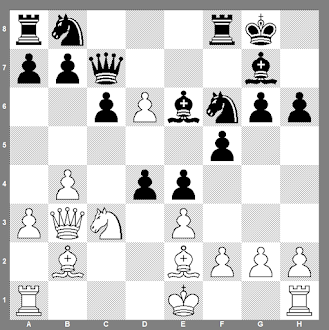
1.Nf3 f5 2.c4 Nf6 3.Nc3 g6 4.b3 Bg7 5.Bb2 d6 6.d4 c6 7.e3 Qa5 8.a3 O-O 9.Be2 e5 10.b4 Qc7 11.d5 h6 12.c5 e4 13.Nd4 dxc5 14.Qb3 cxd4 15.d6+ Be6

Anti-Turton. 15...Qf7 (the other possible move) allows 16.Bc4, to be followed by 16...dxc3 17.Bxf7+ Rxf7 18.Bxc3, when Black has three pieces for the queen. 


16.Qxe6+

The point behind 15...Be6: the white queen was forced to move beyond the critical square (c4), so Bc4 will no longer pin the black queen to the king after Black plays Qf7.

16...Qf7 17 Qxf7+ Rxf7 18 exd4 Rd7 19 d5 Nxd5 20 Bc4 Kh7 21 Bxd5 Bxc3+ 22 Bxc3 cxd5 23 g4 Rxd6 24 gxf5 gxf5 25 Rd1 Nc6 26 b5 Nd8 27 f3 Ne6 28 fxe4 fxe4 29 Rf1 Ng5 30 Rf5 d4 31 h4 Nf3+ 32 Ke2 Rc8 33 Bb4 Rg6 White resigns (0-1).

Jeremy Silman, 1954-2023

Source: amazon.com

Jeremy Silman had just passed away at the age of 69. We have many of his books, from How to Reassess Your Chess and The Amateur's Mind to his co-authored (auto)biography of Pal Benko, which is an excellent book. Always original in his thinking, Silman never wrote a meretricious book. Some of his books are better than others, but he always did his best - some of his books are very good, like Benko's biography. 

Edward Winter's obituary adds that Silman was interested in chess history, and - like Winter himself - had great admiration for the games of the old masters, such as Gioacchino Greco, who was in Silman's estimation, "centuries ahead of his time" in chess understanding, more so than any other player in history. Curiously, he thinks Greco would have easily defeated Philidor

One thing I noted about Silman's work is that when a new edition of his books came out, it was really new. It wasn't just the same book with minor changes. Silman always put a lot of work into improving the new edition over the older one.