Saturday, April 27, 2024

Oren and Blass, 1926 Polish Championship


Source: (Neue) Wiener Schachzeitung, vol. 4 no. 11 (June 1926), p. 169

Both Blass and Oren (then Chwojnik) played in the 1926 Polish championship. Herbert Halsagger provides us with the crosstable and the complete report of the tournament here. Blass scored 4.5 points and Oren 3.5, but his sole victory was against Blass. 

"Both New Masters, Eliskases and Glass"

 
Source: (Neue) Wiener Schachzeitung, vol. 7 no. 19 (October 1929), p. 289

We have often noted in this blog that Glass, the one-time Palestinian / Israeli master, had never in fact seen himself as anything else than Austrian, returning there after the 1935 Maccabiah and, later, after a few years in Israel in the 1950s. This is undestandable considering his greatest chess triumphs were there, in the 1920s. Here, Herbert Halsagger shows us, is a photo of the players of a tournament on top of a mountain, with "both new masters, Eliskases and Glass" in the middle. They both won the Austrian master title for coming in first and second, respectively, in the Innsbruck Congress of the Austrian Chess Federation. The entire article is here.

The "Polish Immortal"

 
Source:(Neue) Wiener Schachzeitung, vol. 32 no. 15/16 (Aug. 1935), p. 226

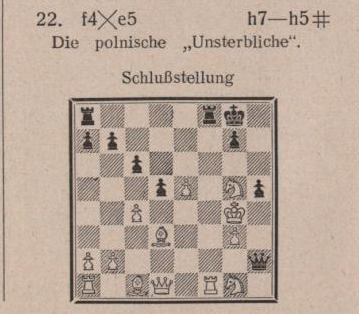
Who was the first to call the game between Glucksberg and Najdorf the "Polish Immortal"? Herbert Halsagger suggests that it was Tartakower, the annotator of the game as part of his article, "Chess in Poland," pp. 225-229 of the same issue. The entire volume can be found here

Sunday, March 24, 2024

Alfred Emil Wolf

 
Source: See below

Herbert Halsegger sends us this very nice photo of Seigfried Reginald Wolf - who eventually emigrated to Haifa - playing chess with his son, Alfred Emil Wolf (1900-1923). 

Tragically, Alfred was killed in a mountaineering accident. He was a promising player in his own right, his obituary appearing in both the chess column of the Illustriertes Wiener Extrablatt (13 August 1923, p. 4) and on the first three and a half pages of the Neue Wiener Schach-Zeitung (vol. 1 no. 6, pp. 161-164), as Mr. Halsegger informs us. The photo is from p. 162 of the latter obituary. 

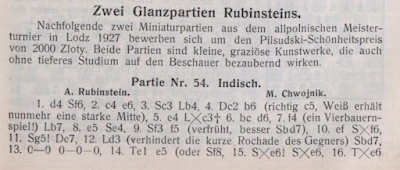
"Two Brilliancies (Glanzpartien) by Rubinstein"


Source: here.


An interesting note about the game below is that it was published in the Weiner Schach-Zeitung, as Mr. Halsegger (see previous post) notes, with another Rubinstein brilliancy - against no other than M. Chwojnik - that is, Mieczysław Chwojnik, better known later as the Israeli player Menachem Oren


A Nice, if Well-Known, Combination


Source: Chessgames.com

The above games, Akiba Rubinstein vs. Moishe Hirschbein, Lodz, 1927, was brought to our attention by Herbert Halsegger. In an aesthetic final combination, play continued: 

21.Rxd7! Bxd7 22.Nf6+ Kf8 23.Nd5 Black resigned (1-0). 

Wednesday, February 21, 2024

More Memorial Problems


Source: Davar Ha'shavua, 3 February 1950, p. 20

A frequent correspondent points out another example of what, in Israel, is often the case: memorial problems which were composed in order to commemorate those who fell in war. Here is one example: a problem by Yosef Goldschmidt (a mate in three) in memory of Abraham Feldklein, who fell in the war of independence. 

Meir Shatil Caricature


Source: Al Ha'mishmar, 2 December 1977, p. 10

Above, from a frequent correspondent, is a caricature of Meir Shatil, a player from the Gal On kibbutz, playing in the inter-kibbutz championship. The artist is Atalia Helman, the wife of the player Amir Helman


Chess for the People


source: see below

A frequent correspondent notes the above long article from Al Ha'mishmar. It starts with quoting a letter by Ya'akov Gavish, from Haderah, writing to Al Ha'mishmar, and published by Eliahu Shahaf on 27 October, 1950, p. 4. Gavish notes that much activity had been done by individuals in the country, while the center - the Emanuel Lasker club in Tel Aviv - had been rather inactive. Gavish also adds that this is done mostly by worker's unions and the Histadrut as a whole. 

Shahaf agrees, and notes that only by such government or public action can chess be improved in Israel, in particular by the creation (or rather revival) of a national sports organization, as it was in the USSR, under the motto: "chess - for the people!" It adds that the Lasker club always saw all criticism as a personal attack and only did internal reforms, which amounted to nothing. 

In fact, just what Shahaf says was done. Chess in the early state was taken over, in effect, by the Histadrut (through its sports section, Ha'poel) all over the country, leading to a great rise in the quality and quantity of chess in the country.