Saturday, October 29, 2022

A Triple Party


The previous post does not, however, mean that the "Reti" club ignored the young players. Here is one example: a frequent correspondent notes that Ha'tzophe reports (June 19, 1959, p. 6) on "a triple party" in the "Reti" club, whose secretary at the time was Eliezer Pe'er

These were the sending of the Israeli Students Organization's team to a Budapest tournament (the 6th World Student Team Chess championship); the prize ceremony of the 1959 Tel Aviv championship (won by Persitz), and presenting the "Reti cup" to the winner of the "Reti" club championship, Meir Rauch

But while "Reti" knew well to honor young players and their achievement in the Reti club, the actual players in the "Reti" club tended to be old-timers, like Rauch. This was not, of course, 100% so: some young players played for the club at the time, in particular Raafi Persitz, as can be seen, e.g., in Ma'ariv's report of league play on 10 June 1960, p. 12. (This too was pointed out to us by a frequent correspondent.)

In that report, it is noted that "Reti" and "Lasker" are fighting for the league championship, which was often the case in those years. "Lasker," in the early years of the state, was by far the strongest club in the country, even as chess activity began to flourish again. So when some of its top players left to form "Reti" in the mid-1950s, for the next period these two clubs were at the top. 


Chess in Israel, 1960


A frequent correspondent points out to us the following note about the "Lasker" (top) and "Reti" (bottom) tournaments in winter 1960 (the source is Ha'boker, 30 March 1960, p. 3.) The interesting point is that in Lasker's "training tournament," the leader is Stepak, then a soldier, who just drew Pilshchik, another young player. Another soldier, Bernstein, is also mentioned. 

On the other hand, Reti's "winter tournament" is still old guard: the winners were Wolfinger and Gruengard, both of whom were already active in the 1940s and earlier. 

Chess Snapshot, 1942


The chess situation in Palestine in the 1940s, due to the war, was not too active. As the note above shows, on Davar of April 21, 1942, p. 6 (we thank a frequent contributor for pointing it out) we have, in Passover, only a "Lasker" club championship, a simultaneous game by Marmorosh, and an announcement by   by the "Central Workers' Chess Club" in Tel Aviv to convene a meeting with youth and other workers' organizations to discuss how to improve chess among the youth. One curiosity is that the first winner in Marmorosh's simul, Makachi Toledano (ph. spelling), 16 years old, won a chess set, "the gift of Mr. Barlevi" (ph. spelling). The latter was a seller publishes of educational toys, books, etc., and also published Marmorosh's own primer in the 1940s. (P.S. for some reason "justifying" the text doesn't seem to be working.) 

Friday, October 28, 2022

Three Games with Smiltiner, Three Draws


Israel Rabinovich-Barav (above, picture from his memorial page) had often been featured in this blog. His son, Ami Barav, had constantly provided us with much information about his life and games. Lately, he provided us with three games played in the "Reti" club championships in the 1950s. The club, created by some players who left the "Lasker" club during that time, had many of Israel's strongest players. 

The new games (nos. 31-33 in the games section of the memorial page) are all draws, but not the less interesting for all that. They show Barav's usual tactical, attacking style. 

Thursday, September 15, 2022

The Menace of Sexism in Chess


This post has nothing to do with Jews in particular, but I hope it's still interesting. 

Perhaps the oddest publication I know of about chess is this odd pamphlet, published by Alexander Baron (certainly not the well-known writer of the same name). The booklet is obviously intended tongue-in-cheek, but whether it is intended fully as a joke is not clear to me. It considers three possibilities (pp. 3-4):


He supports the third explanation, after mentioning, inter alia, that he came to that conclusion after the following stint in prison (p. 1):


William Hartston comes in for special abuse throughout the pamphlet, as in the following "proof" of the conspiracy:


Whether the author is serious or is spoofing those are overly sensitive to "sexist" slights where there are none, is not clear to me. Presumably this is an instance of Poe's law, according to which it is always impossible to tell parody from serious claims, at least on the internet. 

Reb Alter Ego


A frequent correspondent pointed out that Doar Ha'yom's infrequent chess column was in the back pages, next to the "small talk" column. Here is one example, from May 24th, 1929, p. 5. It is a study by H.(erman) Mattison ("White goes and makes a remis", with Black's forces on the bottom). The odd thing is that the "small talk" column is by "Reb Alter Ego" ... 

Monday, August 29, 2022

Pilgrimage


I was notified by a colleague that GM Evgeny Postny added to his social a media a photo he took of Emanuel Lasker's grave. It is reproduce above. 

It should be noted that the graves of many chess masters are found in the somewhat morbid but fascinating web site, "Find a Grave." These include among many others the graves of Steinitz,  Lasker, CapablancaAlekhine, Botvinnik, Tal, and many others. 

Yosef Retter, 1934-2022


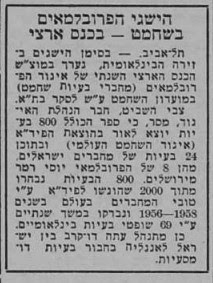
The Israeli Chess Federation notifies on its web page (in Hebrew) that Yosef Retter, an international master of chess composition, had died on August 20th. The article has a very good photo of him and a very nice two-mover, a field in which he specialized. 

Above, we have a note from La'merchav (5 Devember 1960, p. 4) about what is probably Retter's first international appearance. It notes, under the headline "Israeli Problemists' Achievements - in a National Conference," that the 1958-1958 FIDE album, which has 800 problems of the best composers in the world, includes 24 problems by Israeli composers, include eight by Retter. We thank a frequent correspondent for notify us of this article. 

Friday, July 29, 2022

Ben Gurion and Chess


A frequent correspondent notified us of a funny exchange between David Ben-Gurion and Shaul Hon found in Ben Gurion's archives. In 1955, Hon (letter above) asked Ben Gurion to write an introduction to his book, Chess Openings, describing it (technically inaccurately) as "the first chess book in Hebrew." Naturally Hon emphasizes the importance of chess as the "Jewish game," the importance of the book to Zionism under the "for the first time in 2000 years" principle, and flatters Ben Gurion by saying he (Ben Gurion) is known as a chess player. 

Ben Gurion politely refused, noting that while he supports the publication of the book as a worthy goal and would be glad to read it, he is "unjustly suspected" by Hon of having any chess abilities or achievements.

Incidentally, Ben Gurion repeats the same refusal to write an introduction later, in 1966, this this time to a request by Eliahu Shahaf. Again, he supports the publication of the book and even adds that Gat, one of the best Israeli players and a member of his kibbutz, told him about it, but that he doesn't have the chess skills to write an introduction for a chess book. 

The letter is of interest since Ben Gurion gives some details of chess career (or rather lack thereof), noting that he played as a youth (in Russia) but "was never good at the game." Once in Palestine, he hardly played at all, except for a short time in Sejera, against "Meir Rodberg who was a good player."