Wednesday, July 26, 2023

Chess and Science Fiction - in Romania


Credit: Fantasia 2000 no. 23 (1981) p. 24

The above cutting is from an article, "On Science Fiction Literature in Romania," by Menachem Falk. From an Israeli science fiction magazine, it notes (also higlighted) "also appearing is a biweekly which is dedicated to original and translated science fiction, and also to chess." This, presumably, is a unique combination in the history of journalism. Does anybody know the name of the magazine in question - or better yet, has a copy? 


Saturday, July 22, 2023

Meetings in Buenos Aires, 1939


Albert Becker (left) vs. Paul Keres, 1936. Credit: Wikipedia.

We have noted in this blog before how the Palestinian (Jewish) team in 1939 naturally refused to play with the German team, and that this cause a serious problem until Grau "saved the day." Porat's eyewitness account was reported here.

Porat said that the Palestine team was "not invited to the negotiations" and that "the organizers notified us that the German team objected with the claim that Palestine, as a Mandate, is not in a state of war with Germany, so they see no reason to cancel the match!" 

The master's thesis noted in the previous post (see there for credits) sheds more light on the matter. It refers to a letter from the captain of the German team, Becker, to Max Bluemich, originally posted online by Chessbase in 2008. In it, Becker does indeed inform Blumlich that the German team claimed Palestine "is not a British colony, but a League of Nations mandate" and therefore formally not in war with Germany. 

It is clear from Becker's letter that the real reason for his objection is that a 2:2 draw without play with Palestine would benefit other teams (esp. Argentina) which could expect a better result by playing the relatively weak Palestinian team. What is also clear, and more surprising, is that Becker notes "The Jews [i.e., Palestinian team] came with the Argentinians to our apartment to appeal to our sense of sportsmanship" to convince Becker to agree to the 2:2 draw! 

Porat does not mention any such meeting in his recollections. It may be that he was not part of it, or that he wished to hide any such informal connection with the German team. It is clear, from Becker's letter, that the Palestinian team would not have played the German team under any circumstances. 

Another interesting point, also mentioned in the letter and pointed out in the master's thesis, is that Becker complained that Alekhine, the French team's captain (and of course world champion) was very much against the German team, and forbade "his people" from any contact with them - with the absurd result that the Palestinian Jews came to talk with Becker while Alekhine and the French did not. 

Does this prove Alekhine was not an antisemite? It depends on his motives. He could have been opportunistically trying to harm Germany for the benefit of France's chess team. He could have been angry at Germany's aggression and boycotted the Germans out of principle. Or he could have done so out of protest at the German treatment of the Jews. 

The latter two motives, given Alekhine's later behavior, seem unlikely. But this behavior does support the claim that Alekhine, while an opportunist, was not actually devoted to Nazism - or for any other ideology for that matter - but rather would do whatever he thought would benefit him at the time. 

But how could the Jewish team come to meet a man who ended his letter with "Heil Hitler"? It seems that Becker was no fanatical Nazi. Like all of the rest of the German team, he remained in Argentina during the war. Nothing in his biography suggests particular Nazi sympathies. But he was writing in 1939 to a man who was an ideological Nazi, and the "Heil Hitler" signature was more or less compulsory in such situations. 


Friday, July 21, 2023

More on Antisemitism in Chess

Alexander Alekhine. Credit: Wikipedia.

Mr. Herbert Halsegger had brought to our attention a master's work about Antisemitism in chess by Gregor Gottfried Wolfsberger. The work in full is found here (in German). It especially deals with the antisemitism of Franz Gutmayer and Alexander Alekhine, but also with that of Emil Josef Diemer (of Blackmar-Diemer gambit fame). Theodor Gerbec, and others. As we noted elsewhere in this blog, Gutmayer was not especially popular: when a charity attempt to collect money for him by means of a simul was arranged, only two people showed up.

Tuesday, July 18, 2023

Another "Training Tournament"


Credits: see below

A frequent correspondent points out that a 1949 master's tournament in Tel Aviv was named (by Jozsef Hajtun, the column editor) as a "training tournament" before the first championship of Israel. The note about it, above, appeared in Kol Ha'am, 4 March 1949, p. 3. 

This relates to Keniazer's claim, or excuse, that the 1952 "master's tournament" (Taharut Amanim) was really a "training tournament" (Taharut Immunim), which are similar in Hebrew. We related this claim before in this blog with significant skepticism, but the naming of the 1949 tournament as a "training tournament" is interesting, and lends some weight to Keniazer's claim. 

Sunday, June 25, 2023

From the 8th IDF Championship, February 1959

A frequent commentator notes the following game, played in the 8th IDF championship in 1959. The annotator's slightly dismissive remarks are below.

Richter  - Warshevsky (ph. spelling for both players)

Semi-Slav [D46]

8th IDF championship, February 1959

Source: Kol Ha'am, 6 March 1959, p. 6

Annotations: Amos Sa'ar

"This game was played by two of the players whose final ranking were in the middle of the ladder, which gives an idea of the level of this championship." 

1.d4 d5 2.c4 e6 3.Nc3 Bb4 4.Nf3 Nf6 5.e3 0–0 6.Bd3 c6 7.0–0 Nbd7 8.Ne2 Re8 9.Qc2 e5 10.dxe5 Nxe5 11.Nxe5 Rxe5 12.c5 Ne4 13.a3 Ba5 14.b4 Bc7 15.Bb2 Rh5

 16.Ng3 Qh4 17.h3 Bxh3 18.Nxh5 Bxg2 19.Kxg2 Qh2+ White resigns (0-1). 


Avraham Labounsky and Yosef Hermann


Credit: see below

In the above photo, given to us by Ami Barav (Israel Rabinovich-Barav's son) we see Avraham Labounsky (left) playing with Yosef Hermann, probably in a cafe in Tel Aviv in the 1940s. Hermann came to Palestine in 1937 and played in Tel Aviv's Lasker and Reti clubs. Barav, in turn, received the photo from Hermann's daughter, Aliza Distnik (ph. spelling). 

Saturday, June 17, 2023

More on Science Fiction and Chess


Source: here.

Another science fiction book with some - Okay, only the title - relation to chess is Lester Del Rey's Pstalemate - about a man who suspects, and then proves, that he indeed has secret psi (psionic) powers of extra-sensory perception. 

It seems that writers of both fiction and non-fiction, when they use "stalemate," imagine it as some sort of high-tension balance between still-hidden or precariously balanced forces, which are about to burst out and wreck havoc. Here are another two examples: 

Source: here.

Source: here.

This is, of course, the precise opposite of what a stalemate in chess signifies. But I supposed "stalemate" is easier for the general public to understand than "a position of unbalanced dynamic equality with chances for both sides..." 

Saturday, June 3, 2023

Avraham Labounsky


Credit: Prof. Ami Barav

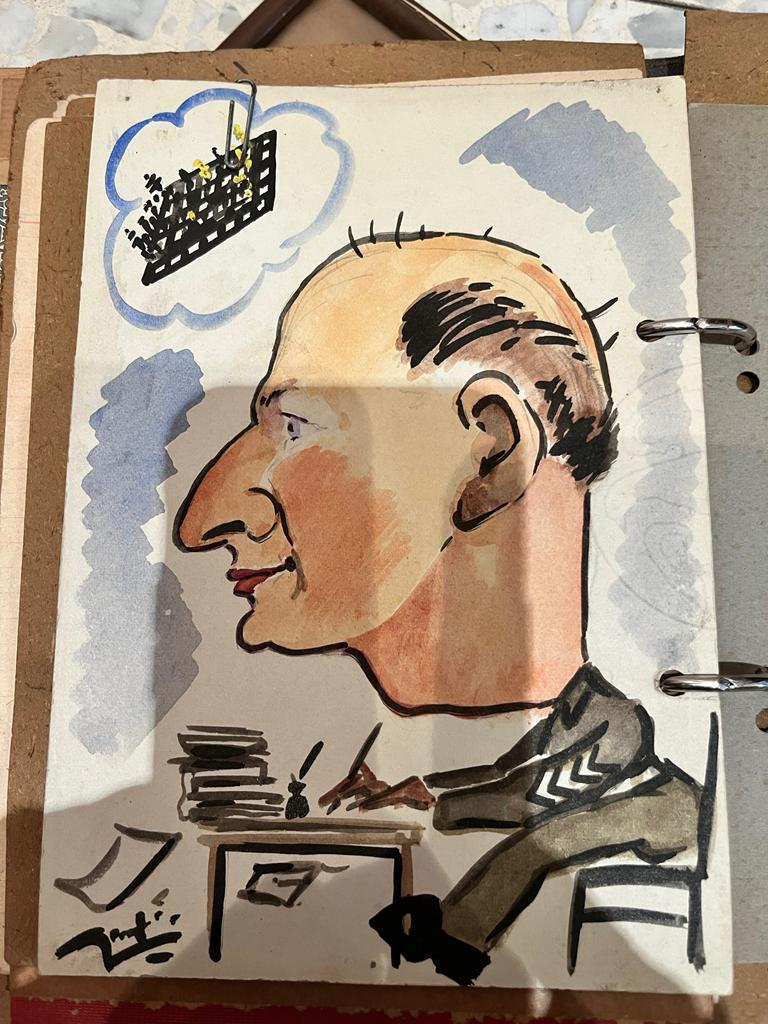
Prof. Ami Barav (Israel Rabinovich-Barav's son) sends us the following high-quality photo of Avraham Labounsky (left) playing against an unnamed opponent in 1938.  Also, found in Avraham Labounsky's apartment after his death, was the following caricature, passed to me by Prof. Barav:


S. R. Wolf and the Trebitsch Memorial Tournament

Credit: see below

We have often mentioned in this blog the chess player S. R. Wolf. We pointed out that he was one of the "old timers" in the Vienna Chess Club. Here is the report of his performance - found by our frequent correspondent, Herbert Halsegger - of Wolf's performance in the Trebitsch memorial tournament, 1926. It was reported in the Wiener Schach-Zeitung in March 1926 (no. 5, p. 69). Wolf came in sixth, with 6/11, quite a credible score. Spielmann was the winner. 

P. S. 

The journal is of course the same journal as the Wiener Schachzeitung. The spelling was changed from one word to two in 1908.