Saturday, May 18, 2024

Palestine Tournaments in Chess Review, 1947


Source: Chess Review, March 1947, p. 9

In Chess Review, 1947, there is a short - but detailed - report on three tournaments in Palestine. One was the Tel Aviv championship (held, we add, in the "Lasker" chess club), mentioning in particular - with slightly variant spellings - A. Labounsky, Mandelbaum, Keniazer and Porat [Foerder]. It also mentions the "Jewish settlements" tournament - presumably the one of the communal settlements - and the upcoming 1947 championship, which eventually did not take place (the next championship, of the new state of Israel, took place in 1951) but mentions Hon, Aloni, and Rabinovich-Barav, as well. 

As Others See Us


Sofonisba AnguissolaPortrait of the artist's sisters playing chess, 1555. Source: wikipedia.

It is annoying that posts that mention chess to the general public often have inaccurate information. One example is the following article, "Game On," by Paul Dickens, from The New Criterion. It notes Anguissola's work and is a book review of Frank Lantz's new book, The Beauty of Games. It is a high-brow, erudite review, but it starts with...
The story goes that in 1923 Marcel Duchamp finally abandoned his “hilarious picture” of psychosexually contorted glass and wire, The Bride Stripped Bare by Her Bachelors, Even, to spend more time playing chess. He was certainly obsessed with the austere beauty of the game, famously pronouncing that “while all artists are not chess players, all chess players are artists.” For most of us, however, if we are minded to consider the aesthetic value of games at all, it is usually only in a derivative sense. We can appreciate the Art Deco elegance of Duchamp’s own custom-made chess set, for instance, without sharing his passion for obscure variations on opening d4.

"The Story goes." "Famously pronouncing." "Obscure variations on opening d4." Why is it that books or articles that mention chess are so often lacking in accuracy and sources? 

Wednesday, May 15, 2024

On Edward Lasker, by Mona Karff


Source: Chess Life and Review, January 1976, p. 7

Biographical articles about chess players by other players are, of course, very common, but Herbert Halsegger notes an interesting example. Not only are both the subject and author Jewish - which is hardly surprising in chess! - but the author of the article about Edward Lasker is a female master, namely the Jewish Mona Karff. We should note that as we mentioned elsewhere, Edward Lasker had, in the same year, visited the chess olympiad in Haifa, 1976. 

Problemists in Palestine


Source: Ha'aretz, 8 October 1939, p. 5

A frequent correspondent notes that a long and detailed chess column appeared in Ha'aretz in October 1939. The most historically interesting part is a long report about the "Lasker" Chess Club in Tel Aviv. In particular (above) it notes that the "problemists' committee" met and decided to create a "composers' club" which will "meet every Thursday at 5 PM" at the chess club. The secretary chosen was Felix Zeidman (ph. spelling). 

Saturday, April 27, 2024

Lasker in Church (?)


Source: Hearst's Sunday American, Atlanta (GA), 13 September 1914, p. 37

Herbert Halsegger adds to us another "once" stories about chess players - and others - is an article titled "Longwindedness" in the humor section of the newspaper. The story about "Herr Lasker" is extremely unlikely, considering that he was Jewish, and therefore not likely to attend church sermons. Besides, the story has similar "witty sayings" by other notables from other fields, all unsourced... 

Oren and Blass, 1926 Polish Championship


Source: (Neue) Wiener Schachzeitung, vol. 4 no. 11 (June 1926), p. 169

Both Blass and Oren (then Chwojnik) played in the 1926 Polish championship. Herbert Halsagger provides us with the crosstable and the complete report of the tournament here. Blass scored 4.5 points and Oren 3.5, but his sole victory was against Blass. 

"Both New Masters, Eliskases and Glass"

 
Source: (Neue) Wiener Schachzeitung, vol. 7 no. 19 (October 1929), p. 289

We have often noted in this blog that Glass, the one-time Palestinian / Israeli master, had never in fact seen himself as anything else than Austrian, returning there after the 1935 Maccabiah and, later, after a few years in Israel in the 1950s. This is undestandable considering his greatest chess triumphs were there, in the 1920s. Here, Herbert Halsagger shows us, is a photo of the players of a tournament on top of a mountain, with "both new masters, Eliskases and Glass" in the middle. They both won the Austrian master title for coming in first and second, respectively, in the Innsbruck Congress of the Austrian Chess Federation. The entire article is here.

The "Polish Immortal"

 
Source:(Neue) Wiener Schachzeitung, vol. 32 no. 15/16 (Aug. 1935), p. 226

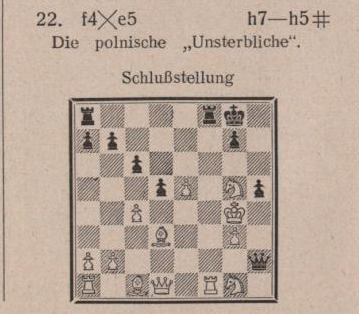
Who was the first to call the game between Glucksberg and Najdorf the "Polish Immortal"? Herbert Halsagger suggests that it was Tartakower, the annotator of the game as part of his article, "Chess in Poland," pp. 225-229 of the same issue. The entire volume can be found here

Sunday, March 24, 2024

Alfred Emil Wolf

 
Source: See below

Herbert Halsegger sends us this very nice photo of Seigfried Reginald Wolf - who eventually emigrated to Haifa - playing chess with his son, Alfred Emil Wolf (1900-1923). 

Tragically, Alfred was killed in a mountaineering accident. He was a promising player in his own right, his obituary appearing in both the chess column of the Illustriertes Wiener Extrablatt (13 August 1923, p. 4) and on the first three and a half pages of the Neue Wiener Schach-Zeitung (vol. 1 no. 6, pp. 161-164), as Mr. Halsegger informs us. The photo is from p. 162 of the latter obituary.