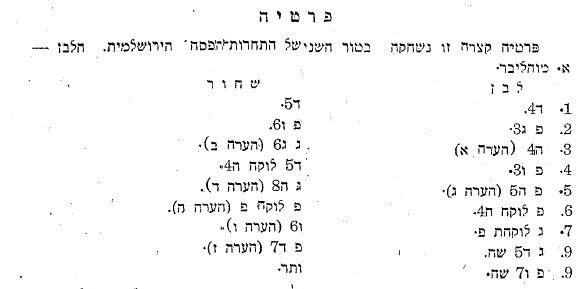
The following rather odd game was published in Doar Ha'Yom, on 23/4/1923, p. 4, as "a miniature player in the Jerusalem Passover championship":
It is, apparently:
White Aryeh Mohilever, Black N. N.
1. d5 d5
2. Nc3 Nf6
3. e4 Qc6
4. Nf3 dxe4
5. Ne5 Qe8
6. Nxe4 NxN
7. QxN f6
9. [sic, meaning of course 8] Qd5+ Nd7
9. Nf7+ Black resigns (1-0)
What is going on here -- and why?
Solution in the next post.
Saturday, September 29, 2012
Saturday, September 22, 2012
Did Rauch Teach Najdorf to Play Blindfold?
![]() |
| Alekhine giving a blindfold display, Paris, 1925. Credit: www.blindfoldchess.net |
Miguel Najdorf (1910-1997) was, as is well known, extremely talented in blindfold chess, setting the world record twice (1943 -- 40 opponents, 1947 -- 45 opponents) in Argentina.
Surprisingly, it might be that he learned the "trick" from Meir Rauch (1909--?), a Palestinian (later Israeli) player who, like Najdorf, had been stranded in Argentina in 1939 when WWII broke out in Europe, being part of the Palestinian team (1st reserve board). Our frequent correspondent Moshe Roytman brings to our attention two articles in the Israeli press:
Ma'ariv, Sept. 28th 1956, p. 7:
"Blind" Fate
In the "Fil" shoe store in Allenby St. in Tel Aviv, works a short, thin clerk -- Meir Rauch. This modest man is the father of a world record, achieve through fun and entertainment.
In 1939 our chess team travelled to the chess Olympiad in Argentina. In the meantime the war broke out and many players were stranded there after the Nazis overran their countries. Among those was the Warsaw player Mendel Najdorf, who played for Poland. He won the "second homeland"'s championship a few times and, in gratitude, changed his name to "Miguel". This ambitious Jew decided to make a name for himself in chess, and if he can't be world champion -- to at least be a champion in blindfold chess. He did not then know the technique of this game, where the player competes with his opponents without looking at the board. He learned it from the Israeli player Rauch, our champion in this field, who long ago played against 18 opponents blindfold in Germany.
Najdorf learned quickly and, between tournaments, would train himself in blindfold chess, Soon the pupil overtook his Israeli master and set a world record playing against 45 opponents at one time, considering 45 different plans without looking at the board.
Rauch never imagined the fun he had with Najdorf would give birth to a world champion in this field. Now there are two world champions. Now there are, in the two poles, two Jews: a communist Jew -- Dr. Mikhail Botvinnik, the world chess champion, and a Jewish "capitalist", the world champion in blindfold chess, Mendel, Miguel Najdorf.
In Ma'ariv, Dec. 30th, 1960, p. 12, Shaul Hon summarizes this story in one paragraph in an article about Najdorf (on the occasion of his visit to Israel), adding that Rauch is a member of the Reti chess club in Tel Aviv, and also holds the Israeli record for a blindfold simultaneous game (8 players, at the time).
The 1956 story, notes Roytman, seems somewhat "puffed", giving to Rauch as much credit as possible, i.e., in claiming that Najdorf didn't know how to play blindfold chess at all before training with Rauch, which seems unlikely. I add it is has some obvious inaccuracies:
1). It is unlikely Najdorf changed his name to Miguel out of gratitude to Argentina, as opposed to the immigrants' age-old custom of changing a name to one that fits with the new country's culture.
2). There is, of course, no such thing as the "world blindfold champion". If the phrase is used loosely to mean holding the world record in the number of opponents played simultaneously, Najdorf's motivation was (as noted here for example) to notify his family in Europe of his whereabouts.
Is anything more known, however, about the Najdorf / Rauch connection in relation to blindfold chess?
Saturday, September 8, 2012
The Set
I had promised in "Chess and Gefilte Fish" to load pictures of the chess set discussed there as soon as possible. Well, the owner of the set had kindly sent me pictures of the chess set. It is a beautiful, obviously Russian-style set, from early in the 20th century. It was made in Russia or the USSR (the set has cyrillic markings) but there is no exact date. Can any reader solve the mystery of the set's maker?
Friday, September 7, 2012
The Vilna Gaon
![]() |
| Ya'akov Bleiman, as the winner of the 1963 Israeli youth championship (detail from Tarbut Encyclopedia, from Mrs. Sarah Bleiman's collection.) |
I suggest that perhaps the man who made the greatest contribution to society outside chess was Ya'akov Bleiman (1947-2004). A child prodigy from Vilnius (Lithuania), he came with his parents to Israel in the 1950s and quickly began to win numerous tournaments in the 50s and 60s. Nicknamed the "Vilna Gaon" (the "Genius from Vilnius", after the title of the famous 18th century rabbi), he received a rare tribute: a picture of him (painted from a photograph) was published in what was then Israel's most popular general encyclopedia for youngsters, Tarbut (see above). There is another picture on the same page -- of Emmanuel Lasker...
He then studied engineering, and was the head of the Israeli SPICE project. He won both Rafael's "manager of the year" award and the Israel Defense Prize -- Israel's top award for defense-related projects -- for heading the project. He sadly died of ALS ("Lou Gehrig's disease") when only 57.
תוויות:
Bleiman,
Lasker,
Philidor,
tournament
Saturday, August 25, 2012
The Bastards -- or are they?
![]() |
| Excerpts from Doar Ha'Yom, Sept. 23rd, 1931, p. 3. |
Above is an excerpt from a letter to Doar Ha'Yom by a man who was with Rubinstein on the ship from Haifa to Trieste (the full article can be found here), on which Rubinstein travelled as he left Palestine on May 25th, 1931. The reader signed himself "one of the passengers" for reasons that will presently become clear.
As Rubinstein told the letter's author aboard the ship, he should have received 120 [presumably Palestinian] pounds. He received 50 for expenses, and when he left Palestine he had little left, except for a third-class ticket to Trieste given to him by the club, because they had "not collected all the money yet"; and that therefore a club representative should meet him in Trieste and pay him the remainder, so he can reach his home in Antwerp. But what if they won't? He asked. "Then things will be very bad" -- replied Rubinstein -- "but it is hard to believe the club will cheat me. It's an official club with a seal and everything."
The author immediately made a collection among the ship's passengers, and they gave Rubinstein the six pounds raised so he could reach Antwerp. A letter from Rubinstein's wife to "one of her relatives in Palestine", dated June 2nd, which the letter's author "happened to see", says inter alia that nobody from the club met him in Trieste, and if it weren't for the fact that he was lent those six pounds, he would have been stranded in Trieste. The money had not yet arrived. "How can our brothers in Palestine do this to us?", complains Rubinstein's wife. "I am utterly disappointed. Do all you can to wire us the money".
The bastards.
Or are they?
First of all, how come the man -- who admitted he did not know Rubinstein personally before -- happen to see a personal letter from Rubinstein's wife? This letter raises quite a few questions apart from that: e.g. why a man who signs himself as merely "one of the passengers", give details (that he met Rubinstein and the club representatives in Tel Aviv's train station as they went to say their good-byes to him, that they asked him to keep Rubinstein company during the trip, that he saw the letter from Rubinstein's wife, etc.) that would quickly identify him. Also, for an historian, the letter reveals that Rubinstein's in-laws were in Palestine at the time. What else is known about his wife's family in Palestine?
What is more, the man responsible bringing Rubinstein to Palestine was probably Moshe "Mendel" Marmorosh, who was the main organizer of chess events in Tel Aviv at the time. He was known as a man of impeccable integrity. It is very unlikely that he, or anyone else in the club, would deliberately set out to defraud Rubinstein.
I suspect they told Rubinstein the simple truth: yes, they promised to pay him 120 pounds, to be collected as playing fees from those who played in the simuls, as well as club funds; they did indeed pay him over 50 pounds (a large amount of money at the time for a Palestinian chess club); but those who promised them money to help pay for the visit, or perhaps those who "forgot" to pay the simul fee, had left them without funds, and thus in an embarrassing situation, being unable to pay Rubinstein what they promised.
Naturally, this is speculation on my part. What is clear is that the whole incident requires further research.
תוויות:
clubs,
Rubinstein,
simultaneous exhibition
Thursday, August 16, 2012
In Memorium: Svetozar Gligoric, 1923-2012
The recent death of Svetozar Gligoric, one of the strongest players of the 20th century (he played for his country, Yugoslavia, in 15 Olympiads, with great success) is universally regretted, Gligoric being known not only as a strong player, but also as a gentleman and a decent, friendly person.
For example, he remained friendly with Robert "Bobby" Fischer for decades -- no easy task -- and recorded his first popular music album at the age of 88 (I haven't checked, but it's probably some sort of record). He was also known as a chess teacher for generations of younger players.
This being the case, I am sure Gligoric would not have minded for me to commemorate his death with a game he lost -- because he lost it in an amusing manner, showing all us patzers that, contrary to what we might think, awful one-move blunders occur on all levels of play. What's more, the move he missed -- a queen sacrifice -- is pretty in itself.
The Jewish connection? He blundered against the Israeli chess master, Yosef Porat.
Perhaps the most famous example of high-level blunders is Fischer's 29. ... Bxh2? in the first game of the world championship against Boris Spassky, 1972. Fischer, however, surely saw the reply 30. g3 traps the bishop. His real error was more excusable error of calculation: he mistakenly believed that he could extricate it. In the Gligoric-Poratt game, on the other hand, the error is a real "oops!" one-move slip.
Porat played well and has some advantage, although the game should probably be a draw. Gligoric, perhaps wishing to "make a draw" by exchanging queens, played 19. Qf5?? --- only to resign immediately after Porat's pretty 19. ... Qg2! (20. Rxg2 Re1#; 20. Rd1 Rxd1+ 21. Kxd1 Qf1+ 22. Kd2 Qxc4-+).
It happens to them, too.
For example, he remained friendly with Robert "Bobby" Fischer for decades -- no easy task -- and recorded his first popular music album at the age of 88 (I haven't checked, but it's probably some sort of record). He was also known as a chess teacher for generations of younger players.
This being the case, I am sure Gligoric would not have minded for me to commemorate his death with a game he lost -- because he lost it in an amusing manner, showing all us patzers that, contrary to what we might think, awful one-move blunders occur on all levels of play. What's more, the move he missed -- a queen sacrifice -- is pretty in itself.
The Jewish connection? He blundered against the Israeli chess master, Yosef Porat.
Perhaps the most famous example of high-level blunders is Fischer's 29. ... Bxh2? in the first game of the world championship against Boris Spassky, 1972. Fischer, however, surely saw the reply 30. g3 traps the bishop. His real error was more excusable error of calculation: he mistakenly believed that he could extricate it. In the Gligoric-Poratt game, on the other hand, the error is a real "oops!" one-move slip.
| Gligoric-Porat, Amsterdam Interzonal, 1964. Position after 18. ... Rad8. |
Porat played well and has some advantage, although the game should probably be a draw. Gligoric, perhaps wishing to "make a draw" by exchanging queens, played 19. Qf5?? --- only to resign immediately after Porat's pretty 19. ... Qg2! (20. Rxg2 Re1#; 20. Rd1 Rxd1+ 21. Kxd1 Qf1+ 22. Kd2 Qxc4-+).
It happens to them, too.
תוויות:
Fischer,
Gligoric,
Porat,
Spassky,
world championship
Chess and Art: Samuel Bak, still Going Strong
![]() |
| Credit: Pucker Gallery |
The exhibition opens in October, and interested readers (if any...) in the area might well wish to purchase some of his art. Those who are not in the area and/or cannot afford to buy the original art, might console themselves with Lawrence A. Langer's study of chess in Bak's art, a large-format, well-produced "coffee table" book (in the good sense of the word), The Game Continues. It is available on amazon and elsewhere.
Saturday, August 4, 2012
Chess for Gefilte Fish
![]() |
| Gefilte Fish. Credit (public domain photo): www.wikipedia.org. |
One would hardly expect a Jewish chess history blog to be complete without a link of chess history to that most Jewish of all foods -- gefilte fish. How could there possibly be a connection? It is rather more dramatic than one would imagine.
Simcha and Shula Moretsky were married for many years until Simcha passed away recently. They were the parents of a good friend of ours. Among their possessions was an old, beautiful chess set -- by its looks, ca. 1920s or earlier. Where did they get it? Shula sent her the following mail, which he forwarded to me for publication. I translated it and (very) slightly edited it.
After the first bombing of Warsaw in 1939... Simcha, his sister, and his mother had managed to smuggle themselves to the USSR by crossing the Bug river, and lived in a while in Brest-Litovsk. The refused a Soviet citizenship and were therefore expelled at the end of 1940 -- on rafts -- to Komi, USSR, not far from the capital, Syktyvkar.
That city was a place where Stalin and Trotsky exiled political prisoners since 1927 [sic -- a reader notes this is slightly inaccurate. Trostsky lost power by then, and the town was probably used as an exile place already in Tzarist times.] So apart from "anti-socials" there was in the city also an intellectual elite... most of the labor camp's workers did work on the Syktyvkar river, cutting trees and sailing them down the river. Where there's a river, there are fish! ... he and his sister remembered their mother making gefilte fish and would barter it for needed items. It is possible they got the set from one of her customers then -- sometime between 1941 and 1943.
His father got ill with tuberculosis and his mother with kidney disease. As incredible as this sounds, they both got released from the work camp [in 1943] for medical reasons [! - A. P.] and moved to Voronezh, where they both worked for the railway administration, as it was an important railway center.
The city is on both sides of the Voronezh river, and, when she was not hospitalized or in treatment, his mother would get fish and make gefilte fish. People didn't have money to pay, as there was a terrible shortage of everything, so they bartered. One client taught him to play the violin. It is possible another taught him chess and left his set with them as payment. ... at any rate the set is in our family's possession at the very latest from the beginning of 1944.The set is still in their possession. From its looks it is from pre-revolutionary Russia, and probably a treasured possession of the chess teacher or worker who traded it for gefilte fish. I will post a photo of it as soon as I can.
Thursday, August 2, 2012
Long Distance (Chess and Stamps, part VIII)
| Image credit: A. P. |
In pre-interent days, the post was of course the way to get chess news. We have sometimes discussed in this blog Chess in Israel magazine, which was published in the 1990s by the Israeli Chess Players' Association (a competing body to the Israeli Chess Federation), edited by Efraim Carmel and Nigel Davies.
Carmel's widow had shown me, inter alia, the following postcard -- a request for subscription from, of all places, Cuba. How, in those pre-internet days, the man who requested the subscription even heard of the new magazine, is beyond me.
Subscribe to:
Posts (Atom)


